







Ask ten firms the same question — how much do property managers charge — and you will hear 4% to 12% of the monthly gross rent. That number is true, and it is the smallest part of the bill. One San Francisco manager publishes a flat 6% of rental income; another Bay Area firm quotes 4% to 12% of monthly gross rent depending on the property. Underneath those headlines sit placement fees worth half to a full month’s rent, renewal fees, markups on every repair invoice, and vacancy charges that bill hardest in the months you earn nothing. Price the whole contract over three years and a 7% quote can cost more than a 9% quote. Here is the arithmetic that tells you which is which.
Key Takeaways
- Bay Area monthly management fees are published at 4% to 12% of gross rent, and at least one San Francisco firm charges a flat 6%. The percentage alone never tells you the annual cost.
- Tenant placement is the largest single line item at 50% to 100% of one month’s rent, or $1,500 to $3,000 on a $3,000 rental, every time the unit turns.
- Over three years on that same rental, a 7% quote with a full-month leasing fee, a $350 renewal fee and a 10% maintenance markup totals $11,420 — $420 more than a 9% quote carrying none of them.
- “Percent of rent collected” and “percent of rent due” are different contracts. Collected pays the manager when you get paid; due pays them through a tenant who has stopped paying.
- Median gross rent is $2,841 in Santa Clara County against $1,487 nationally, so one percentage point costs a Bay Area owner about $341 a year versus $178 on the national median.
- California treats collecting rent for someone else as licensed brokerage, and your rent belongs in a trust account. Both are verifiable before you sign.
What the Monthly Management Percentage Actually Buys You
When owners ask what property managers charge, they are usually asking what the monthly percentage is. It is a retainer for standing capacity, not a menu of services. You are paying a firm to keep staff, software, a call line and a vendor bench available whether or not anything happens this month. In a normal month almost nothing does. The fee earns its keep the night the water heater fails at nine on a Friday.
That explains the structure’s central oddity: the fee scales with rent, while the work scales with units. Collecting $6,000 from a Palo Alto house is not twice the labor of collecting $3,000 from a Concord duplex, but at 8% it costs twice as much. Managers know it, which is why the percentage-only quote is rare — the add-on fees re-attach revenue to the activities that actually consume staff time.
Rent collected versus rent due is the clause that decides your worst month. Collected means the manager is paid when you are paid, so a non-paying tenant costs you both. Due, sometimes written as “scheduled rent,” bills the full fee on a unit that produced nothing. Where an unlawful detainer in San Francisco or Oakland can run for months, that is not academic. Ask for collected in writing, and read the definition rather than the heading.
Watch the minimum monthly fee too. A $150 floor on a 7% agreement is invisible at $3,000 rent and becomes an effective 12.5% on a $1,200 converted garage. At the low end of the Bay Area rent range, the floor is your real rate.
The Fees That Live Outside the Monthly Percentage
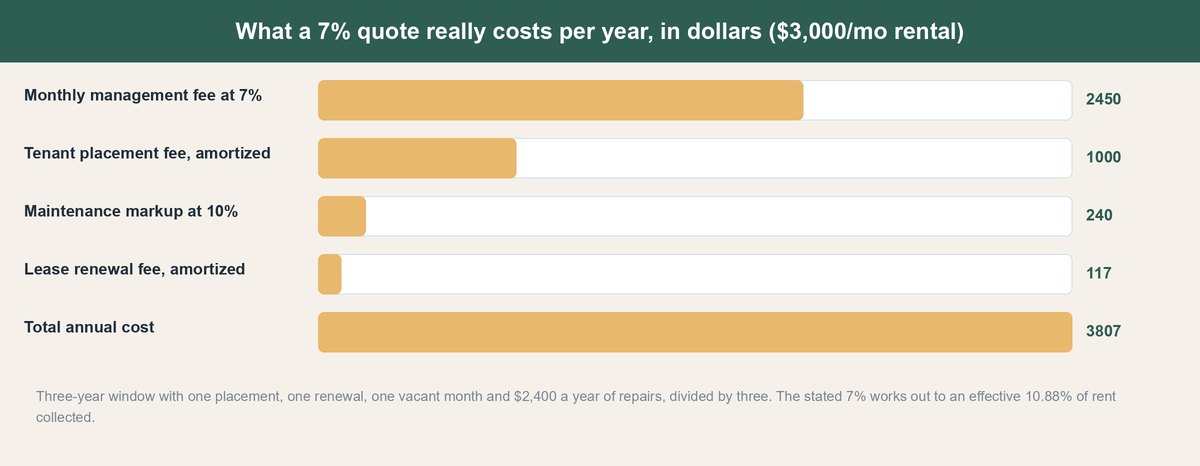
Each fee below is defensible on its own. The problem is that no two agreements carry the same combination, so two quotes with identical headline percentages can differ by thousands a year. This is where “how much do property managers charge” stops being one number.
| Fee | Typical Bay Area range | What triggers it | Cost on a $3,000 rental |
|---|---|---|---|
| Monthly management | 4%–12% of gross rent | Every month | $120–$360 a month |
| Tenant placement | 50%–100% of one month’s rent | Each new tenancy | $1,500–$3,000 per turnover |
| Lease renewal | $0–$350, or up to 25% of a month | Each renewal | $0–$750 |
| Maintenance markup | 0%–10% of the vendor invoice | Every repair | ~$240 a year on $2,400 of repairs |
| Vacancy fee | $0–$100 a month | While the unit sits empty | $0–$100 per vacant month |
| Setup / onboarding | $0–$500, one time | At signing | $0–$500 |
| Early termination | 2–3 months of management fee | If you leave the contract | ~$480–$900 |
| Eviction coordination | $500–$1,000 plus court costs | Per eviction | $500–$1,000 |
Tenant Placement Fees Are the Largest Single Charge You Will Pay
What it is: a one-time fee for marketing, showings, screening and lease preparation, priced at 50% to 100% of one month’s rent. Why it is large: placement is the most labor-dense work a manager does, and a bad screen becomes a two-year problem. The catch: it recurs with every turnover, so its true cost depends on tenancy length, not on the fee. A full-month fee across a two-year tenancy is 4.2% of rent; across five years it is 1.7%.
Lease Renewal Fees Charge You Again for Keeping a Good Tenant
What it is: a flat charge, commonly $0 to $350, for papering a renewal. The argument against it: renewing a paying tenant is the cheapest good outcome in the business, and charging for it mildly rewards turnover, which triggers the far larger placement fee. What to look for: plenty of Bay Area firms do not charge it, including the San Francisco manager cited above. If your quote has one, it negotiates more easily than the monthly percentage.
Maintenance Markups Turn Every Repair Into a Second Fee
What it is: a percentage added to the vendor invoice, typically 0% to 10%, sometimes labeled coordination or supervision. Why it matters: it is the one fee that grows as your building ages. A 10% markup on $2,400 of repairs is $240; in the year the sewer lateral fails and repairs hit $9,000, it is $900. The structural problem: paying the manager more when repairs cost more is the wrong incentive on the exact decision where you want a disciplined negotiator. Ask for a flat coordination fee above a dollar threshold, and ask to see the vendor’s original invoice.
Vacancy Fees Charge You Most When You Are Earning Least
What it is: a reduced monthly charge, often $0 to $100, while the unit is empty. The logic: the manager still fields showings and inspections with no rent to take a percentage of. The honest read: defensible on a unit being actively marketed, indefensible as a standing charge on one you are holding off-market for renovation. Cap it to the marketing period, and confirm it stops when the lease is signed rather than when the tenant moves in.
Setup, Technology, and Early Termination Fees Round Out the Menu
What they are: onboarding charges of $0 to $500, small monthly technology or admin fees, and an exit charge often equal to two or three months of management fee. Why the exit fee matters most: it turns a bad fit into a sunk cost and is the clause most likely to keep you somewhere you have outgrown. What to do: negotiate a 30-day no-penalty termination right after the first 12 months. A confident firm usually agrees; one that refuses has told you something useful.
How to Turn Two Different Quotes Into One Comparable Number
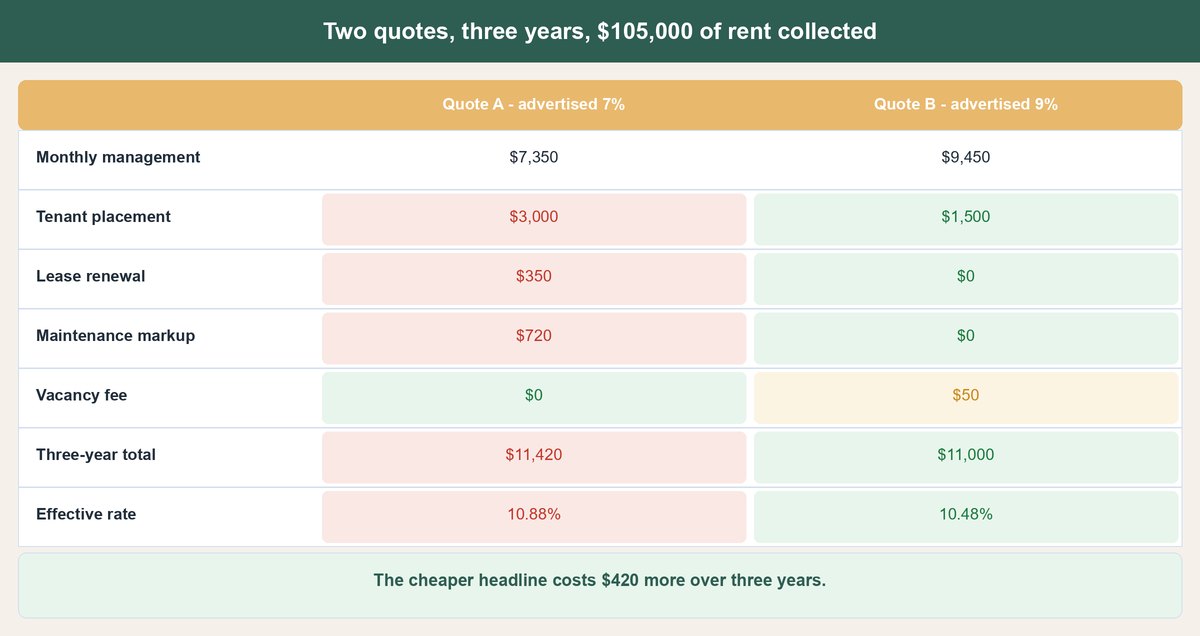
Stop comparing percentages and compare total dollars across a holding period. Pick a window, estimate occupied months, add every fee that will actually fire, then divide by the rent you expect to collect. What comes out is the effective rate, and it is the only number worth negotiating.
Take a $3,000-a-month Bay Area rental over three years with one placement, one renewal, one vacant month and $2,400 a year of repairs — 35 occupied months and $105,000 collected.
Quote A advertises 7%: management $7,350, a full month’s placement fee of $3,000, a $350 renewal, and a 10% markup on $7,200 of repairs adding $720. Total $11,420, an effective 10.88%.
Quote B advertises 9%: management $9,450, a half-month placement fee of $1,500, no renewal fee, no markup, and a $50 vacancy charge. Total $11,000, an effective 10.48%.
The cheaper headline is the more expensive contract by $420.
Turnover swings the answer. Stretch the identical quotes over six years with one tenancy, two renewals and the same repair rate, and Quote A totals $20,050 against Quote B’s $20,720. The ranking reverses, because A’s placement fee spreads over twice the rent while B’s higher percentage accrues every month. So the real question is not which quote is cheaper but how long your tenants stay. Stable long-hold tenancies favor the low percentage; a unit that turns every year or two favors the low placement fee.
Why One Percentage Point Costs More in the Bay Area Than Nationally
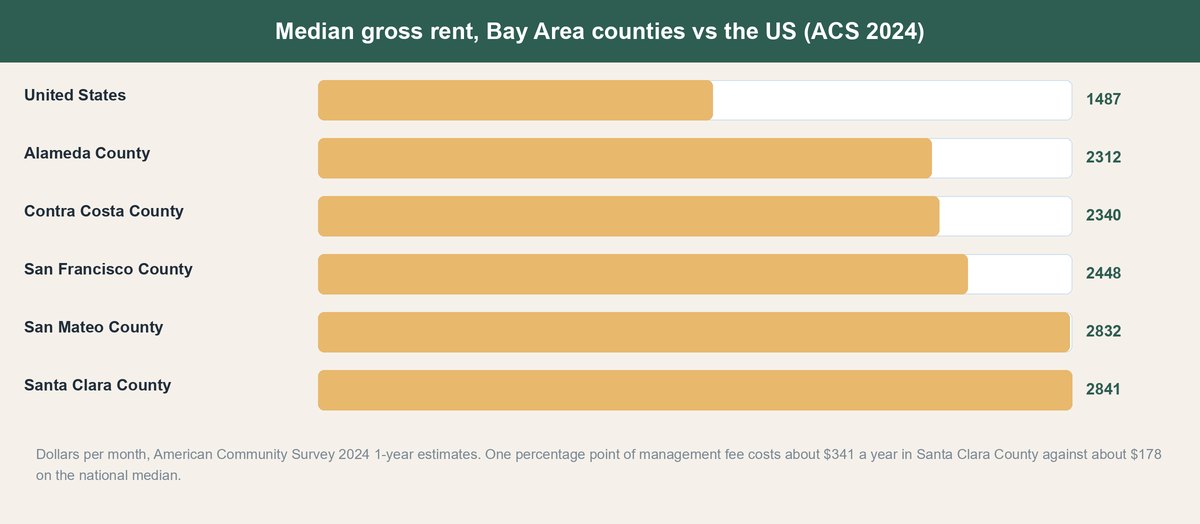
National guides answering the question “how much do property managers charge” quote the same percentage band to a landlord in Ohio and one in San Mateo, and the percentage really is comparable. The dollars are not. Median gross rent was $1,487 nationally in the 2024 American Community Survey, against $2,312 in Alameda County, $2,448 in San Francisco County, $2,832 in San Mateo County and $2,841 in Santa Clara County. One point of management fee costs about $341 a year on a median Santa Clara rental and $178 on the national median — roughly $1,600 of difference over a ten-year hold from a single point.
The mechanism matters more than the outrage. Bay Area manager costs are genuinely higher: staff, liability coverage and vendor labor all price locally, and insurance has been climbing across California. But those costs track headcount and unit count, not rent. The higher your rent, the more of the fee is margin — which is exactly why a point is worth roughly twice as much to negotiate here as the national guides imply.
It also changes the flat-fee math. Price any fixed monthly charge against the percentage at your actual rent: 8% of $2,841 is $227 a month, while 8% of a $4,500 single-family rental is $360. The further your rent sits above the local median, the more a flat structure is worth asking about. Investors underwriting with a DSCR loan should note that lenders size the loan off net operating income, so the fee structure you accept today quietly limits what you can borrow next.
The California Rules That Change What You Are Actually Buying
Fee shopping assumes two firms are selling the same thing. In California they are not always legally permitted to.
A Broker License Is Required to Collect Rent for Someone Else
Business and Professions Code section 10131(b) defines a real estate broker to include anyone who, for compensation, leases or rents property for another, solicits prospective tenants, or “collects rents from real property.” So the firm managing your rental must hold a broker license or work under one, with narrow exceptions such as an on-site resident manager. A quote from an unlicensed operator is not a discount; it is an unbonded counterparty holding your rent. Check the license before you compare rates.
Your Rent and Deposits Belong in a Trust Account
Section 10145 requires a broker accepting funds belonging to others to place them into a neutral escrow, into the principal’s hands, or into a trust fund account at a recognized depository. Your rent and your tenants’ deposits are other people’s money in someone else’s hands, and commingling is the failure that turns a fee dispute into a loss. Ask which bank holds the trust account and how often you get a reconciled statement.
The Security Deposit Cap Changed What a Leasing Fee Sits On
Under Civil Code section 1950.5, deposits collected on or after July 1, 2024 are capped at one month’s rent, with an exception permitting two months for small landlords who are natural persons, or LLCs whose members all are, owning no more than two residential rental properties totaling no more than four units. Less deposit means less cushion, which raises the value of the screening your placement fee is buying and lowers your tolerance for a manager who treats screening as paperwork.
This is educational information, not financial, legal or tax advice. Agreements and local rent ordinances vary block by block here; consult a licensed attorney, CPA or broker before signing.
Questions That Expose the Real Cost Before You Sign the Agreement
Ask these in writing and compare answers side by side rather than brochures.
- Is the monthly fee charged on rent collected or rent due, and where is that defined?
- Is there a minimum monthly fee, and what is it as a percentage of my actual rent?
- Is the placement fee charged again if the tenant you placed leaves in month four?
- Is there a renewal fee, and will you waive it?
- What is the maintenance markup, and will you send the vendor’s original invoice?
- What is your spending authority before you must call me, and can we set it at $400?
- Does the vacancy fee apply while the unit is off-market for renovation?
- What does it cost me to leave, and after how long can I leave for free?
Three situations deserve extra care. A single condo is often quoted higher because a fixed workload sits on a small rent, and the HOA adds a second rulebook. An ADU or in-law unit shares utilities and access with your own home, so settle who handles tenant contact before any fee schedule matters. And a rent-controlled unit in San Francisco, Oakland or Berkeley — or any building under California’s statewide cap from AB 1482 — carries noticing and just-cause rules where one procedural error costs more than several years of management fees. There, hire for ordinance fluency and treat price as the second question.
Frequently Asked Questions
What is the average property management fee for a single-family rental?
Published Bay Area rates run 4% to 12% of monthly gross rent, with at least one San Francisco firm advertising a flat 6%. Property management fees average higher on small units and lower on larger portfolios, because workload is per unit rather than per dollar of rent.
How much do property managers charge in California specifically?
The percentages California firms publish — 4% to 12% of monthly gross rent — look like the ones quoted anywhere else. The dollar cost does not, because rents are higher. One point on a $2,841 Santa Clara rental is about $341 a year, against roughly $178 on the $1,487 national median.
Do property managers charge a fee while the property is vacant?
Some do, usually $0 to $100 a month while the unit is actively marketed. A percentage-of-rent-collected agreement charges nothing during a vacancy, which is one good reason to prefer it.
Is a percentage or a flat monthly fee better for a Bay Area rental?
Flat fees favor high-rent units, because the work does not scale with rent. Compare at your actual rent: 8% of $2,841 is $227 a month, while 8% of $4,500 is $360.
Are property management fees tax deductible on a rental?
Yes. IRS Publication 527 lists management fees and commissions among common deductible rental expenses, reported on Schedule E of Form 1040. Confirm your own treatment with a CPA.
Can I negotiate what property managers charge landlords?
Yes, and the add-ons negotiate far more easily than the headline percentage. Renewal fees, maintenance markups and early termination clauses are the three most commonly waived or reduced.
The Bottom Line
Every manager leads with the headline percentage because it is the number that compares well. Build the three-year total instead, divide it by the rent you actually expect to collect, and ten minutes of arithmetic tells you which quote is genuinely cheaper and which is priced to look that way. Take the eight questions above into your next call, and you will leave it knowing what a manager will actually cost you over a full holding period — not just what the brochure quotes.