






A perc test measures how fast water soaks into the soil on a piece of land. That one number decides whether the county will let you install a septic system. And without a septic system or a sewer hookup, you cannot build a home on that land. That is the whole game. If you are buying land outside a city sewer line, the perc test is the single most important test you will pay for. It can turn a $150,000 lot into a $40,000 headache, or confirm you found a bargain. This guide walks through how the test works, what it costs, how long results last, and what your real options are when land fails.
Key Takeaways
- A perc test times how fast water drops in a soaked test hole. The result is stated in minutes per inch. Many jurisdictions accept rates between roughly 5 and 60 minutes per inch, but every county sets its own rules.
- More than one in five U.S. households depend on a septic system, so this test gates a huge share of rural and edge-of-town land.
- A typical perc test costs about $750 to $1,850 nationwide, and around $1,300 on average. Engineer or soil scientist fees can add $150 to $500 more.
- How long results stay valid varies wildly by county. Some honor old results unless the site changed. Others tie approvals to permits that expire in about five years. Confirm locally before you rely on a seller’s old report.
- A failed test is not always the end. Retesting in a new spot, testing in the right season, or an engineered system can save the site. Expect an engineered system to cost two to three times more than a standard one.
- Never buy raw land without a perc contingency in the contract. It is the cheapest insurance in real estate.
What a Perc Test Measures and Why the County Cares
A perc test, short for percolation test, answers one question. Can this soil absorb and treat wastewater safely? When a home is not connected to a city sewer, everything that goes down the drain flows into a septic tank. Solids settle in the tank. The liquid then flows out into a drainfield, a set of buried trenches where soil does the real cleaning work. Soil filters the water, and the microbes living in it break down what remains before it reaches groundwater.
That system only works if the soil cooperates. The EPA reports that more than one in five U.S. households depend on a septic or other on-site system to treat their wastewater. Every one of those homes sits on land that had to prove its soil first.
Here is the mechanism that matters. Soil that drains too slowly, like heavy clay, backs up. Wastewater pools on the surface or backs into the house. Soil that drains too fast, like coarse sand or gravel, is just as bad, and this surprises most buyers. Water races through before the soil can treat it, and sewage reaches the groundwater that feeds nearby wells. The perc test exists to catch both failure modes before anyone builds.
The county health department is the gatekeeper. The EPA does not regulate individual home septic systems. Your state writes the framework, and your county or local health office enforces it, sets the passing thresholds, and issues the permit. This is why every number in this guide comes with the same warning. Rules genuinely vary by county, sometimes between neighboring counties in the same state. The only number that counts is the one your local health department uses.
So what for you. Before you get attached to any parcel, make one phone call to the county health department. Ask what soil testing they require, who is allowed to perform it, and whether the parcel has any testing history on file. Ten minutes on the phone can save you from wiring earnest money toward land the county has already failed once.
How the Test Physically Works From Hole to Stopwatch
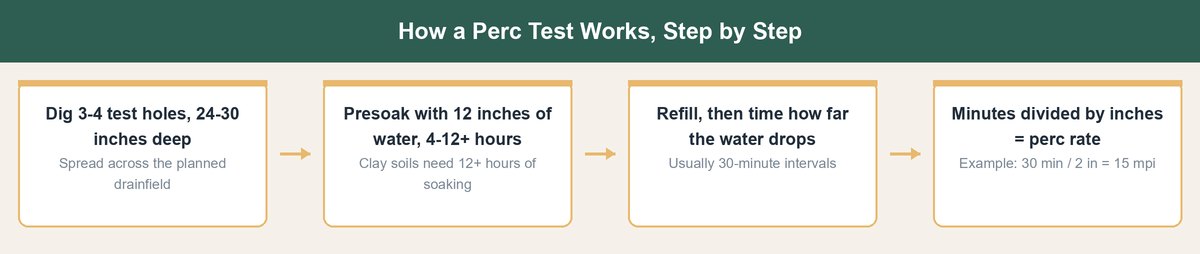
The test itself is simple, almost old-fashioned. Someone digs holes, fills them with water, and times how fast the water level drops. The University of Nebraska-Lincoln Extension procedure is a good picture of the standard method, and most counties follow the same basic script.
Step one, dig the holes. At least three holes, and preferably four, spread across the proposed drainfield area. If the soil varies across the site, more holes. Each hole is roughly 4 to 12 inches wide and dug to the depth of the planned trenches, commonly about 24 to 30 inches down.
Step two, presoak. This is the step that separates a real test from a junk one. The holes are filled with about 12 inches of water and kept wet for at least four hours, and ideally overnight. Clay soils need 12 hours or more. The point is to test saturated ground, the way soil behaves after a week of rain, not dry ground that drinks water fast and flatters the result. A test on dry soil in August can pass a site that fails every March.
Step three, time the drop. The tester refills each hole to a set depth, about 6 inches over a gravel base. Then they measure how far the water falls over timed intervals, usually 30 minutes at a stretch. Sandy soils get shorter 10-minute intervals because they drain quickly.
Step four, do the math. Divide the minutes elapsed by the inches the water dropped. If the water fell 2 inches in 30 minutes, the perc rate is 15 minutes per inch. Lower numbers mean faster drainage.
Worth knowing before you order one. Many counties have moved past the classic perc test, or layered more on top of it. Some now require a deep-pit soil evaluation, where a licensed soil scientist reads the soil layers and the seasonal water table marks in an open excavation. Others require both. When you hear “perc test” in a listing, treat it as shorthand for whatever soil approval your county actually requires.
What the Perc Rate Numbers Mean for Your Septic Design
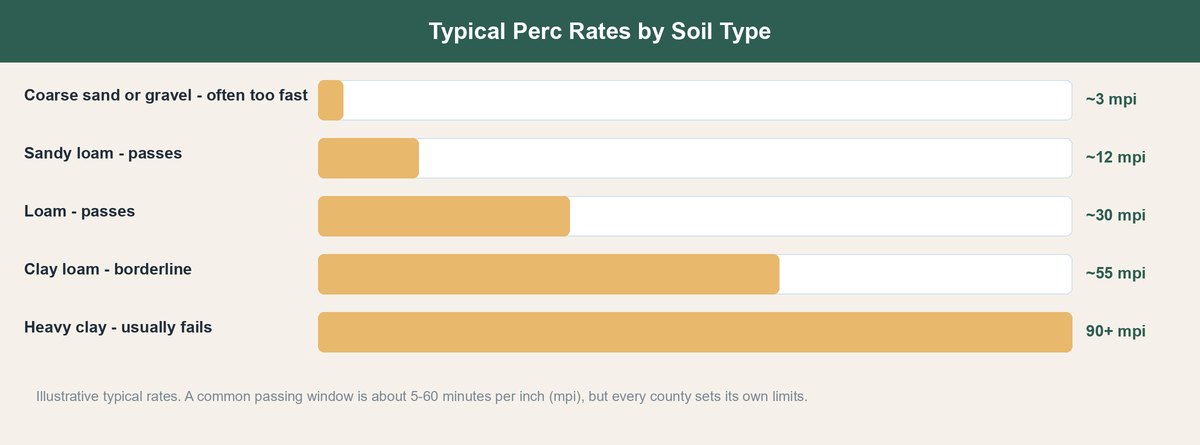
The result comes back as a number in minutes per inch, and that number sorts land into three buckets.
The passing zone. As a common benchmark, soil in the range of roughly 5 to 60 minutes per inch supports a conventional drainfield. That is the window the Nebraska extension guidance describes, and many states set their limits in that same neighborhood. Loams and sandy loams, the middle-of-the-road soils, usually land here. This is the cheap outcome. A conventional septic system typically runs about $3,000 to $10,000 installed.
Too fast. Faster than about 5 minutes per inch means coarse sand or gravel is passing water through before it gets treated. Counties often still allow building here, but with a system designed to slow the water down or treat it harder first. The land is not dead, but the budget grows.
Too slow. Slower than about 60 minutes per inch usually means clay. Some jurisdictions stretch the limit to 90 or 120 minutes per inch with special designs, and others cut it off sooner. This is the result that sinks deals, because heavy clay across the whole parcel leaves few places to hide.
The rate does more than pass or fail the site. It sizes the system. A slower rate means the soil accepts less water per square foot each day, so the drainfield must spread the load across more trench area. A three-bedroom home on 50-minutes-per-inch soil needs a far bigger drainfield than the same home on 15-minutes-per-inch soil. Bigger field, more pipe, more excavation, more of your buildable yard consumed. Two lots can both “pass” and still carry septic budgets thousands of dollars apart, which is a detail listing agents almost never volunteer.
Who Runs the Test, Who Regulates It, and What It Costs
Who physically performs a perc test depends entirely on where the land sits. There are two common models. In some places, the county runs the show. In Anne Arundel County, Maryland, for example, you file a perc application and pay a $450 residential fee. You stake the property corners, and a county sanitarian runs the test. At least three satisfactory tests are required. In many other places, you hire a licensed private professional, a soil scientist, an engineer, or a certified installer, and the county reviews or witnesses the work.
Costs follow the same pattern, real but variable. Here is the honest national picture, stated as ranges because that is what they are.
| Cost Item | Typical National Range | Notes |
|---|---|---|
| Perc test (basic) | $750 – $1,850 | About $1,300 on average; simple hand-dug tests can run as low as ~$300 |
| Licensed engineer involvement | $200 – $500 extra | Required in some counties, or for engineered designs |
| Soil scientist evaluation | $150 – $400 extra | Deep-pit soil evaluations where required |
| County application fee | Varies (example $450) | Anne Arundel County MD residential perc application |
| Septic permit | $320 – $1,880 | Separate from the test itself |
| Conventional septic system | $3,000 – $10,000 | The reward for a clean pass |
| Mound or engineered system | $10,000 – $30,000 | The price of marginal soil |
The test-cost and permit figures come from Bob Vila’s cost data, and the system costs from septic industry ranges. Machine-dug deep pits, large parcels needing many holes, and remote sites all push toward the high end. These are estimates, not quotes. Your county fee schedule and two local bids will give you the real number.
One more structural point. Because the county sets the rules, the county also decides the season. Some offices only test when they choose to, and a few restrict certain areas to wet-season testing windows. Anne Arundel County, for instance, schedules wet-season testing roughly between February 1 and April 30, first come, first served. If you need a wet-season test and you miss the window, your deal timeline just grew by most of a year. Check the calendar before you write the contract.
How Long Perc Test Results Stay Valid Before You Retest
Buyers love this question and hate the answer. There is no national rule, and county policies range from generous to strict.
At the generous end, Caroline County, Maryland states plainly that perc tests do not expire. But the county adds a catch. Changed site conditions, missing design records, or new regulations can still make an old approval unusable. At the stricter end, many health departments tie the approval to a permit with a clock on it. In North Carolina’s framework, for example, the health department’s improvement permit is commonly valid for about five years. A licensed soil scientist’s evaluation of undisturbed ground, by contrast, does not expire there. Other states and counties land anywhere between two and five years, or require a fresh perc test for every permit application.
Why the spread exists. The test describes the soil, and undisturbed soil changes slowly. What changes fast is everything around it, grading, fill dirt, new wells, new setback rules, and the paperwork standards a modern design review demands. A 1998 perc letter may describe soil perfectly and still be useless because nobody can reconstruct where the holes were dug.
This matters most when a seller waves an old passing result at you. Treat it as a good sign, not a green light. Real talk, a seller’s decade-old perc letter is marketing until your county says otherwise. Call the health department, ask whether the result is on file, whether it is still honored, and whether the rules have changed since it was issued. If the answer is fuzzy, price a fresh test into your offer. Spending $1,000 to confirm is cheap against a five-figure engineered-system surprise, and if the seller refuses to allow testing, that refusal is information too.
What a Failed Perc Test Really Means for Your Land

“Failed perc” is the phrase that makes land buyers panic and land sellers go quiet. But failure is a spectrum, not a verdict, and the smart move is to work through the options in order of cost.
Retest in a Different Spot on the Parcel
What it involves. A perc test only describes the exact holes that were dug. Soil changes across a parcel, sometimes within a hundred feet. A five-acre parcel that failed near the road may pass on the back rise, because ridges and slopes often drain better than low spots where water and fine clay collect.
Best for. Larger parcels with varied ground. On a small flat lot, the second set of holes usually reads like the first, so weigh the retest fee against what the first result already told you.
Retest in the Right Season and With the Right Method
Why it works. Seasonal timing cuts both ways. A test in saturated spring soil can fail ground that performs fine, and some counties only accept wet-season results for exactly that reason. A dry-season pass can also hide a spring water-table problem that a deep-pit evaluation would catch. And a sloppy test is not a verdict. If the failing test skipped the presoak, or was run by someone the county does not recognize, a correctly run perc test may simply produce a different answer.
Watch out. This is not about shopping for a friendly tester. It is about making sure the method matches what your county requires, because only that result counts.
Design Around the Soil With an Engineered System
What it involves. Modern septic design has answers for bad soil. The EPA’s catalog of system types covers several of them. Mound systems raise the drainfield into a built sand bed above shallow or wet ground. Aerobic treatment units clean the wastewater harder before the soil ever sees it. Sand filters and drip systems spread small, treated doses through shallow soil.
The math. Capability costs money. A mound system typically runs $10,000 to $30,000 installed against $3,000 to $10,000 for a conventional system, and pump-based systems add electricity and maintenance for the life of the house. The question shifts from “can I build” to “does the total project still pencil at this land price.”
Accept What the Land Now Is and Price It That Way
Real talk. Some land fails everything, every spot, every season, every design. That parcel is not worthless, but it is no longer homesite land. Its value falls toward what hunters, campers, farmers, or a neighboring owner will pay, which is often a steep discount from buildable-lot pricing. If you already own it, that is painful. If you are buying, it is leverage. A documented failure is one of the strongest price levers in rural real estate. Some investors buy failed parcels cheap on purpose. They solve the soil problem with an engineered design or a later retest, then capture the difference.
How to Protect Yourself When Buying Land That Needs Septic
Everything above compresses into one rule. Never close on unsewered land without proof it can host a septic system, and put that proof inside the contract.
Make the offer contingent on a satisfactory soil evaluation, with enough days to actually get one done. Testing can take weeks when county schedules, seasonal windows, or contractor backlogs stack up, so a 10-day window is often fiction. Thirty to sixty days is realistic in many counties. This is the same discipline that protects your cash elsewhere in a deal, the way an appraisal gap clause does on a house purchase. Decide in the offer who pays for the perc test, because it is negotiable. And while your money is in escrow, the same closing diligence applies to land as to houses, including title insurance on the parcel itself.
Then verify, do not assume. Confirm any existing perc results directly with the county, in writing if you can. Ask about validity, seasonal windows, and whether current rules would honor the old approval. If the parcel has no history, budget the test as a cost of the purchase, not an optional extra.
This article is educational, not financial or legal advice. Land and septic rules are local and change often, so confirm specifics with your county health department and consult a licensed professional before you commit money to a purchase.
Frequently Asked Questions
What is a perc test in simple terms?
It is a soil drainage test. Holes are dug, soaked, refilled with water, and timed to see how fast the water level drops. The result, in minutes per inch, tells the county whether the soil can safely absorb wastewater from a septic system.
How much does a perc test cost?
Most buyers pay roughly $750 to $1,850, with a national average around $1,300. Simple hand-dug tests can cost as little as $300, while large parcels with machine-dug pits and engineer involvement can reach $3,000 or more. County application fees are extra.
What happens if land fails a perc test?
You still have options. Retest in a different spot, or in the correct season with the county-approved method. An engineered system such as a mound or aerobic unit can also save the site. If nothing works, the land stays usable for recreation or farming but loses much of its homesite value.
How long is a perc test good for?
It depends entirely on the county. Some honor old results indefinitely unless the site changed, while others tie approvals to permits valid for roughly two to five years. Always confirm an old result with the local health department before relying on it.
Can you build a house without passing a perc test?
Not with a standard septic system, and most counties will not issue a building permit without approved wastewater plans. Alternatives like connecting to a nearby sewer line or, where legal, an engineered system can substitute, but some path to approved wastewater treatment is required.
Who pays for the perc test when buying land?
It is negotiable. Buyers often pay because the test protects them, but sellers sometimes test upfront to market the land as approved. Whoever pays, the buyer should confirm the results directly with the county rather than relying on the seller’s paperwork.
The Bottom Line Before You Sign
The perc test is a few hundred dollars of dirt and water standing between you and every dollar you plan to put into a piece of land. Passing soil makes a parcel a homesite. Failing soil makes it scenery. Counties write their own rules on thresholds, testers, seasons, and expiration. So the first call on any land deal belongs to the local health department, and the contingency clause belongs in every offer. Get the soil answer first, in writing, before your money stops being refundable. The buyers who skip that step are the ones who end up owning very expensive campgrounds.