







Someone on your feed made tax lien investing sound like a cheat code. Pay a stranger’s tax bill, collect 18%, maybe walk away with a house for pennies. Here is the honest version. Yes, this is a real investment. Counties really do sell tax debts, and state law really does attach double-digit interest caps to them. But the advertised rates almost never survive the auction. The “get the house” ending is rare. And funds with lawyers on staff pick over the best inventory first. I have watched this market up close for years. It can work as a small, patient, cash-only corner of a portfolio. It does not work the way the courses pitch it. This guide walks through what actually happens, state by state, dollar by dollar.
Key Takeaways
- A tax lien certificate is a claim on someone’s unpaid property taxes. You pay the county now, and you earn interest when the owner pays you back. Florida caps that interest at 18% per year; Arizona caps it at 16%.
- Those caps are ceilings, not payouts. Most big auctions bid the rate down. In Florida, bids drop in quarter-point steps, and competitive certificates often clear far below the cap.
- Most certificates end with the owner paying up, not with you owning a house. Foreclosing takes years. Arizona makes lien holders wait three years before they can even file.
- Lien states, deed states, and redeemable deed states are three different games. Texas sells the deed itself but lets the owner buy it back with a 25% penalty inside the redemption window.
- Tax sales run in roughly 2,500 cities and counties, and institutional buyers work the biggest ones with software and staff. Individuals win at the edges, not the center.
- If the returns were as easy as the seminar claims, the person on stage would be buying liens quietly, not selling courses loudly.
How a Tax Lien Certificate Actually Works
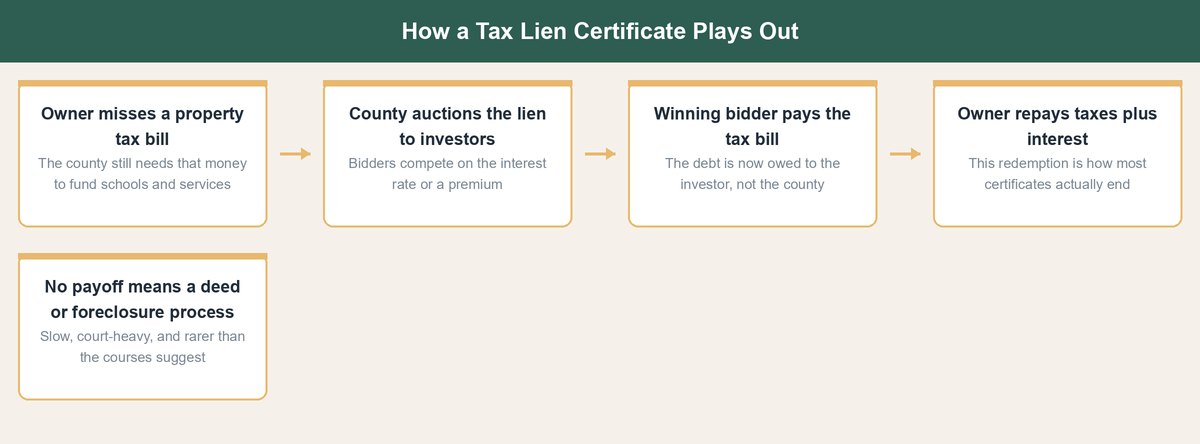
Start with the county’s problem, because the whole product exists to solve it. Property taxes fund schools, fire departments, and sheriff patrols. When an owner skips a bill, the county cannot wait years to collect. So about half the states let the county sell that debt to investors and get cash today.
Here is the trade. The county records a lien against the property for the unpaid taxes. At a public sale, you buy a tax lien certificate by paying the full tax bill, plus fees. The owner now owes that money to you instead of the county, and state law adds interest on top. When the owner redeems, meaning they pay off the debt, the county collects from them and cuts you a check for your principal plus the interest.
Notice what you did not buy. You do not own the property. You cannot visit it, rent it, or force the owner out next month. You own a debt with strong legal priority, a state-set interest rate, and a built-in waiting period. That priority is the real asset. Property tax liens generally sit ahead of mortgages. That is why banks usually step in and pay the taxes on homes with loans against them. The liens that ride all the way to foreclosure are mostly ones no bank cares about. That fact should make you pause. We will come back to it.
Lien States, Deed States, and Redeemable Deed States
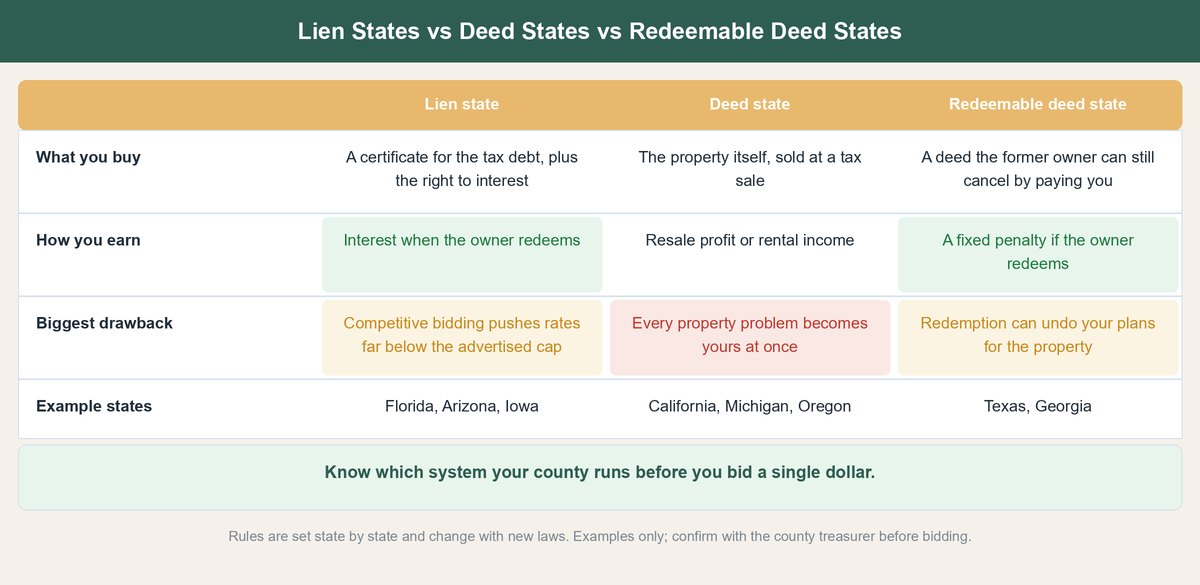
This is the distinction that changes everything, and the sales pitches love to blur it. States handle unpaid property taxes in three broad ways. Your money behaves differently in each one.
Lien States Sell You the Debt and the Interest
What you get: a certificate and an interest stream, as described above. Florida, Arizona, and Iowa run this model. Iowa’s statutory rate is a striking 2% per month, which is why its June sales draw national money. Your upside is capped at the interest. Your downside is your whole principal if the parcel is junk.
Deed States Sell You the Property Itself
How it differs: in states like California, Michigan, and Oregon, the county forecloses first, then auctions the property. The winning bid gets a deed, not a certificate. Bidding usually starts near the back taxes. It climbs toward market value fast when the property is worth anything. These tax deed sales feel like buying a foreclosure home, with rougher title problems and no interior access before you bid.
Redeemable Deed States Sit in the Middle
Where it lands: Texas and Georgia sell you a deed, but the former owner can still cancel it by paying you a penalty. In Texas, an owner who redeems in year one pays 25% on top of what you paid, and 50% in year two. Homes and farm land get two years to redeem; most other property gets 180 days. The penalty is your return if they redeem. The property is your return if they do not. Either way you have tied up real purchase money, not just a tax bill.
| State | System | Advertised Rate or Penalty | Redemption Reality | What the Auction Does to It |
|---|---|---|---|---|
| Florida | Lien | 18% per year cap | Deed application possible after 2 years | Rate bid down in 0.25% steps, often to near zero |
| Arizona | Lien | 16% per year | Foreclosure filing allowed only after 3 years | Rate bid down at February online sales |
| Iowa | Lien | 2% per month | Varies; confirm with the county | Bidders compete by taking smaller ownership stakes |
| Texas | Redeemable deed | 25% penalty year one, 50% year two | 180 days, or 2 years for homesteads and farms | Cash bidding raises your purchase price |
State rules shift, and counties layer their own procedures on top. Treat every row above as an example to verify, never as the rule where you live.
The Bid-Down Auction Quietly Shrinks Your Return

The webinars skip this part, and it is the single most important mechanic in tax lien investing. The advertised rate is a maximum. The auction exists to make you accept less.
In Florida, every certificate starts at 18%, and the certificate goes to whoever demands the lowest rate, in quarter-point steps. On a decent house in a decent county, dozens of bidders want that lien, because the bank will almost surely redeem it. So the rate falls. And falls. Bids at 0.25% are routine on quality liens. That sounds crazy until you read the fine print. Florida law adds a mandatory minimum charge of an absolute 5% of the certificate face when a lien redeems, unless the winning bid was exactly zero. A fund that wins at 0.25% and gets redeemed in eight months still books that flat 5%. On tens of millions of dollars deployed, that is a fine business. On your $2,000, it is about $100 before costs.
Other states bid down differently. Arizona bids down its 16% rate directly, with no 5% cushion. Iowa keeps the rate at 2% per month but makes bidders accept a smaller ownership share if a foreclosure ever comes. Different levers, same result. Competition moves most of the advertised return from you to the owner who is behind. The double-digit outcomes live in the liens nobody fought over. Ask yourself why nobody fought over them.
What Foreclosing on a Tax Lien Really Takes
The pitch says missed payments turn into free houses. The statutes say otherwise, and the statutes win.
First comes the waiting. In Arizona, you cannot file a foreclosure action until three years after the lien sale, and your window closes after ten. In Florida, you cannot even apply for a tax deed until two years have passed since April 1 of the certificate year. During all that time, the owner can redeem and cut you a check. That ends your shot at the property. That is how it ends for almost every property anyone would want.
Then comes the work. Foreclosing is a real court process. It means formal notices to every interested party, title searches, and filing fees. Plan on four figures in legal costs even for a smooth case. Miss one required notice and a court can undo the whole thing years later. You will also keep paying the new taxes each year while you wait, or watch someone else buy the next lien on your parcel.
And after you win, the title you hold is thin. Most title insurers will not fully insure a fresh tax title. First they want a quiet title action, another court process that costs months and thousands of dollars. Anyone who has priced title insurance on a normal purchase knows insurers hate doubt, and a tax deed is doubt in recorded form. Budget for it, or plan to hold the property for years before selling to a financed buyer.
The Four Risks That Cost New Lien Buyers Real Money

Losses in this market are lumpy. You collect small interest checks for a while, then one bad certificate eats a year of gains. These are the four ways it happens most.
Worthless Parcels That Nobody Will Ever Redeem
What goes wrong: the list is full of landlocked slivers, utility strips, and shacks with collapsed roofs. Nobody redeems, because the taxes exceed what the land is worth. You “win” the foreclosure and own a liability. The defense is boring, and it is not optional. Pull the parcel on the county GIS map, check the assessed value against the tax debt, and drive by or pay someone local who will. Never bid on a legal description you have not seen rendered on a map.
Environmental Problems That Can Follow the Property
Why it stings: an old gas station, a dry cleaner, or an illegal dump site can carry cleanup duties that land on whoever takes title. Cleanup costs can pass six figures on a parcel you bought for four. Seasoned buyers check commercial parcels against state cleanup lists, and they skip anything with fuel or factory history. The interest on one lien can never pay for one polluted acre.
Senior Claims That Survive the Sale
Worth knowing: the tax lien’s high priority is powerful, not absolute. Other government claims, city fines, and some federal interests can survive or slow the process. The rules differ by state and by claim type. This is exactly what the quiet title action and a title attorney are for. Price that professional help into your expected return before you bid, not after you are stuck.
Bankruptcy Filings That Freeze Your Timeline
Real talk: when an owner files bankruptcy, an automatic stay pauses collection, including your foreclosure clock. Your capital sits, sometimes for years, while the court sorts out creditors. You usually still hold a strong secured position, but a strong position and money you can spend are different things. Never put cash into liens if you might need that cash back on a schedule.
Why Institutional Buyers Take Most of the Good Inventory
Walk into a large county’s online sale and you are not bidding against other hobbyists. You are bidding against funds and bank arms that treat lien buying as a volume business. They parse the whole list with software, score every parcel, and bid on thousands of liens at rates that only work at scale. Remember Florida’s math. A flat 5% minimum on huge, mostly bank-redeemed volume is a solid institutional yield. It is not worth your weekend.
The strategy lesson matters more than the unfairness. In big counties, the safe liens that will surely redeem clear at rates that barely beat a savings account. What is left for individuals sits at the two ends. Small rural counties with live auctions and thin crowds still produce near-cap rates, because no fund staffs them. And the risky leftovers carry high advertised rates on exactly the parcels described above. That is the honest map of the opportunity in tax lien investing today. The edge for a small investor is local knowledge in unglamorous places, not speed in Miami-Dade.
The Course Seller Math Nobody Runs on Stage
The seminar’s business model works no matter what liens pay, and that tells you almost everything. Say a weekend event moves 200 people into an upsell priced from $1,000 to $5,000. That grosses $200,000 to $1,000,000. To earn that from liens at a realistic blended 6%, the speaker would need millions of dollars working all year, plus the patience to wait out redemptions. Selling the map pays faster than walking the territory. That does not make every teacher a fraud. It does mean the incentive is to advertise the 18% cap and the once-a-decade house story, not the 0.25% clearing bids and the three-year waits. Nobody buys a course about earning 5% slowly.
Run your own numbers instead. Suppose you put $10,000 across ten certificates in a mid-size county at a blended 6%. Eight redeem within 18 months and pay you roughly $700 to $900 in interest combined. One drags toward foreclosure and swallows $2,000 in legal and title costs against an uncertain payoff. One is a dud parcel you should never have bought, and your $800 principal on it is gone. The realistic outcome sits between a small loss and mid-single-digit returns, and your money is locked up the whole time. Do the same exercise before you bid anywhere, with your county’s real rates. If the math only works at the advertised cap, the math does not work. Owners in real tax trouble also have options the pitch ignores, from payment plans to a homestead exemption that trims the bill. That is one more reason redemption, not foreclosure, is the normal ending.
Frequently Asked Questions
Is tax lien investing a good way for a beginner to start in real estate?
It is one of the harder corners to start in, despite the low buy-in. You need statute-level knowledge of one state, parcel research skills, and cash you can lock away for years. A beginner who wants property exposure usually gets more education per dollar from a simple rental or a REIT first.
How do I buy tax lien properties in my county?
Search your county treasurer or tax collector site for the annual sale, usually labeled tax certificate sale or tax deed sale. Register, fund a deposit, and pull the parcel list early. Research every parcel on the county GIS map before bidding, and set a maximum bid or minimum rate you will not cross.
What happens if the homeowner never pays the lien back?
After the state’s waiting period, you can start the deed or foreclosure process, which involves formal notice, courts or applications, and real legal costs. In Florida that starts two years in; in Arizona, three. If no one redeems along the way, you eventually take title, then typically need a quiet title action to sell cleanly.
Do tax deed sales wipe out the mortgage on the property?
Often a completed tax foreclosure extinguishes junior interests, including many mortgages, but the details depend on state law and on whether every party got proper notice. Defective notice can revive old claims. Assume nothing until a title professional reviews the specific file.
How much money do I need to start buying tax lien certificates?
Individual certificates can run from a few hundred dollars to several thousand, so $2,000 to $10,000 is a workable starting range in many counties. Keep extra cash for later tax years and possible legal costs, and treat the whole amount as locked up for one to three years.
Can I lose money on tax lien certificates?
Yes. Worthless parcels, environmental cleanup exposure, bid rates near zero, legal costs on foreclosure, and long capital lockups all produce real losses. The certificate is secured by the property, so total losses are less common than in unsecured lending, but a claim secured by a junk parcel is not security worth having.
A Sane Way to Start if You Still Want In
Here is the position I would defend at any dinner table. Tax lien investing is a real but narrow yield play. It rewards patient, local, detail-obsessed investors, and it quietly punishes everyone who arrived through an ad. If you still want in, start with one county, ideally smaller than the famous ones. Read the statute yourself and sit through one full sale without bidding. Then invest only money you will not need for three years, spread across many small liens on parcels you have actually checked. Expect mid-single-digit blended returns, and let anything better surprise you. This article is education, not financial, legal, or tax advice. Talk to a licensed attorney or advisor who knows your state before you spend real money. And if a course promises you the 18% and the free houses in the same breath, keep your tuition. You now know more than the seminar was going to teach you.