





So how does rent to own work? You rent a home for a set period, usually one to three years. You pay a one-time option fee up front, often 1% to 7% of the agreed price. Part of your monthly rent may be set aside as a credit toward the purchase. At the end of the lease, you buy the home, usually with a mortgage. That is the brochure version. The version that matters is where the money goes when things do not go to plan. If the deal dies, the seller usually keeps your fee and your credits. These contracts put most of the risk on the person with the least experience reading them. This guide follows every dollar so you can see the trap doors before you sign.
Key Takeaways
- The option fee is a one-time payment, usually 1% to 7% of the agreed price. In almost every contract it is nonrefundable, per how NerdWallet describes typical deals.
- Rent credits only survive if you close. Walk away, miss the deadline, or fail to get a loan, and the seller usually keeps them.
- One word separates the two contract types. A lease option gives you the right to buy. A lease purchase gives you the duty to buy.
- The FTC warns that in some deals, one missed payment kills the whole agreement.
- Many contracts push repairs onto you during the rental years. A normal lease does the opposite.
- Before signing, verify three things at the county. The seller owns the home. The taxes are paid. No foreclosure is underway.
The Two Contracts Hiding Inside Every Rent to Own Deal

A rent to own deal is not one agreement. It is two stapled together, and each one can hurt you on its own.
The first is a lease. It works like any rental contract. It sets the monthly rent, the term, and the house rules. The second is a purchase agreement. It locks in a price today for a sale that happens years from now. That second document is where the real money lives, and it comes in two very different flavors.
A lease option means you can buy. You pay for the right to purchase the home at the set price before the deadline. If life changes, you can walk away. You lose what you paid in, but nothing follows you.
A lease purchase means you must buy. You have already committed to the sale. If you cannot close, you did not just lose your deposits. You broke a contract. The seller may sue you for damages or try to force the sale.
Sellers and middlemen often say “rent to own” for both. The contract heading may not even use these words. What matters is the obligation language inside. If the document says you “shall purchase,” you are in a lease purchase. If it says you “may exercise the option,” you can still exit. That single verb decides who is trapped if prices move or your loan falls through. Read for it before anything else.
Where Your Money Goes Month by Month
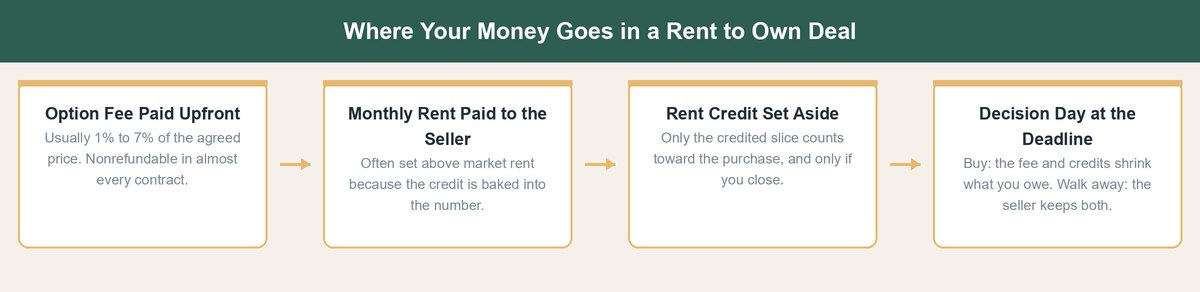
The money in a rent to own deal moves through three channels. Each one has a different rule for what happens if the deal dies. The FTC’s plain summary is that “rent you pay now is counted toward your future down payment on the house,” but it also warns you may pay “upfront fees and higher monthly payments than if you were renting.”
| Payment | Typical Size | If You Buy | If You Walk Away |
|---|---|---|---|
| Option fee | About 1% to 7% of the agreed price | Usually credited toward the purchase | Seller keeps it |
| Base rent | Market rent for the area | Spent, like any rent | Spent |
| Rent premium and credit | An extra slice added to rent, set by contract | Credited toward the price or down payment | Seller usually keeps it |
| Repairs and upkeep | Varies by contract, often shifted to you | Improves the home you will own | Improves someone else’s house |
Run the numbers on an example. Say the agreed price is $300,000 and the option fee is 3%. That is $9,000 paid on day one. Say the contract credits $200 of each month’s rent over a three-year lease. That is another $7,200 set aside. If you close, roughly $16,200 works for you at the closing table. If you cannot close, that same $16,200 usually stays with the seller. You were not saving. You were paying for a chance.
Two details deserve a hard look. First, ask where the credits sit. Money held in a neutral escrow account is far safer than a promise on paper from a seller who may hit money trouble. Second, compare the rent to real market rent. The premium is often built in quietly, so you feel like you are saving while you are simply paying more.
Lease Option vs Lease Purchase Decides Who Is Trapped
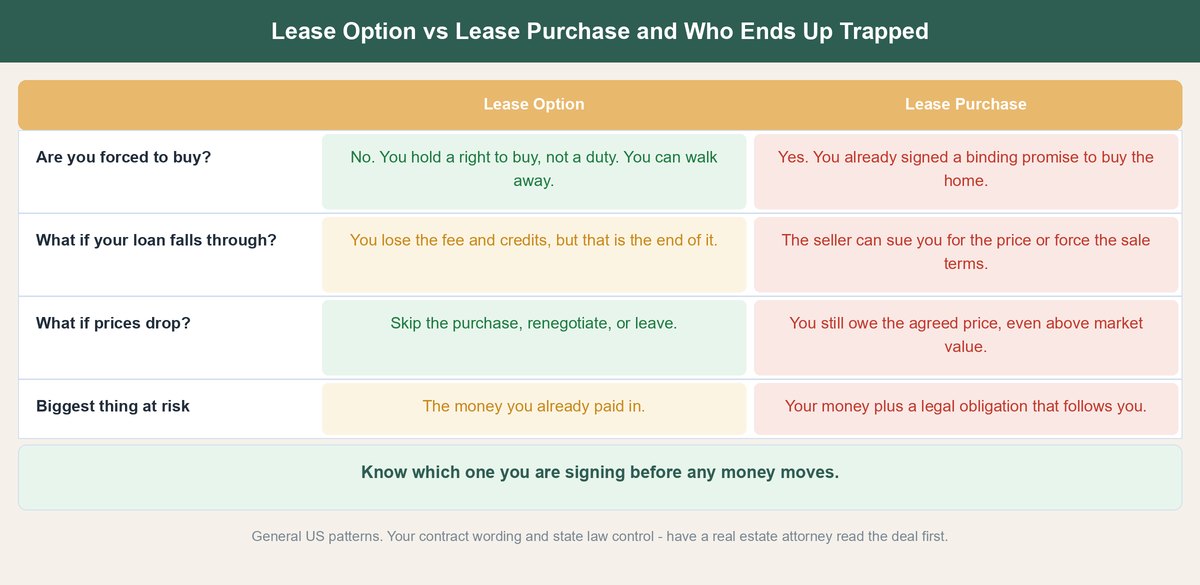
The difference between these two contracts looks small on paper. It becomes enormous the moment the market moves or your financing slips.
When prices fall, the lease option protects you. Suppose you locked a $300,000 price and similar homes now sell for $260,000. With an option, you decline, take the loss on your fee, and buy a cheaper home down the street. With a lease purchase, you still owe $300,000 for a $260,000 house, and the seller can hold you to it. The FTC flags exactly this risk. You can end up “locked into paying more than the home is now worth.”
When prices rise, the trap flips to the seller. Your locked price is now a bargain, so some sellers look for an exit. This is why the contract’s default terms matter so much. If a late rent payment voids your option, a seller with a below-market price locked in has a reason to hope you slip. Legal aid lawyers in Washington State note that in some deals the landlord can move to evict after a single late payment, with no right to catch up.
The stakes are not symmetric. A seller who breaks a deal loses a sale. A buyer who breaks a lease purchase can face a lawsuit, a lost fee, lost credits, and a lost home all at once. That is why the honest advice is boring. Never sign a lease purchase unless a lender has already told you, in writing, what you qualify for and what must change before closing.
Who Pays When the Roof Leaks During the Rental Years

In a normal rental, the landlord fixes the roof. In many rent to own contracts, that duty quietly moves to you. Sellers justify it by saying you are the future owner, so you should maintain your future home. The economics say something else. You are paying ownership-level costs on a home you do not own and may never own.
Think about what that means over a three-year lease. A water heater, an HVAC repair, and a roof patch can easily run several thousand dollars combined. If you close, fine, you invested in your own house. If the deal dies, every dollar of that work raised the value of a home the seller keeps. You funded their renovation.
There is also a legal wrinkle in your favor. Repair-shifting clauses can collide with state habitability laws. Washington’s legal aid guidance puts it directly. The agreement “may say you must make all repairs,” but “state law makes your landlord responsible to keep the property fit for living,” and clauses like that may not be enforceable. Do not count on winning that fight later, though. Negotiate it now. A fair structure caps your repair duty at small items, perhaps a few hundred dollars per incident, and leaves structural systems, the roof, and code issues with the owner. Get the home inspected before you sign so you are not inheriting a known problem dressed up as a surprise.
What Happens at the Deadline When the Loan Is Not Ready
Every rent to own deal ends at a hard date. On that date you either close with real financing or you fall back on the contract’s default rules. Most of the pain in these deals happens right here.
The uncomfortable base rate is that many renters reach the deadline unable to qualify. The FTC lists this as a core risk. You may find “that you can’t qualify for a mortgage to finish paying off the house.” The reasons are usually the same ones that pushed people toward rent to own in the first place. Thin credit, past collections, self-employment income that is hard to document, or a debt load that keeps the ratios too high.
When the deadline arrives without a loan, you have three realistic paths. You can negotiate an extension, which sellers often grant only for a fresh fee. You can ask the seller to carry financing themselves, which is rare and needs its own legal review. Or the deal dies, and the forfeiture rules fire. Fee gone, credits gone, home gone. Some contracts also require a large balloon payment at the end, a final lump sum many renters simply cannot produce.
The fix is to treat the lease term as a mortgage bootcamp with a countdown clock, not a waiting room. Talk to a real lender in month one, not month thirty. Ask exactly what your credit score, savings, and debt need to look like to qualify, and track it quarterly. A HUD-approved housing counselor can build that plan with you for free or close to it. If eighteen months in, the numbers say a loan is unrealistic, you want to know while you can still limit the damage.
The Scam Patterns That Target Rent to Own Buyers
Rent to own attracts predators because the buyers are, by definition, people the banks turned away. The FTC’s 2024 alert on renter issues says it plainly. “Deceptive rent-to-own schemes say you can buy in installments, but don’t make clear the conditions that mean it’s nearly impossible for you to actually rent to own.” These are the four patterns that show up again and again.
The Seller Does Not Actually Own the Home
How the trap works: A middleman with no title, or a bare lease, collects your option fee and rent for a home they have no power to sell. By the time the real owner surfaces, the money is gone.
Your move: Pull the deed from the county recorder before any money moves. The name on the deed must match the name on your contract. A title search costs little compared to a lost option fee, and it also reveals liens that could sink the sale later.
The Home Is Already Sliding Toward Foreclosure
The warning sign: The seller is behind on the mortgage or the property taxes. Your payments go in, the bank’s foreclosure grinds forward, and your contract with the seller means nothing to the lender. The FTC lists unpaid taxes and looming foreclosure among its top red flags for these deals.
Your move: Ask for proof the mortgage and taxes are current, and check tax status directly with the county. Then record a memorandum of your option with the county recorder. Recording puts the world on notice that you have a claim, which makes it harder to sell the home out from under you.
The Contract Dumps Every Cost on You
How the trap works: The agreement shifts all repairs, taxes, insurance, and even code violations onto you while the seller keeps the deed. You carry an owner’s costs with a renter’s rights. If you miss one obligation, the default clause takes your fee and credits.
Your move: Have a real estate attorney read the maintenance, default, and forfeiture clauses before signing. One or two hours of legal review is cheap insurance on a deal where four or five figures of your cash are at stake.
The Price and Terms Are Built for You to Fail
The warning sign: The purchase price sits far above what nearby homes sell for, or the rent credits vanish on any late payment, or the deadline is too short for any realistic credit repair. A deal engineered to fail lets the seller keep the fee and credits, then reload with the next hopeful renter.
Your move: Order your own appraisal, or at minimum compare recent sales of similar homes, before agreeing to a price. If the number is far off market and the seller will not budge, the overpricing is not a mistake. It is the business model.
How to Protect Yourself Before You Sign Anything
None of the protections above are exotic. They are the same checks a bank would run before lending on the house. You are the bank in this deal, so run them yourself.
- Verify ownership and liens. Get a title search from the county recorder or a title company. This is the same work that title insurance exists to backstop in a normal sale.
- Inspect and value the home. Pay for an independent inspection and an appraisal. Buyers in ordinary sales fight over appraisal gaps for good reason. The gap between a contract price and real value is exactly where rent to own buyers get hurt.
- Put a lawyer on the contract. Focus the review on four clauses. Option versus obligation. Default and forfeiture. Maintenance duties. What happens to credits if the deal ends.
- Record your option. File a memorandum with the county so your claim is public.
- Escrow the credits. Push for rent credits held by a neutral third party, with monthly statements.
- Build the loan file early. Lender conversation in month one. A written qualification roadmap. Quarterly check-ins until closing.
Frequently Asked Questions
Is rent to own a good idea?
It can work for a renter who is close to mortgage-ready and needs one or two years to fix credit or season income. It is a poor fit if a loan is far out of reach, because the forfeiture rules mean the seller keeps your money when the deal dies. The FTC’s blunt alternative is worth weighing. Save and repair credit first, then buy normally.
Do I get my option fee back if I do not buy the house?
Almost never. The option fee pays for the right to buy, and the seller keeps it whether or not you close. Assume it is gone the moment you pay it, and size it accordingly.
What happens if I miss a rent payment in a rent to own deal?
In many contracts a single missed or late payment voids the option and the credits, and some allow fast eviction with no right to catch up. This is the single most dangerous clause in these agreements, so know exactly what your contract says before you sign.
Who pays property taxes and repairs during the rental period?
The deed holder, meaning the seller, normally owes the taxes, but many contracts shift taxes, insurance, and repairs to the renter. Whatever you agree to, verify with the county each year that the taxes are actually being paid, because unpaid taxes can cost you the home.
Can the seller sell the home to someone else during my lease?
Not legally, if you have a valid option and, ideally, a recorded memorandum of it. Recording your option with the county makes your claim public and protects you if the seller tries to sell or borrow against the home anyway.
How long does a rent to own agreement usually last?
Most run one to three years. Shorter terms leave little time to repair credit. Longer terms mean more rent premium at risk. Match the term to a written plan from a lender, not to hope.
The Bottom Line on Rent to Own
Rent to own is not a scam by nature. It is a tool with the risk stacked on your side of the table by default. The option fee is real money you will probably never see again. The credits are only yours if you close. The word “option” versus the word “purchase” decides whether a failed loan costs you savings or lands you in court. Every protection that matters, from the title search to the recorded option to the lender roadmap, costs little and must happen before you sign, not after. If a seller resists those basic checks, that resistance is the answer. Walk, keep saving, and buy on your own terms when the timing works for you.
This article is educational only, not financial or legal advice. Rent to own contracts vary by state and by deal, so have a licensed real estate attorney and a lender review yours before you commit. Property10x publishes plain-English guides like this one so renters and buyers can walk into big decisions with their eyes open. If this helped, the rest of our buying guides are built the same way.