







A life estate deed does one job very well. It passes your home to your heirs the moment you die, with no probate court involved. The price is steep, though, and most families never hear it up front. The day you sign, your heirs become part owners. You cannot sell, refinance, or cancel the deal without their signatures. I have watched this deed save families months of court time. I have also watched it trap a healthy 68-year-old in a house she wanted to sell. This guide walks through how the ownership split really works, the Medicaid rules that drive most of these deeds, the friendlier Lady Bird version, and the alternatives that usually deserve a look first.
Key Takeaways
- A life estate deed splits ownership in two. You keep the right to live in the home for life. Your heirs, called remaindermen, own the rest starting now, not at your death.
- The deed is nearly irreversible. Selling, mortgaging, or undoing it requires every remainderman to sign, plus their spouses in some states.
- Medicaid reviews gifts made in the 60 months before you apply for long-term care coverage under federal law. Recording this deed starts that five-year clock.
- Five states offer the Lady Bird deed, an enhanced version that lets you sell or cancel without anyone’s permission.
- Transfer-on-death deeds now work in about 32 states and jurisdictions, and they stay fully revocable. Where available, they solve the same probate problem with none of the lock-in.
- Deed law is state law. An estate attorney in your state should draft any of these documents.
What a Life Estate Deed Actually Does to Your Ownership
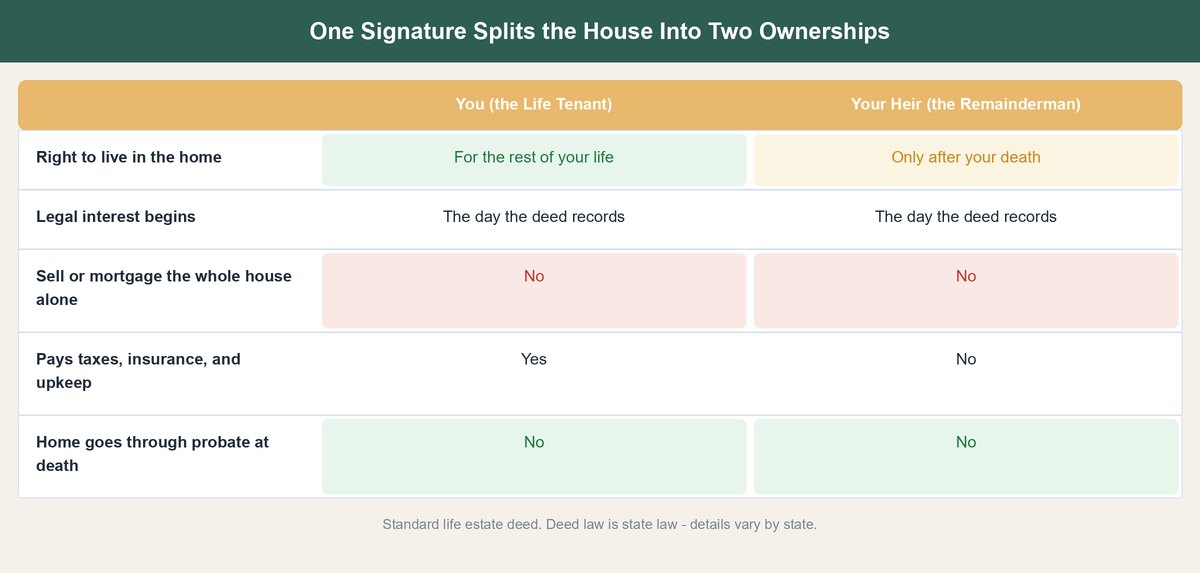
Most people think a deed either transfers a house or it does not. A life estate deed does something stranger. It slices ownership along a timeline and hands out both pieces on the same day.
You keep the life estate. That is the legal right to possess and use the home for the rest of your life, as Cornell Law School’s legal encyclopedia defines it. You are called the life tenant. Your heirs receive the remainder. They are the remaindermen, and their piece becomes full ownership automatically at your death. No will controls the house anymore. No probate judge touches it.
Here is the part that surprises families. The remainder is not a promise of a future gift. It is a real property interest that exists today. Your daughter’s name goes on the title now. Her ownership just does not include the right to move in until you pass. That timing gap is the whole design, and it is also the source of every problem this deed creates.
Why do people sign it anyway? Three reasons drive almost every one of these deeds. Probate avoidance, because the home skips court entirely. Medicaid planning, because after five years the home is generally out of reach. And simplicity, because the deed costs far less than a trust. All three benefits are real. So are the trade-offs below.
What You Keep and What You Lose the Day You Sign

Signing changes your legal life immediately, not at death. The split looks tidy on paper. In practice, you keep the daily benefits and lose the big decisions.
You Keep the Right to Live There for Life
What it means day to day: nothing visible changes. You stay in the home, rent it out if you wish, and collect any rent yourself. Nobody can evict you, including your own children. In most states you also keep claiming your property tax breaks, such as a senior freeze or a homestead exemption, because you still hold a present ownership interest.
The duty that comes with it: the life tenant customarily carries the property. Taxes, insurance, and ordinary upkeep are your job. Courts also expect you not to commit what old property law calls waste. Let the roof rot for a decade and the remaindermen can actually sue you for damaging their future interest.
You Lose the Power to Sell or Borrow Alone
The trap in plain words: you no longer own the whole house, so you cannot sell the whole house. A buyer of only your interest would have to hand the keys to your heirs the day you die, which is why no real buyer exists for a bare life estate. A true sale needs every remainderman on the contract. The same wall blocks a cash-out refinance and usually a reverse mortgage. Lenders want the whole title, and you only have a slice.
The second-order cost: even a cooperative sale splits the money. The IRS and title companies divide the proceeds between the life tenant and remaindermen using actuarial tables based on your age. At 80, your share of the sale price may be a modest fraction. The rest belongs to your heirs, whether or not you need the cash for assisted living.
You Cannot Change Your Mind Without Every Signature
Why the deed is nearly irreversible: undoing a life estate deed means the remaindermen deed their interest back. All of them. If one refuses, or has died, or is mid-divorce, or simply stopped returning calls, you are stuck. Contrast that with a will or a revocable trust, which you can rewrite alone on any Tuesday. This deed is the one estate planning tool most families sign exactly once, blind, with no undo button.
Why the Remainderman’s Problems Become Your Problems
The word remainderman sounds like a title for later. The exposure starts immediately, and it flows in a direction nobody expects. Their financial life reaches back into your house.
Because the remainder interest exists now, it sits on your heir’s personal balance sheet now. If your son is sued after a car accident, his creditors can go after his remainder interest. If he files bankruptcy, the trustee lists your home among his assets. If he divorces, his spouse’s attorney will find it. None of these events take the roof from over your head during your life, because your life estate is yours. But they can plant a stranger, a creditor, or an ex-in-law on your title, and that person’s signature is now required to sell.
There is a quieter version of the same problem. You cannot cut anyone out. If you named three children and one stops speaking to you, the deed does not care. A will lets you respond to life. A life estate deed freezes one moment of family goodwill into permanent title. Before signing, ask a blunt question about each remainderman. Is this person’s financial and marital life stable enough to be welded to my house? If the honest answer is no, this is the wrong tool.
How a Life Estate Deed Collides With Medicaid Rules
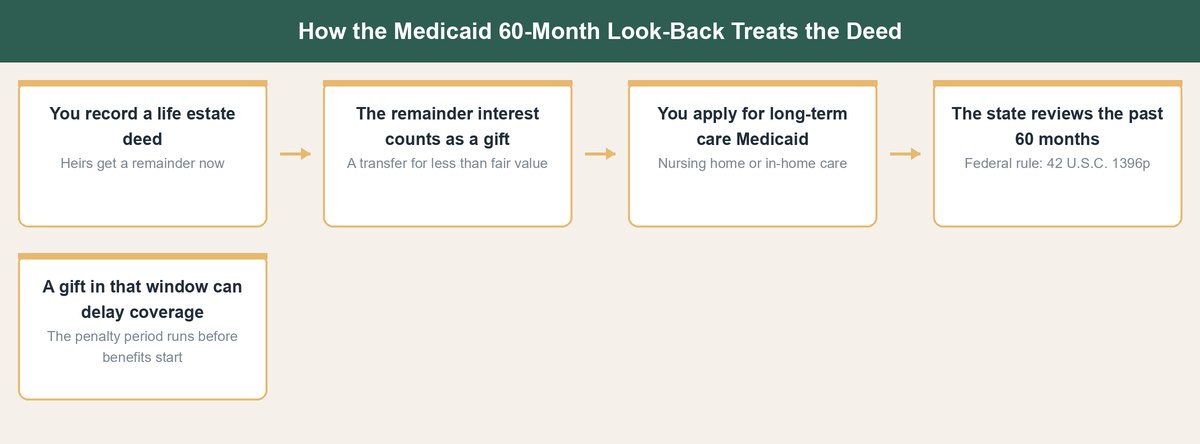
Medicaid is the reason most of these deeds get signed, so the rules deserve plain words. This part is education, not advice. Medicaid is run state by state, and the details genuinely differ.
When you record a life estate deed, you give away the remainder. Federal law treats a transfer for less than fair market value as a gift, and 42 U.S.C. § 1396p sets a 60-month look-back for transfers made on or after February 8, 2006. Apply for long-term care Medicaid within five years of recording the deed and the state counts the gifted remainder against you. The result is a penalty period, a stretch of months when Medicaid will not pay for your care even though you otherwise qualify. Apply after the five years have fully run and the transfer is generally outside the window.
The other half of the equation is estate recovery. Federal rules require states to seek repayment for long-term care costs from the estates of recipients who were 55 or older, with exceptions such as a surviving spouse or a disabled child. States that limit recovery to the probate estate often cannot reach a home that passed by deed, because it never enters probate. States that use expanded recovery definitions may still reach it. That single variable, which your state’s recovery statute picks, decides whether this deed protects the house at all. It is the first question to ask an elder law attorney, and asking it early beats asking it at 84.
The Lady Bird Deed Gives Five States a Better Version
If you live in the right state, there is a version of this deed with the lock-in removed. The enhanced life estate deed, nicknamed the Lady Bird deed, is recognized in five states, per the elder law publisher ElderLawAnswers. Florida, Texas, Michigan, Vermont, and West Virginia.
The enhancement is the whole point. You keep an enhanced life estate, which means you retain the power to sell the property, mortgage it, keep the proceeds, and even revoke the deed entirely, all without the beneficiaries’ consent. Change your mind at 82? Record a new deed. Need to sell and move near your grandchildren? Sign alone, keep every dollar. The named beneficiaries only take whatever is left at your death, and only then.
Because you never complete a gift during life, the Medicaid math changes too. In these states the Lady Bird deed generally does not trigger the look-back penalty the way a standard life estate deed can, which is exactly why elder law attorneys in Florida and Texas reach for it first. If you live in one of the five states and a standard life estate deed is on the table, ask your attorney why the enhanced version is not. There should be a specific answer.
How the Alternatives Stack Up Against a Life Estate Deed
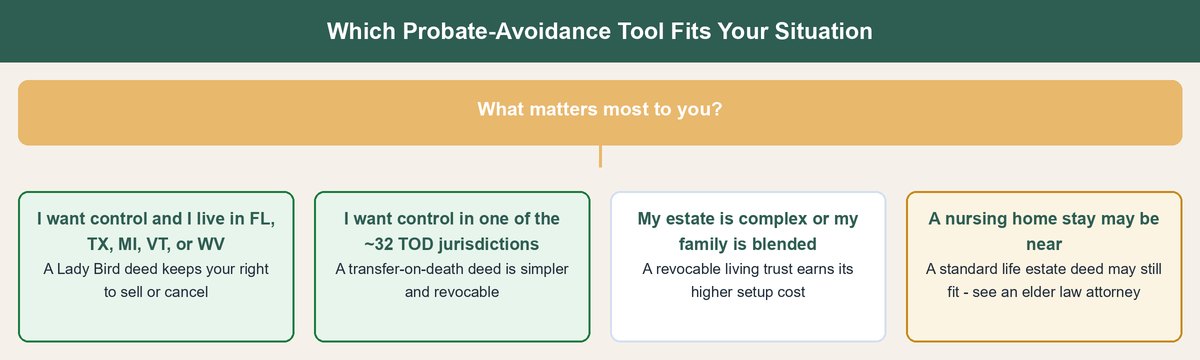
Probate avoidance is a crowded market. Before you weld your heirs onto your title, price the other three tools that do the same core job.
| Standard life estate deed | Lady Bird deed | Transfer-on-death deed | Revocable living trust | |
|---|---|---|---|---|
| Avoids probate for the home | Yes | Yes | Yes | Yes |
| Change your mind alone | No, all remaindermen must sign | Yes | Yes | Yes |
| Sell or mortgage alone | No | Yes | Yes | Yes |
| Heirs’ creditors can touch it during your life | Yes | No | No | No |
| Where it works | All states | 5 states | About 32 states and jurisdictions | All states |
| Typical setup effort | One recorded deed | One recorded deed | One recorded deed | Full document package, retitling assets |
The transfer-on-death deed deserves the longest look. Under the Uniform Real Property Transfer on Death Act, the American Bar Association counts about 32 jurisdictions that let an owner name a beneficiary who inherits at death, while the owner keeps every right, including the rights to sell and to revoke. It is a beneficiary form for your house. California’s version has its own quirks, which we broke down in our transfer on death deed guide. One honest caution cuts the other way. Because a TOD deed transfers nothing during your life, it starts no Medicaid look-back clock. If shielding the home from long-term care costs is the actual goal, the TOD deed does not attempt that job, and the standard life estate deed still has a lane.
The revocable living trust is the premium option. It handles the house plus every other asset, covers incapacity, and works in all fifty states. It also costs the most to set up. Plan on a few hundred dollars for a simple deed and, in most markets, a four-figure fee for a full trust package. For a family whose only probate-triggering asset is one home, a deed-based tool often does the work at a tenth of the price.
What the Tax Math Looks Like for Your Heirs
Here is the counterintuitive part. The same feature that traps you, the retained life estate, is what makes this deed tax-friendly at death.
Because you kept a lifetime interest, federal tax law still counts the home in your estate when you die. That inclusion is what qualifies your heirs for a stepped-up basis. Their cost basis resets to the home’s market value at your death, wiping out the taxable gain on decades of appreciation. Buy a house for $80,000, die when it is worth $500,000, and your heirs can sell near $500,000 with little or no capital gains tax. An outright gift of the home during your life would have handed them your old $80,000 basis instead, a difference worth tens of thousands of dollars in tax on a typical long-held home.
Selling during your life reverses the picture. Your slice of the proceeds may qualify for the home sale exclusion of up to $250,000, or $500,000 for couples, because you live there. The remaindermen’s slices usually do not, since it is not their residence, so their shares of the gain are taxable now, at their old basis. There is one more form to know about. The remainder you gave away is a gift, so recording the deed can require a federal gift tax return. Very few families owe actual gift tax, because the lifetime exemption runs in the millions, but the filing still exists and surprises people. A sale after death also interacts with the rules we covered in our capital gains on a home sale guide.
Frequently Asked Questions
Can a life tenant sell the house without the remainderman?
No. The life tenant can only transfer their own lifetime interest, which ends at their death, so no buyer will pay full value for it. A normal sale of the whole property requires every remainderman to sign.
Does a life estate deed avoid probate?
Yes. The remaindermen already hold title, so at the life tenant’s death the home passes to them automatically. Recording a death certificate is typically all the paperwork required.
Can a remainderman be removed from the deed?
Generally only with that person’s consent. The remainderman must sign a deed conveying their interest back. Courts will not remove a remainderman just because the family relationship soured.
Who pays the property taxes on a life estate?
The life tenant customarily pays taxes, insurance, and ordinary maintenance, since they hold the present right to use the property. The remaindermen have no duty to carry the home while the life tenant is alive.
Which states allow Lady Bird deeds?
Florida, Texas, Michigan, Vermont, and West Virginia recognize the enhanced life estate deed. Everywhere else, a standard life estate deed, a transfer-on-death deed where available, or a trust fills the role.
Will a life estate deed protect my house from nursing home costs?
Sometimes, and only with timing. The gifted remainder is subject to Medicaid’s 60-month look-back, and estate recovery rules differ by state. This strategy needs an elder law attorney’s review before you sign, not after.
The Bottom Line Before You Call an Attorney
A life estate deed is a strong tool with a narrow lane. It fits when the family is stable, the five-year Medicaid clock has room to run, and you are certain you will never need to sell alone. It fails when life changes, because it cannot change with you. If you live in a Lady Bird state, the enhanced deed removes most of the risk for the same effort. If your state offers a transfer-on-death deed and Medicaid is not the driver, the revocable option usually wins outright. Deed law is state law, and one afternoon with an estate or elder law attorney costs far less than un-sticking a title with an uncooperative co-owner on it.
Featured photo: Annika Wischnewsky / Unsplash.
This article is educational only, not legal, financial, or tax advice. Rules vary by state and change over time, so confirm your plan with a licensed estate attorney in your state. If real estate decisions like this one are on your plate this year, Property10x publishes plain-words guides on exactly these crossroads. Read a few before you sign anything.