







A transfer on death deed in California lets you name a beneficiary who inherits your house the moment you die, without probate, without giving up a thing while you are alive. It costs almost nothing, the form is free, and you can revoke it whenever you like. The catch is what happens to your beneficiary in the months after you are gone: California Probate Code section 5694 lets a court void the deed outright if an heir files suit inside a 120-day window, and that clock does not even start until your beneficiary records an affidavit and notifies the heirs. That single provision is the reason this deed is a superb tool for some owners and a trap for others.
Key Takeaways
- It only works on one to four residential units, a condominium unit, or agricultural land of 40 acres or less with a home on it — not raw land, not mixed-use, not out-of-state property.
- It must be signed by you, witnessed by two people present at the same time, notarized, and recorded within 60 days of notarization. Miss the 60 days and the deed is simply not effective.
- Probate Code section 5600 repeals the entire scheme on January 1, 2032 unless the Legislature extends it again.
- On a $1,950,000 Santa Clara County home, statutory probate compensation alone runs about $65,000 across the attorney and the personal representative. The deed avoids that for the price of a notary and a recording fee.
- The deed does nothing for incapacity, cannot name a class (“my children”), and leaves your beneficiary a title that stays challengeable for at least 120 days after notice.
How a California Transfer on Death Deed Moves Title at Death
The mechanism is deliberately narrow. You record a deed naming a beneficiary, and nothing happens. You still own the house, still pay the tax bill, and can sell or mortgage it without asking anyone. The beneficiary has no interest at all — nothing they could borrow against, nothing a creditor of theirs could attach. On your death, Probate Code section 5652 transfers whatever interest you held, subject to every limitation of record at that moment — and to anything recorded up to 120 days after your beneficiary records the affidavit required by section 5682(c).
That last clause is the design philosophy in miniature. The Legislature wanted a probate shortcut that costs nothing, so instead of the front-end supervision a court or a trustee provides, it moved the scrutiny to the back end — after you are dead and cannot clarify what you meant.
Eligibility is tight. Section 5610 limits the deed to one to four residential dwelling units on a single parcel, a residential unit in a common interest development, or agricultural land of 40 acres or less containing a single-family residence. A Bay Area owner with a house plus a detached ADU is comfortably inside. An owner of a vacant Sonoma parcel, a five-unit building, or a mixed-use property is not, and no careful drafting fixes that.
Two more constraints kill this deed for a lot of families. Section 5622 requires you to identify the beneficiary by name — no “my surviving children in equal shares,” so every change in your family means a new recording. And section 5600 repeals the entire part on January 1, 2032. Deeds already effective are not retroactively unwound, but an owner planning on a 25-year horizon is building on a statute the Legislature has to keep renewing. It renewed once already, through SB 315 in 2021, which also ordered the California Law Revision Commission to study by 2031 whether the deed has been used to perpetrate financial abuse on property owners. That is the Legislature saying out loud that it is not yet sure this tool is safe.
Completing and Recording the California Transfer on Death Deed Form

The statutory form is free and short. Most of the ways people ruin it are procedural, not substantive.
Signing the Deed in Front of Two Witnesses and a Notary
What the law requires: section 5624 makes a deed effective only if you sign and date it, two witnesses who are present at the same time sign it after watching you sign or hearing you acknowledge your signature, and a notary acknowledges it. The two-witness rule arrived with SB 315 and applies to deeds signed on or after January 1, 2022 — older forms circulating online often omit it entirely.
The catch: section 5625 says that if a beneficiary is also one of the subscribing witnesses, the law presumes the deed was procured by duress, menace, fraud, or undue influence. A beneficiary who signs as one of the two witnesses hands the deed that presumption automatically. This is the single most common way a well-meaning family hands a disinherited sibling a ready-made lawsuit.
Recording the Deed Within Sixty Days or Losing It Entirely
The rule: section 5626 provides that the deed is not effective unless it is recorded on or before 60 days after the date it was acknowledged before the notary. There is no cure, no late filing, no substantial-compliance argument in the statute.
Why it bites: people sign at a notary, put the form in a drawer, and mean to take it to the county recorder. Two months pass. The deed is now a worthless piece of paper that everyone in the family believes is a valid estate plan — and nobody discovers it until the funeral. A deed recorded even a day past the 60-day mark is not effective — no grace period, no exception.
What it costs: a first page typically runs in the low tens of dollars, plus the $75-per-instrument fee under Government Code section 27388.1, capped at $225 per transaction.
Revoking or Replacing a Recorded Transfer on Death Deed
How it works: you can revoke at any time while you have capacity to contract. A revocation instrument must be executed and recorded the same way the deed was, and neither your beneficiary’s consent nor notice to them is required. If you record a second transfer on death deed on the same property, the later-executed deed is the operative one and its recording revokes the earlier deed.
The practical read: because revocation is unilateral and silent, a beneficiary never really knows where they stand until you die. A feature for the owner; a source of family conflict later.
What the Deed Costs Against What California Probate Costs
California sets probate compensation by statute, not by negotiation. Probate Code section 10810 pays the attorney 4% of the first $100,000, 3% of the next $100,000, 2% of the next $800,000, and 1% of the next $9 million — and the personal representative is entitled to the same schedule. Critically, the percentages apply to the gross value of the estate accounted for, not your equity. A $1.95 million house with a $900,000 mortgage is a $1.95 million estate for fee purposes.
Run it on the June 2026 California Association of Realtors county medians: a $1,950,000 Santa Clara County home produces about $32,500 for the attorney and $32,500 for the representative — roughly $65,000 before filing fees, probate referee appraisal, and publication. Statewide, at the $904,640 median, it is about $42,200.
| Cost line | TOD deed | Revocable living trust | Probate with no plan |
|---|---|---|---|
| Document preparation | $0 (free statutory form) | Roughly $2,000–$4,000 in California | Not applicable |
| Notarization | About $15 per signature | About $15–$45 | Not applicable |
| Recording | Low tens of dollars plus up to $225 in Gov. Code § 27388.1 fees | Similar, for the deed transferring the home into the trust | Not applicable |
| Statutory fees on a $1.95M home | $0 | $0 | About $65,000 combined |
| Typical time to settle the home | Weeks after the affidavit and notice | Weeks to a few months | Commonly a year or more |
| Ongoing maintenance | Re-record after any change in beneficiaries | Amendments as life changes | Not applicable |
So the deed wins on price by five figures. For an owner whose entire estate is one modest house and a bank account, that can be the right answer. It is also, on its own, an incomplete argument — price is not the only thing being bought.
The Title Insurance Gap That Can Strand Your Beneficiary
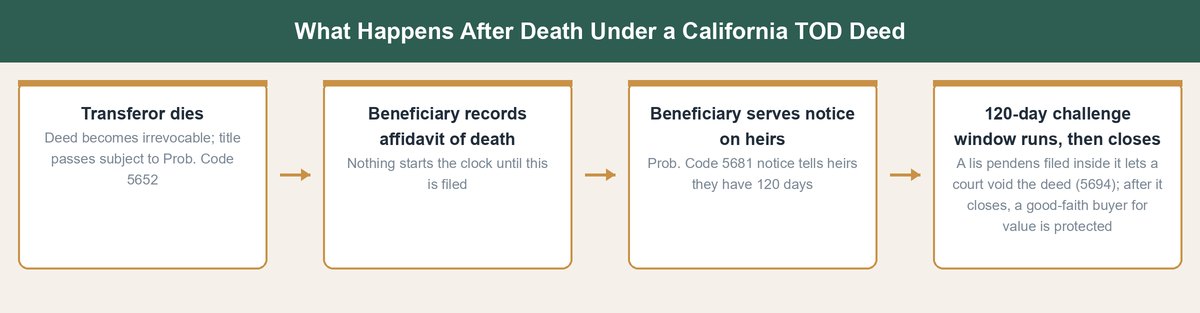
Here is what most articles on this topic bury, and it is the most important thing to understand before you record anything: your beneficiary’s title is not quiet on the day you die. Section 5681 requires the beneficiary to serve notice on your heirs, and that notice tells them in plain language that they have only 120 days from the date of the notice to file a fully effective challenge. Section 5694 supplies the teeth: if a contestant records a lis pendens within 120 days after the required affidavit, a court can void the deed entirely. Miss that window and a court can still grant relief, but its order cannot disturb the rights of a purchaser or encumbrancer for value and in good faith who acquired before the proceeding began.
Read those two provisions together and the consequence for a seller is obvious. Inside the window, a buyer is being asked to purchase a property whose underlying transfer the statute expressly permits a court to unwind. That statutory exposure is what an underwriter has to price, and requirements vary by company and by file — the window closed, heir signoffs, an indemnity, sometimes a full probate. A beneficiary who needs to sell fast should assume the property is not cleanly marketable until the notice has gone out and the 120 days have run.
The trap inside the trap is that nothing starts the clock but your beneficiary’s own paperwork. Section 5652(b)’s 120-day window on what the transfer stays subject to, and section 5694’s contest window, both run from the section 5682(c) affidavit, not from the date of death. A grieving beneficiary who waits eight months to record one has not bought eight months of peace; they have pushed the start of the challenge period eight months into the future.
Creditors sit on top of that. Section 5670 gives a creditor with a lien of record at your death priority against the property, and section 5672 makes each beneficiary personally liable for your unsecured debts, capped by section 5674 at the fair market value of the property received less liens. Section 5678 even lets a beneficiary voluntarily hand the property back into the estate for administration — a strange thing to have to weigh on a supposedly probate-free transfer.
Transfer on Death Deed vs Living Trust for California Homeowners
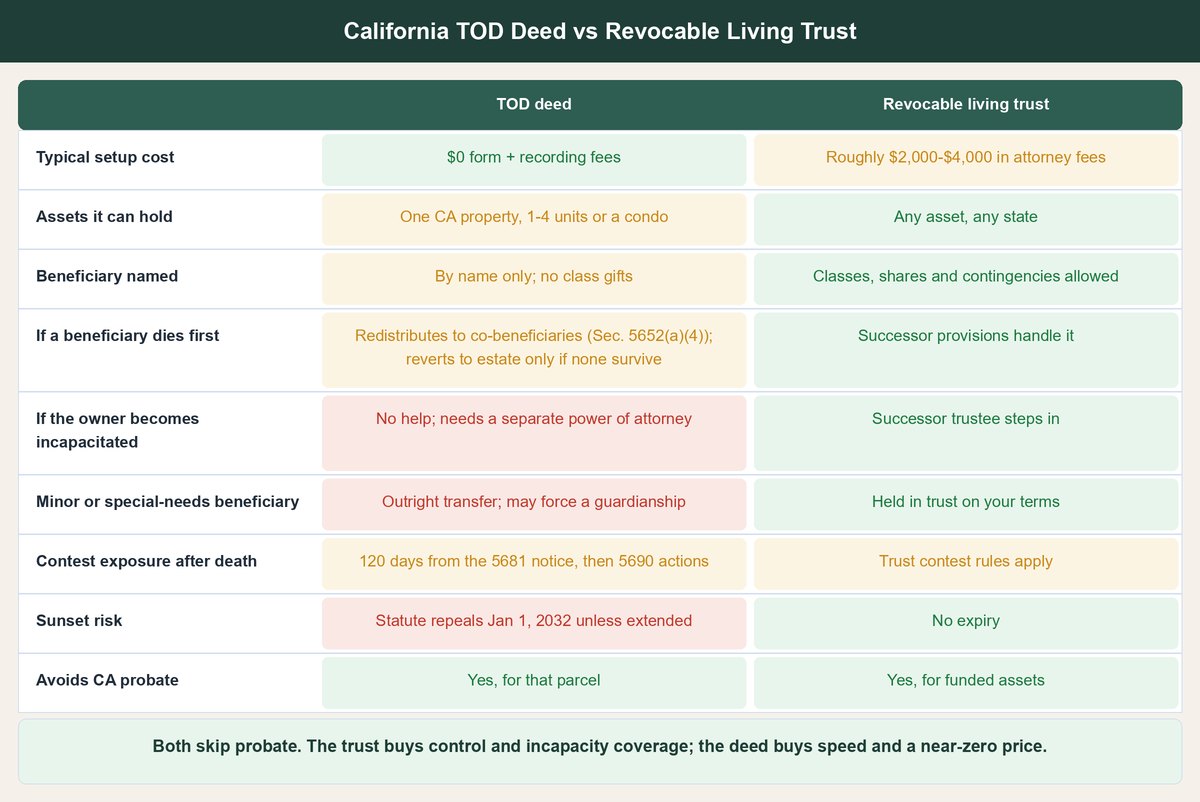
Both instruments avoid probate on the home. That is where the similarity ends, and the comparison turns on two questions that have nothing to do with money.
The first is incapacity. A transfer on death deed does nothing while you are alive but impaired. If you develop dementia and cannot sign, the deed is irrelevant; someone still needs a durable power of attorney, or your family is heading to a conservatorship hearing. A funded revocable trust puts a successor trustee in charge the day a doctor certifies you cannot manage your affairs. For an owner in their eighties, that gap is frequently worth more than the $2,000–$4,000 the trust costs.
The second is control after death. The deed transfers the property outright to a named human being. If that person is 19, or on means-tested benefits, or mid-divorce or mid-bankruptcy, the house lands squarely in the middle of that situation. A trust can hold the property, stage distributions, and protect a special-needs beneficiary’s eligibility. Section 5690 also leaves the deed open to contest by the personal representative or an interested person, including under California’s disqualified-transferee rules aimed at caregivers and drafters.
The deed’s design assumes a single California property with one competent adult beneficiary. Multiple or out-of-state properties, co-owners, a beneficiary who might predecease you, or contested family circumstances all fall outside what the instrument does.
Tax Implications of a California Transfer on Death Deed
There is a persistent myth that this deed carries a tax advantage. It does not. It is tax-neutral by design — good news, but not a strategy.
Property Tax Reassessment Under Proposition 19
Death is a change in ownership whether the house passes by deed, trust, or probate, so the assessor treats a transfer on death deed like any other transfer at death. The Proposition 19 parent-child exclusion applies only if the home was your principal residence and becomes your child’s principal residence, with the homeowners’ exemption filed within one year. Even then it is capped: the excluded value is the factored base year value plus $1,000,000 as adjusted for inflation, which is $1,044,586 for transfers between February 16, 2025 and February 15, 2027. On a Bay Area house with a low Prop 13 basis and a $2 million market value, everything above that ceiling is added to the taxable value, so an heir who moves in can still see the bill jump. An heir who rents it out loses the exclusion entirely.
Gift Tax and Estate Inclusion During Your Lifetime
Because you keep full ownership until death, nothing is a completed gift during your lifetime — no gift tax return, no lifetime exemption consumed. The property stays in your taxable estate, so your beneficiary inherits it at a fair-market-value basis stepped up on the date of death; see our capital gains calculation on a home sale for how that basis applies when they sell.
Medi-Cal Estate Recovery and Creditor Claims
For deaths on or after January 1, 2017, Welfare and Institutions Code section 14009.5 limits Medi-Cal estate recovery to assets in the decedent’s probate estate, for recipients aged 55 or older, with hardship waivers including a homestead worth 50% or less of the county average. Property passing by a recorded TOD deed does not go through probate — a real consideration for an owner who has received long-term care benefits, and exactly the kind of question for a California elder law attorney rather than a form.
Frequently Asked Questions
Is a California transfer on death deed form available for free?
Yes. The statutory form and its cover-page questions live in Probate Code sections 5642 and 5644, and county recorders and law libraries publish it free. Check that any copy you download includes the two-witness signature block added in 2022 — many circulating versions predate it.
Can I sell or refinance my house after recording a TOD deed?
Yes, without restriction. The beneficiary has no present interest, no consent right, and no notice right. If you sell, there is simply nothing left for the deed to transfer at your death.
What happens if my named beneficiary dies before I do?
If you named more than one beneficiary, a lapsed share transfers to the surviving beneficiaries in equal shares under Section 5652(a)(4). Only when no named beneficiary survives does the property fall back to your will or intestate succession — the probate you were trying to avoid. An outdated deed carries that gap forward until a new one is recorded.
Does a TOD deed trigger the mortgage due-on-sale clause?
Federal law bars a lender from calling a loan due on a transfer to a relative resulting from the borrower’s death, and the loan itself passes with the house. A transfer to someone who is not a relative sits outside that protection, so confirm the position with the servicer before relying on it.
Can more than one person own property with a TOD deed?
Joint tenants can each record one, but survivorship transfers title first, so the deed only reaches the last surviving owner’s interest. With tenancy in common, each deed carries only that owner’s share — often producing the fractional co-ownership the family was trying to avoid.
How long does the beneficiary have to record the affidavit of death?
The statute sets no outside deadline, but delay is costly rather than protective — the contest and limitation windows run from the affidavit, not from the death, so waiting only postpones the day the title settles down.
The Bottom Line on California Transfer on Death Deeds
The honest summary is that the California transfer on death deed is an excellent instrument for a narrow fact pattern and a mediocre one everywhere else. Owners in that fact pattern — one qualifying California home, one competent adult beneficiary, no family conflict on the horizon — are the narrow group the statute was drafted for. If any of those conditions wobble — a second property, a minor, a blended family, a beneficiary who will need to sell immediately — the 120-day exposure window and the absence of incapacity coverage are the two variables that drive the comparison.
This article is educational and is not legal, tax, or financial advice. Outcomes turn on facts specific to your family and your title, and California’s TOD deed statute is scheduled to sunset. Consult a licensed California estate planning attorney before you record anything.
Whichever way you lean, do one thing first. Pull your current grant deed and confirm exactly how title is vested today. Half the estate planning surprises in the Bay Area start right there.