







An appraisal gap is the dollar difference between the price you agreed to pay and the value the lender’s appraiser assigns to the house. Your lender does not fund against your contract. It funds against the lower of the two numbers, so every dollar of gap is cash you wire at closing on top of your down payment. Gap coverage, clauses, contingencies, addenda and waivers are all ways of deciding in advance who absorbs that difference. The version that wins Bay Area offers without wrecking your balance sheet is a capped promise, not a blanket waiver.
Key Takeaways
- Fannie Mae’s Selling Guide sets the property value for loan-to-value purposes as the lower of sales price or appraised value, which is why a low number becomes your cash problem, not the bank’s.
- On a $1,500,000 purchase appraising at $1,400,000 with 20% down planned, cash to close on the purchase price alone jumps from $300,000 to $380,000 — an effective 25.3% down.
- A capped appraisal gap clause and a full waiver are not the same instrument. One caps exposure at a stated dollar figure; the other hands the seller an open-ended promise.
- California’s appraisal contingency defaults to 17 days, must be removed actively in writing, and does not lapse on its own. Removing the loan contingency does not remove it.
- Under California Civil Code section 1675, a deposit up to 3% of the purchase price on an owner-occupied home is presumed reasonable as liquidated damages — $45,000 at stake on a $1,500,000 home if you promise cash you cannot produce.
- NAR’s December 2025 REALTORS Confidence Index put appraisal issues behind 6% of delayed settlements nationally.
How an Appraisal Gap Turns Into Cash You Have to Wire
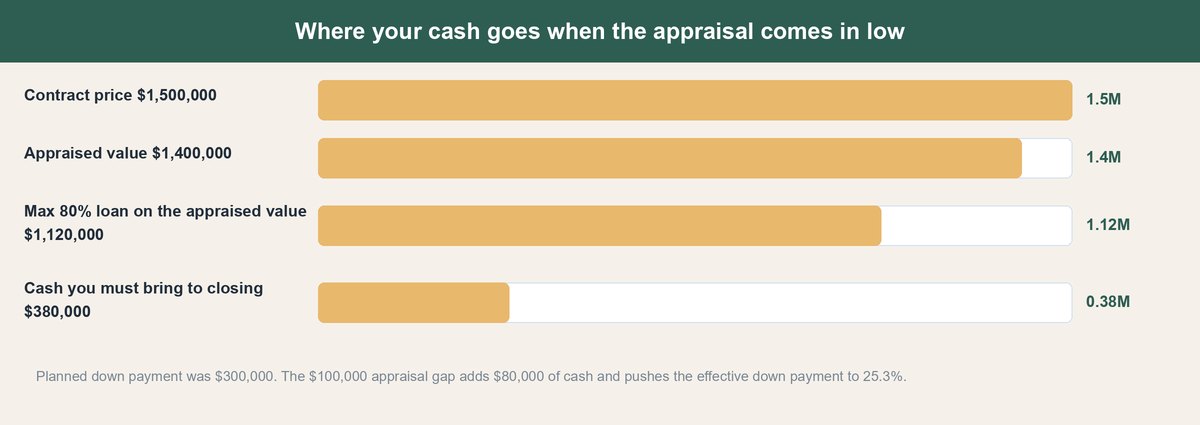
Lenders size a loan against value, not against enthusiasm. Fannie Mae’s Selling Guide section B2-1.2-01 tells lenders that on a purchase, the property value is “the lower of the sales price or the current appraised value.” Freddie Mac and conventional investors follow the same rule. So when the appraisal lands under contract price, the bank does not reduce your obligation to the seller. It reduces its own exposure and leaves the shortfall to you.
Run the arithmetic on a realistic Peninsula number. Contract price $1,500,000, 20% down, loan of $1,200,000. The appraisal returns $1,400,000. Your maximum 80% loan is now $1,120,000, so cash to close on the purchase price alone rises from $300,000 to $380,000. That $80,000 is not a fee you can negotiate down or roll into the loan. It is a wire.
The second-order effect is the one buyers miss. That $80,000 comes out of post-close reserves, and lenders re-verify assets before funding, so draining reserves can weaken the same approval you are trying to protect. The alternative — keeping your cash at $300,000 and asking for a $1,200,000 loan against a $1,400,000 value — is an 85.7% loan-to-value request, which changes your pricing and generally triggers mortgage insurance. Neither path is free.
Bay Area buyers hit this more often because the offer culture manufactures gaps. The San Francisco Standard reported in July 2026, citing Compass data, that 144 San Francisco homes sold at least $1 million over asking in the first half of 2026, against eight a year earlier, with single-family overbids averaging about 25% over asking in May 2026 versus roughly 10% in 2025. Appraisers value the property, not the bidding war. Nationally, NAR’s December 2025 REALTORS Confidence Index attributed 6% of delayed settlements to appraisal issues; in an overbid market your odds are worse.
Why Appraisals Come In Below Contract
Four causes account for most of it. Comparable-sales lag: the closed sales an appraiser must cite are weeks old and miss whatever recent bidding did to price. Unique or heavily updated properties have no clean comps, so the appraiser estimates rather than matches. An appraiser unfamiliar with a specific block can miss the premium that micro-market commands. And overbid pricing itself has not yet shown up in any closed sale the appraiser can cite. None of that means the appraiser got it wrong.
What to Do When the Appraisal Comes In Below Your Contract Price
A low appraisal is not a dead deal. Buyers have six real moves, and the right one depends on your cash and how badly you want the house.
| Move | How it works | What it costs you |
|---|---|---|
| Renegotiate the price | Ask the seller to drop the price to appraised value | Time in escrow, no guarantee they agree |
| Split the difference | Each side absorbs part of the shortfall, usually by addendum | Less cash than the whole gap, still real money |
| Apply with a different lender | A new lender orders a new appraisal from a different panel, and comp selection varies enough that a second number sometimes lands higher | A fresh underwriting timeline, a new appraisal fee, no guaranteed improvement |
| Pay the gap in cash | Bring the shortfall to closing, keeping price and loan intact | Reduces post-close reserves dollar for dollar |
| Cancel under the contingency | If the contingency is still open, cancel in writing and recover your deposit | You lose the property and the escrow time |
| Challenge the number | A reconsideration of value runs through your lender when the appraisal is wrong on facts, not just low | Time, no guarantee of a revised number |
Most competitive offers combine several.
What the Appraisal Gap Contingency in the California Purchase Agreement Actually Does
Before you promise anything, understand what you are promising away. The California Association of REALTORS residential purchase agreement carries a standalone appraisal contingency with a 17-day default period, separate from the loan contingency. Three points decide real outcomes.
First, contingencies do not expire quietly — they are not waived automatically when the 17 days elapse. What the clock gives the seller is the right to serve a Notice to Buyer to Perform, handing you two days to remove in writing or face cancellation. Second, removal must be active and signed. Third, if you properly cancel while the appraisal contingency is still open because the property did not appraise, you are not in breach and you are entitled to your deposit back. That entitlement is not automatic release — if a seller refuses to sign off on the deposit in escrow, the dispute goes to mediation, arbitration or court, so treat it as a right you may have to enforce, not a button you press.
That is the whole reason this contingency has value. It is a priced exit, and it is independent: removing the loan contingency because your underwriter cleared you does not remove the appraisal contingency. Buyers who assume otherwise sign away an exit they still had. The appraisal gap contingency is your door out, and an appraisal gap clause is a written promise about how far you will walk into the room before you use it.
Appraisal Gap Clause Versus Appraisal Gap Waiver Versus Removing the Contingency
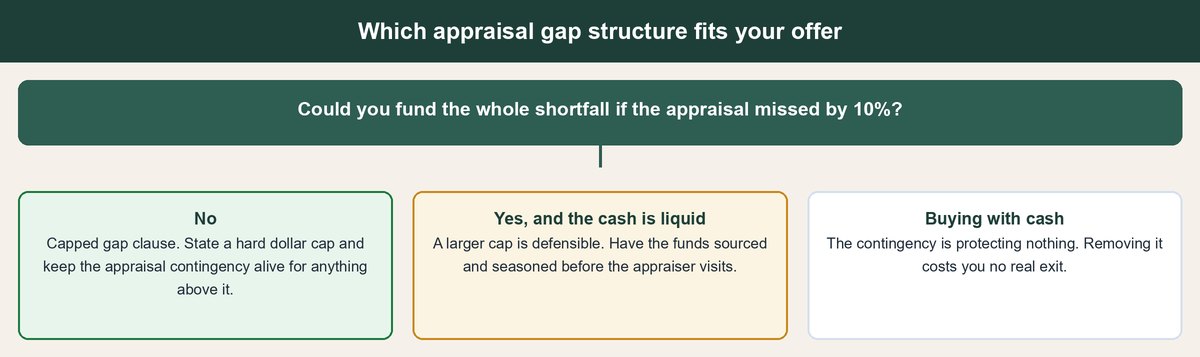
Listing agents use these three terms loosely, and search results blur them together. They are different levels of exposure, measured in tens of thousands of dollars.
The Capped Appraisal Gap Clause
What it is: a term stating that if appraised value comes in below contract price, you cover the shortfall up to a specific dollar cap, and the appraisal contingency survives for anything beyond it.
Why it works: it gives the seller the one thing they want — certainty that a mediocre appraisal will not reprice the deal — while keeping your downside bounded and your exit intact for a genuinely bad number.
The catch: the cap must be a number, not an adjective. “Reasonable shortfall” and “up to a commercially acceptable amount” are invitations to argue.
The Full Appraisal Gap Waiver
What it is: a promise to cover any shortfall, with no ceiling, effectively waiving the appraisal contingency’s protection while leaving the paragraph nominally in place.
Why sellers ask for it: it removes their entire valuation risk and costs them nothing to request.
The catch: you have written an unlimited check against a number produced by a third party you do not choose and cannot control. A 12% miss on $1,500,000 is $180,000. If you cannot fund it, you are in breach and your deposit is the seller’s first target. Do not confuse this with a lender’s appraisal waiver — that is Fannie Mae or Freddie Mac offering to fund without a full appraisal at all, which removes the gap risk rather than shifting it to you.
Removing the Appraisal Contingency Outright
What it is: striking the contingency entirely, so a low value gives you no cancellation right at all on valuation grounds.
Best for: all-cash buyers, and buyers whose loan is small enough that appraised value cannot constrain it, where the contingency never protected anything real.
The catch: financed buyers who do this are relying on the loan contingency to save them, and it will not. A lender that funds $1,120,000 against a $1,400,000 appraisal has approved your loan. You are not unable to obtain financing. You are short on cash, which is not a covered reason.
| Structure | What you promise | Maximum cash exposure | Exit if the number is bad | Best fit |
|---|---|---|---|---|
| Capped gap clause | A shortfall up to a stated dollar cap | The cap, not a dollar more | Survives past the cap | Financed buyers in a competitive bid |
| Full gap waiver | The entire shortfall, whatever it is | Unlimited | None, in practice | Buyers with deep, verified liquidity |
| Contingency removed | No valuation-based cancellation right | Unlimited | None | Cash buyers, or very low LTV |
| Contingency intact, no gap language | Nothing | Zero | Full, deposit returned | Balanced and off-market deals |
How Much Appraisal Gap Coverage to Offer Without Buying a Problem
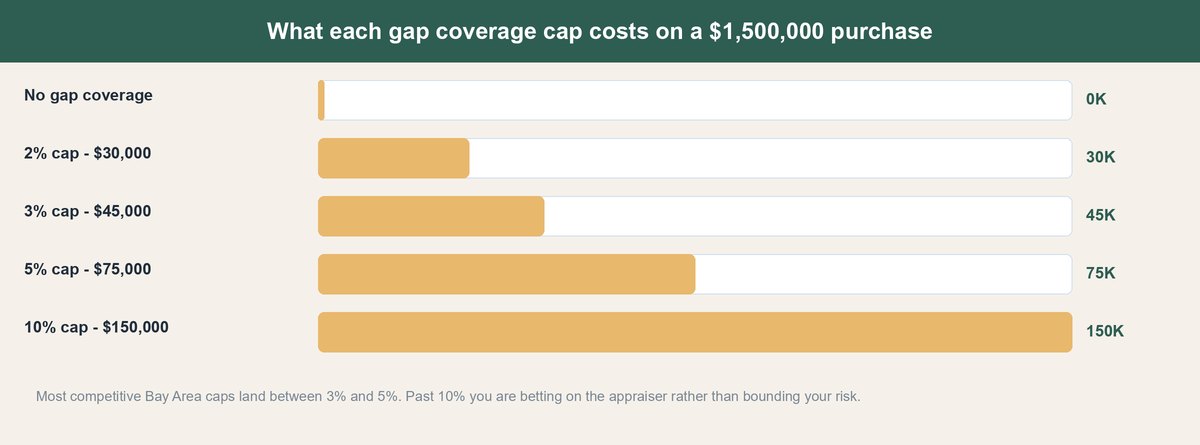
Appraisal gap coverage is the number that actually gets negotiated, and most buyers size it backwards. They ask what they could survive. The right question is what they would still be content to have paid three years from now.
Two anchors give you a defensible cap. First, the comparable-sales spread: pull the last three to six closed sales your appraiser would reach for and measure how far your price sits above the highest. That distance, not your enthusiasm, is the realistic miss. Second, your post-close reserve floor, set after closing costs that run 1% to 2% of price before prepaids. Decide the liquid balance you refuse to go below and treat everything under it as unavailable.
In practice, a cap of roughly 3% to 5% of purchase price covers the overwhelming majority of real-world misses — $45,000 to $75,000 on a $1,500,000 home. Put concretely, a $60,000 cap means your deal survives any appraisal down to $1,440,000; below that, your contingency is live again. Caps above 10% stop being risk management and start being a bet that the appraiser will agree with you. A bigger cap does not make your offer proportionally stronger either, because sellers weigh gap coverage against close date, deposit size and loan type, all of which cost you less.
What Goes in an Appraisal Gap Addendum and the One Line That Breaks It

An appraisal gap addendum is not a separate C.A.R. form the way a purchase agreement is. In California the gap language typically lives inside the purchase agreement’s appraisal contingency terms, an addendum, or a counter offer. C.A.R.’s June 2026 forms release was reported to add an option to base the contingency on a stated gap rather than the older all-or-nothing structure, with the counter offers updated to simplify when a gap applies. Confirm the edition your agent uses, because revisions roll out unevenly.
The Four Blanks Every Gap Clause Needs
A workable clause states four things and nothing vague.
- The appraisal gap amount as a hard dollar figure.
- The trigger: it applies only when appraised value falls below contract price.
- The source of funds: additional cash, not a change to the loan amount.
- What survives: the appraisal contingency remains available for any shortfall above the cap.
Assembled, the four blanks might read: “Buyer will pay up to $50,000 above the appraised value if the appraised value is below the purchase price, as additional cash and not a loan increase, and Buyer’s appraisal contingency remains in effect for any shortfall beyond that $50,000 cap.”
This is educational content, not legal or financial advice. Appraisal gap terms are enforceable contract language with real money attached, so have your agent and, where the numbers justify it, a California real estate attorney review the exact wording before you sign.
The Wrong Wording That Quietly Waives Everything
Three phrasings do real damage.
- “Buyer will pay the difference between the appraised value and the purchase price” with no cap is a full waiver wearing a clause’s clothing.
- “Buyer waives the appraisal contingency” dropped into additional terms surrenders the exit for the entire shortfall, not just the covered portion.
- A gap amount written into a counter offer without restating it when the price changes leaves you arguing about which price your cap attached to. Restate the cap every time the price moves.
How the Gap Interacts With Your Loan Approval and Your Deposit
The financing and appraisal contingencies protect against different failures, and a gap clause quietly shifts risk between them. Your loan contingency covers an inability to qualify. It does not cover an inability to produce cash you promised. Once you have written a gap clause, a shortfall inside your cap is a liquidity obligation, and failing it is a breach.
That is where the deposit comes in. California Civil Code section 1675 applies only to residential property of four units or fewer that the buyer intends to occupy — an investor buying a rental does not get this presumption. Within that scope, subdivision (c) presumes a liquidated damages payment not exceeding 3% of the purchase price valid unless the buyer shows it is unreasonable; under subdivision (d), above 3% the party seeking to uphold the provision must prove reasonableness. Bay Area deposits sit right at that 3% line for exactly this reason. On a $1,500,000 purchase that is $45,000 exposed the moment your contingencies are gone and your funds are not.
There is also a documentation trap. If gap cash comes from a source your underwriter has not seen — a gift, a brokerage liquidation, a retirement withdrawal — expect sourcing and seasoning questions late in escrow. Tell your loan officer the day you write the gap clause, not the day the appraisal lands. Investors using a debt-service ratio product face the same lower-of rule with less flexibility, so review the DSCR loan requirements before committing to a gap on a rental purchase.
A gap clause is also not your only response. If the appraisal is wrong on facts rather than judgment, the reconsideration of value route runs through your lender, and the preparation behind one is a separate exercise from the gap math here.
Frequently Asked Questions
What is an appraisal gap in real estate?
An appraisal gap is the difference between the agreed contract price and the lender’s appraised value when the appraisal comes in lower. Because lenders size loans off the lower figure, the gap becomes additional cash due at closing.
Who pays the appraisal gap?
The buyer does, unless the seller reduces the price or the parties split the difference. Lenders will not lend against a value the appraisal does not support, and the shortfall cannot be rolled into the mortgage.
Is an appraisal gap clause the same as waiving the appraisal contingency?
No. A capped clause commits you to a stated dollar amount and keeps the contingency alive beyond it. Waiving the contingency gives up your cancellation right entirely, at any shortfall size.
How much appraisal gap coverage should I offer?
Most competitive offers land between 3% and 5% of the purchase price. Size it against the spread between your price and the closest comparable sales, then cap it at cash you can lose without touching reserves.
Can I lose my earnest money over an appraisal gap?
Yes. If you promise gap coverage and cannot fund it, you are in breach rather than exercising a contingency. Under California Civil Code section 1675, a deposit up to 3% of the price on an owner-occupied home is presumed reasonable as liquidated damages.
Does an appraisal gap change my down payment or my loan amount?
It reduces the maximum loan, since loan-to-value is calculated on the appraised value, so your cash contribution rises. On a $1,500,000 purchase appraising at $1,400,000, a planned 20% down payment effectively becomes 25.3%.
The Bottom Line
An appraisal gap is not a market accident to be endured. It is a contract term you get to draft, and the drafting is where buyers either bound their risk or hand it away for free. Pick a hard dollar cap you would still be at peace with in a flat market, keep the contingency alive above it, and tell your lender before the appraiser walks the property. Price your cap before you price your enthusiasm.