







Here is the one sentence that changes how you should read this entire loan: a DSCR lender qualifies the property’s rent, not your paycheck. That is the whole game. The DSCR loan requirements that matter most are not about your W-2, your tax returns, or your two years of self-employment history — they are about whether the rent covers the mortgage payment with a little room to spare. If you are a self-employed investor, a BRRRR operator past your conventional loan limit, or a house-hacker who writes off too much to qualify the normal way, this is the door built for you. Below is the honest gatekeeping guide: the ratio that decides everything, every real threshold for 2026, the fees lenders bury in the fine print, and a worked $350,000 duplex example that shows exactly where deals pass, get priced up, or die.
Key Takeaways
- The ratio decides everything. DSCR = rent ÷ PITIA. Most lenders want 1.0 minimum (rent covers the payment) and reward 1.25+ with the best rates; sub-1.0 “no-ratio” programs exist but cost more.
- Plan for 20–25% down and a 620–660 credit floor. A 700+ score with 25% down unlocks the best pricing; weaker files pay in both rate and down payment.
- Reserves are non-negotiable — 3–6 months of PITIA is standard, 6–12 for thin files or investors carrying multiple financed properties.
- DSCR loans are non-QM and rate about 0.5–1.5 points above conventional (roughly 6.5%–8% in mid-2026 against a Freddie Mac benchmark near 6.5%), and most carry a 5/4/3/2/1 prepayment penalty lenders rarely lead with.
- No primary residences, no true fixers. The property must be a rent-ready investment; a raw-shell BRRRR won’t clear a standard DSCR appraisal until it’s leaseable.
What a DSCR Loan Actually Is When Rent Does the Qualifying
A DSCR loan is an investment-property mortgage underwritten to the property’s cash flow instead of your personal income. DSCR stands for Debt-Service Coverage Ratio — a commercial-lending concept borrowed for one-to-four-unit rentals. The lender asks a single question: does this property throw off enough rent to cover its own mortgage payment? If yes, the deal underwrites. Your personal debt-to-income ratio, the number you sweat on a conventional loan, never enters the math.
The reason this is even legal — and why lenders can skip income verification — is worth understanding, because it explains the whole product. Under the Consumer Financial Protection Bureau’s Regulation Z, the Ability-to-Repay rule applies to consumer loans secured by a dwelling. But credit extended to acquire or maintain non-owner-occupied rental property is deemed a business-purpose loan, and business-purpose loans are exempt from the Ability-to-Repay requirements. No ATR obligation means no requirement to document your income the traditional way. That single carve-out is why DSCR loan requirements lean entirely on the asset. The trade-off: you sign as an investor running a business, and you give up the consumer protections that come with an owner-occupied mortgage.
This is educational content, not financial, legal, or tax advice — every lender writes its own overlays, and rates and rules move weekly, so confirm your specific numbers with a licensed DSCR lender, and consult a licensed CPA or attorney on the tax and entity questions, before you make an offer.
The DSCR Formula and How Lenders Score Your Deal
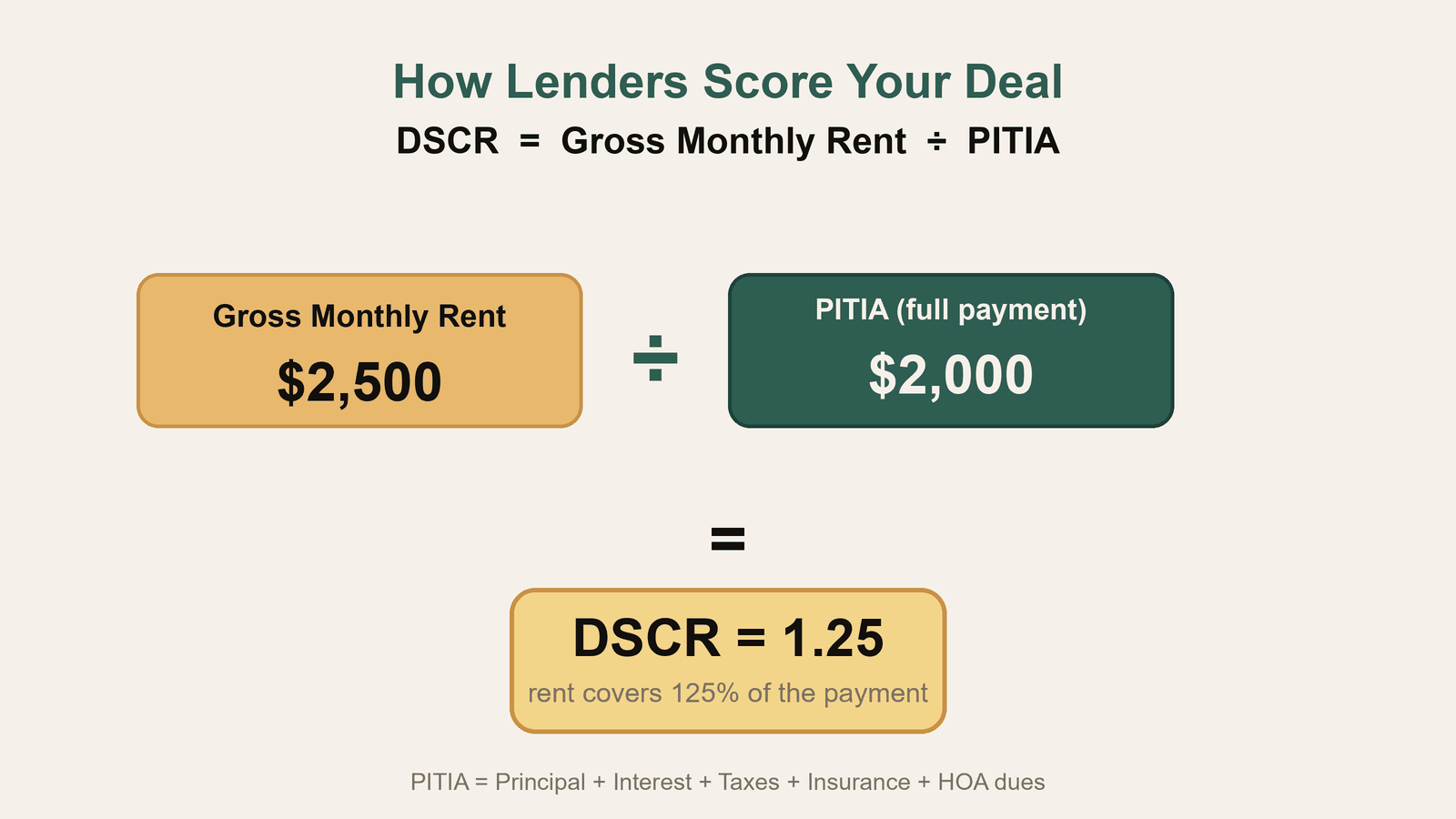
The formula is deliberately simple, which is exactly why investors love it:
DSCR = Gross Monthly Rent ÷ PITIA
PITIA is the full housing payment: Principal, Interest, Taxes, Insurance, and any Association (HOA) dues. Some lenders and most commercial-style programs use net operating income (NOI) divided by debt service instead, which nets out operating expenses first and produces a slightly lower ratio. For standard one-to-four-unit residential DSCR loans in 2026, the gross-rent version is the norm — but ask which one your lender uses, because it changes your outcome at the margin.
A worked read: a single-family rental that leases for $2,500 a month against a PITIA of $2,000 produces a DSCR of 1.25 ($2,500 ÷ $2,000). That means the rent covers 125% of the payment — the property services its own debt with 25 cents of cushion on every dollar owed. That 1.25 is the number most lenders treat as the threshold for their best pricing, which is why you see it everywhere. Anything under 1.0 means the rent does not cover the payment, and the property is negatively cash-flowing before you’ve paid for a single repair.
The Minimum DSCR Ratio and What Each Tier Actually Costs You
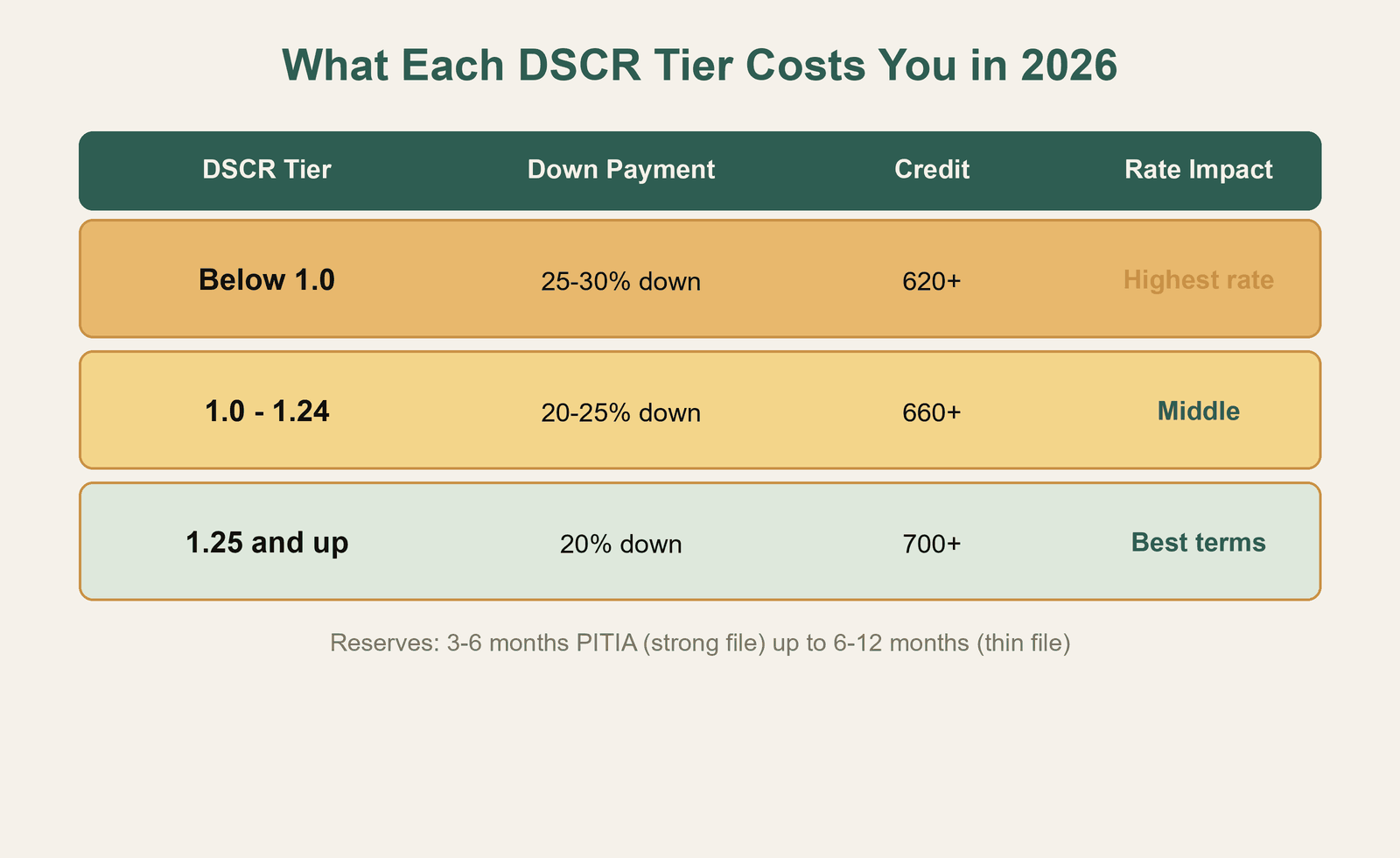
There is no single national minimum — each lender sets its own — but the market has settled into recognizable tiers, and each one carries a real price in rate and leverage. This is where most guides wave their hands; here is what the tiers actually mean for your terms.
DSCR Below 1.0 — The “No-Ratio” or Negative-Cash-Flow Tier
What it is: the rent does not fully cover PITIA. Specialized “no-ratio” or “sub-1.0” DSCR programs will still lend, usually down to about 0.75. The catch: you pay for it with a lower loan-to-value (expect 25–30% down), a higher rate (often 0.5–1.0 point above the standard-tier rate), and sometimes larger reserves. Best for: appreciation-play markets or a property you’ll rent-bump after a light renovation — not a buy-and-hold you need to cash-flow on day one.
DSCR of 1.0 to 1.24 — Approved but Priced Up
What it is: the rent covers the payment but without much cushion. Most lenders approve this range. The catch: you’re on a worse rung of the pricing ladder — a modestly higher rate and often a hard 20% down floor rather than the best-case terms. It funds, but it’s not the deal the marketing pages advertise.
DSCR of 1.25 and Above — Best Terms
What it is: the property clears the coverage bar with real margin. Best for: everyone — this is the tier where you get the advertised rate, 20–25% down, and the smoothest underwriting. Every lever you can pull to push a deal from 1.05 to 1.25 (a bigger down payment, a rate buydown, or simply a better-renting property) pays for itself in your monthly payment.
Credit Score, Down Payment, and Cash Reserves Requirements Side by Side
The ratio gets your deal in the door; these three personal factors set your price and your leverage. None of them is a paycheck check — but your credit and cash still matter. Here is the honest 2026 picture across the three profiles lenders actually price to.
| Requirement | Minimum / Weak File | Standard File | Strong File (best pricing) |
|---|---|---|---|
| Credit score (FICO) | 620–640 | 660–699 | 700+ |
| Down payment (LTV) | 25%+ (75% LTV) | 20–25% | 20% (80% LTV) |
| Cash reserves (PITIA) | 6–12 months | 6 months | 3–6 months |
| Typical DSCR needed | 1.0+ (or no-ratio) | 1.0–1.24 | 1.25+ |
| Rate impact | Highest | Middle | Lowest |
A few things this table won’t say out loud. Credit below roughly 620 shuts most standard DSCR programs; between 620 and 680 you’ll fund but pay for it. Reserves are liquid post-closing money — cash, or often 100% of vested retirement and a portion of brokerage accounts — and the requirement scales up with the number of properties you already finance, because each one is another payment you might have to cover through a vacancy. Per NerdWallet’s DSCR overview, the typical shape is a 1.25 target ratio, at least 20% down, and three-to-six months of payments in reserve — a fair baseline to anchor against, then adjust for your file.
Which Property Types Qualify and Which Ones Get Excluded
DSCR loans are built for income property, and the eligibility list follows that logic precisely. This is a section incumbents love to skip, so here is the real allowed-versus-excluded map.
Generally eligible: single-family rentals, 2–4 unit residential (duplex through fourplex), warrantable condos, townhomes, and — with the right lender — small 5-to-8-unit multifamily and short-term-rental properties. The common thread is a property that produces, or can immediately produce, market rent.
Generally excluded: your primary residence (the whole product is defined by non-owner-occupancy — living there breaks it), true fixer-uppers or uninhabitable shells, rural or agricultural land, most manufactured housing, and unique or non-conforming properties an appraiser can’t easily comp. This is the trap for BRRRR investors: a gutted property mid-rehab usually can’t clear a standard DSCR appraisal and rent schedule until it’s leaseable, which is why most BRRRR operators use short-term financing for the buy-and-rehab and refinance into a DSCR loan only after the property is stabilized. If that’s your playbook, our BRRRR method walkthrough shows where the DSCR refinance slots in.
LLC Vesting and the Personal Guarantee Reality

One of the genuine advantages of DSCR loans is that most lenders happily let you take title in an LLC — something conventional Fannie and Freddie loans effectively forbid. For an investor building a portfolio, holding each property in its own entity is a real asset-protection and organizational win.
But read the fine print, because there’s a catch nobody advertises. Vesting in an LLC does not mean the debt is non-recourse. Nearly every residential DSCR lender requires a personal guarantee from the LLC’s principal members. You sign personally, guaranteeing the loan behind the entity. If the property goes to foreclosure and there’s a deficiency, the lender can pursue you, and the loan reports to your personal credit in most cases. So the LLC gives you liability separation for slip-and-fall and operational risk — worth having — but it does not wall you off from the mortgage itself. Treat the “close in your LLC” pitch as a title and organization benefit, not a magic shield against the debt. If you want the deeper mechanics of holding rentals in an entity, our guide on how to buy a rental property covers the setup.
The Fees and Penalties Lenders Don’t Lead With
This is where the honest math lives, and where the glossy lender pages go quiet. A DSCR loan’s headline rate is only part of the cost. Here are the four line items that surprise investors.
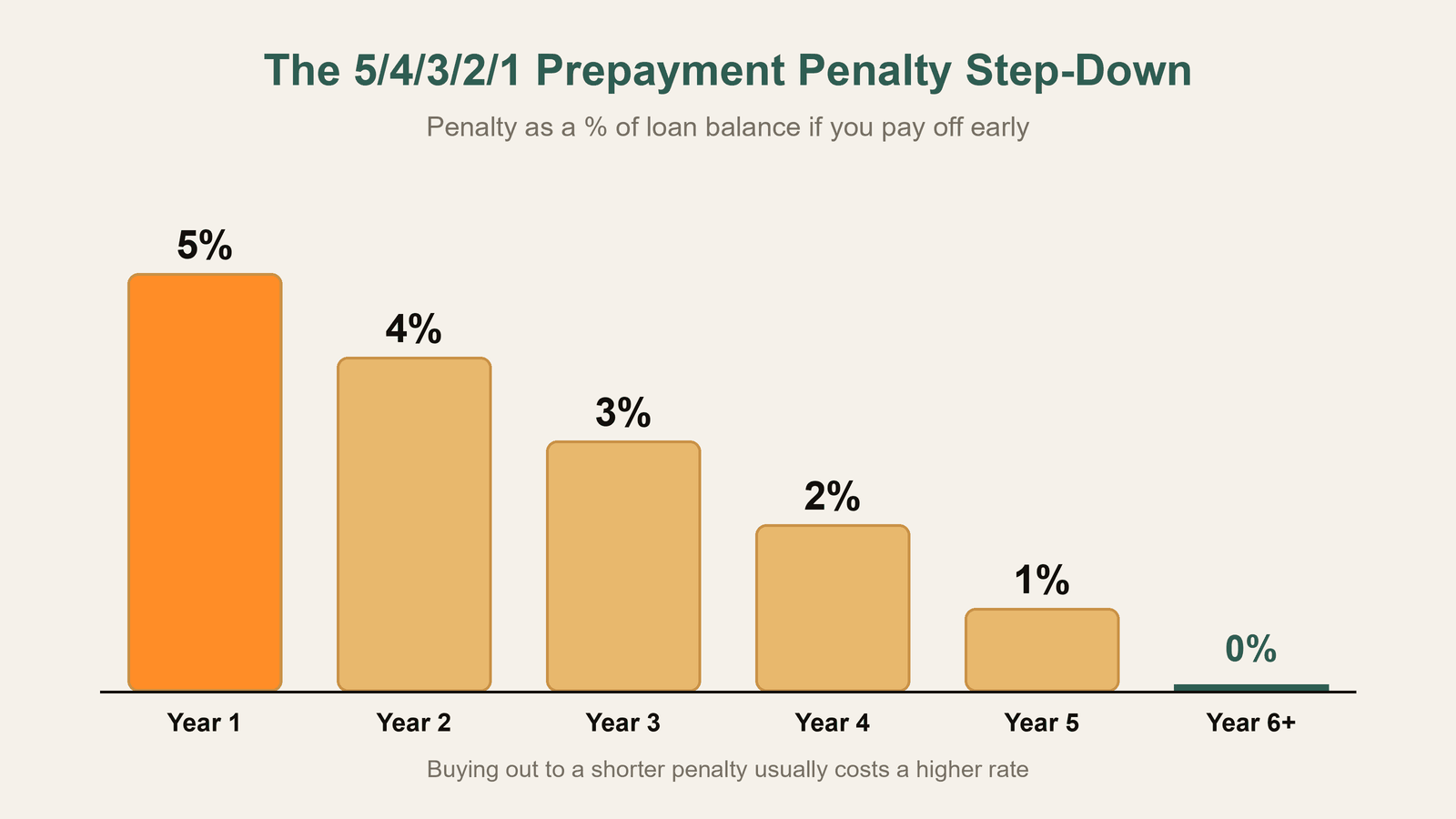
The Prepayment Penalty Step-Down
What it is: most DSCR loans carry a prepayment penalty, commonly structured as a 5/4/3/2/1 step-down — 5% of the balance if you pay off in year one, 4% in year two, down to 1% in year five, then zero. Why it exists: these loans are packaged and sold to investors who priced in years of interest; paying off early breaks that math, so the penalty compensates them. The catch for you: if you plan to sell or refinance within five years — a real possibility for a BRRRR or value-add — that penalty can cost thousands. You can often buy out to a shorter penalty (3/2/1 or none) in exchange for a higher rate; run that trade before you sign.
The Rate Premium Over Conventional
What it is: DSCR loans price above owner-occupied conventional mortgages — roughly 0.5 to 1.5 points higher, landing most fixed DSCR loans in the 6.5%–8% range in mid-2026 against a conventional 30-year benchmark that Freddie Mac’s weekly survey put near 6.5% in July 2026. Why: no income verification and non-owner-occupancy are riskier, so the market charges for it. A dated 2026 DSCR rate page from Sistar Mortgage shows the same 6.5%–8% band. Verify live pricing the week you apply — this number moves.
The Appraisal Plus the 1007 Rent Schedule
What it is: DSCR appraisals cost more than a standard purchase appraisal because they include an extra document — the Fannie Mae Form 1007 Single-Family Comparable Rent Schedule, where the appraiser establishes the property’s market rent from comparable rentals. Why it matters: that appraiser-determined market rent, not your optimistic pro forma, is often what the lender plugs into the DSCR calculation. Budget $150–$300 above a normal appraisal for the rent schedule, and don’t assume your target rent is the number that qualifies.
Higher Origination and Points
What it is: DSCR lenders frequently charge origination points (often 1–2% of the loan) plus the usual title, escrow, and lender fees. The catch: on a $300,000 loan, two points is $6,000 in cash at closing, on top of your 20–25% down. Fold every one of these into your true cost of capital before you decide the deal cash-flows.
DSCR vs Conventional vs Hard Money and When Each Is the Wrong Call
Here is the neutral part most lender pages refuse to write, because they only sell one product: sometimes a DSCR loan is the wrong tool. Use this comparison to place it honestly against the two alternatives investors weigh most.
| Factor | DSCR Loan | Conventional (Fannie/Freddie) | Hard Money |
|---|---|---|---|
| Qualifies on | Property rent (DSCR) | Your personal income/DTI | Property value / after-repair value |
| Income docs | None | Full (W-2s, tax returns) | Minimal |
| Typical rate (mid-2026) | ~6.5%–8% | ~6.5% | ~10%–13%+ |
| Down payment | 20–25% | 15–25% (investment) | 10–25% + rehab |
| Property condition | Rent-ready | Rent-ready | Distressed OK |
| Term | 30-year fixed common | 30-year fixed | 6–24 months |
| Portfolio limit | Effectively unlimited | ~10 financed properties | N/A |
| Closes in LLC | Usually yes | Effectively no | Yes |
When DSCR is the wrong call: if you have clean W-2 income, a strong DTI, and fewer than ten financed properties, a conventional investment loan will almost always beat a DSCR loan on rate and often on down payment — take it. And if you’re buying a distressed property to rehab, hard money (or a fix-and-flip line) is the right tool for the acquisition and construction phase, because a DSCR loan can’t fund a property that isn’t rent-ready. DSCR shines in the specific gap between them: a rent-ready property you want to hold, when your income won’t document cleanly or you’re past the conventional property-count wall.
A Worked Pass/Fail Example on the Same $350,000 Duplex
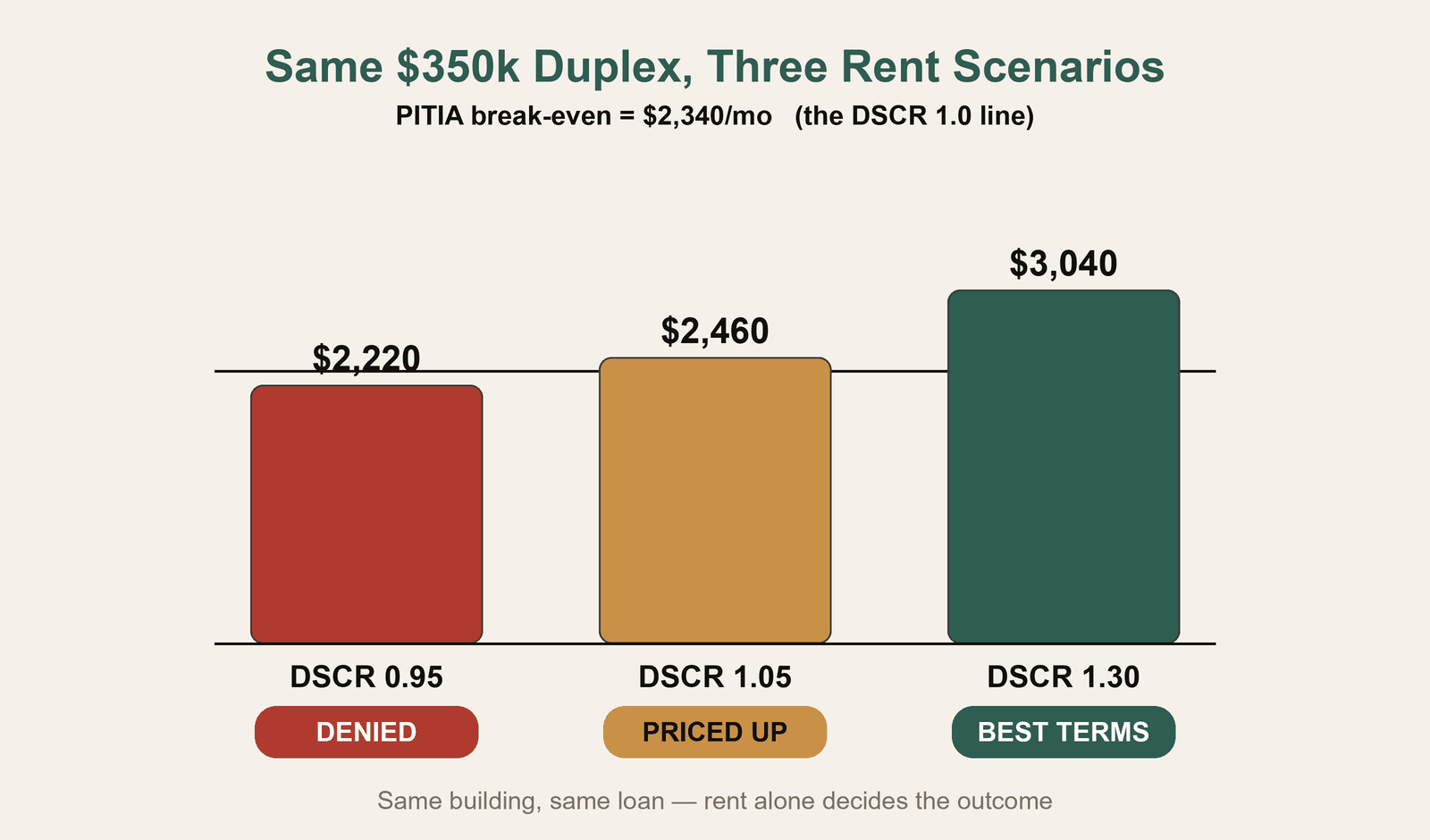
Nothing makes DSCR loan requirements concrete like watching one property pass and fail on rent alone. Take a $350,000 duplex, 25% down ($87,500), a $262,500 loan at 7.5% over 30 years. That’s about $1,836 in principal and interest, plus roughly $350 in property taxes and $150 in insurance a month — a PITIA of about $2,340. Now run three rent scenarios for the two units combined.
| Scenario | Combined Monthly Rent | DSCR (Rent ÷ $2,340) | Lender Outcome |
|---|---|---|---|
| A — Soft rents | $2,220 | 0.95 | Denied — below 1.0; only a no-ratio program would touch it, at worse terms |
| B — Market rents | $2,460 | 1.05 | Approved but priced up — funds, higher rate, hard 25% down |
| C — Strong rents | $3,040 | 1.30 | Best terms — advertised rate, cleanest underwriting |
Same building, same loan, same borrower — three completely different answers, decided entirely by rent. Scenario A doesn’t fail because of your credit or income; it fails because the property loses money every month, and no responsible lender wants that risk at standard terms. This is the discipline the DSCR model forces on you: if the deal doesn’t clear 1.0 on realistic, appraiser-supported rents, the loan is telling you the truth about the investment. The fix for a borderline deal is always the same short list — more down, a rate buydown, or a property that simply rents for more.
Edge Cases That Trip Up Real Deals

The standard rules cover most files. These are the situations where investors get surprised — the paragraphs the incumbent pages almost never include.
Short-Term-Rental and Airbnb Income
The wrinkle: many DSCR lenders now qualify short-term-rental properties, but they don’t all treat the income the same way. Some use the long-term market rent from the 1007 schedule (which can be far lower than your Airbnb gross), while STR-friendly lenders will use a 12-month AirDNA or actual-revenue history. If your deal only pencils on nightly-rental income, you must find a lender that underwrites STR revenue — otherwise your DSCR collapses to the long-term-rent number and the deal fails.
No-Ratio and Sub-1.0 Programs
The wrinkle: if the property can’t hit 1.0, no-ratio DSCR programs exist that skip the coverage test entirely, qualifying on down payment, credit, and reserves alone. They’re real, but they price like it — bigger down payment, higher rate, fatter reserves. Use them for a genuine appreciation or rent-growth play, never as a way to force a bad-cash-flow deal to close.
Cash-Out Refinance Seasoning
The wrinkle: planning to pull cash out via a DSCR refinance — the “R” in BRRRR? Most lenders impose a seasoning period, commonly 3–6 months of ownership, before they’ll lend against the new appraised value rather than your purchase price. Buy a property, rehab it, and try to cash out at week six, and many lenders will cap you at what you paid. Know your lender’s seasoning rule before you build the timeline; it decides when your capital comes back out. If you’re combining this with an owner-occupied unit, our house hacking guide covers how the owner-occupancy rule interacts with investment financing.
How to Apply and the Document Checklist You’ll Actually Need

Because there’s no income underwriting, a DSCR application is refreshingly light compared to a conventional loan. Here’s what a typical lender asks for.
- Property details and a lease or rent estimate — the signed lease if it’s rented, or the appraiser’s 1007 market-rent figure if it’s vacant.
- Two to three months of bank statements — to prove your reserves and down-payment funds.
- Entity documents — if closing in an LLC: articles of organization, operating agreement, and EIN.
- Credit authorization — the lender pulls your score; no tax returns or pay stubs required.
- Purchase contract (for a buy) or current mortgage statement (for a refinance).
- Property insurance quote and, for a purchase, proof of earnest money.
Expect roughly 3–4 weeks from application to closing on a clean file — faster than conventional precisely because there’s no income to verify. The slowest step is usually the appraisal and its rent schedule, so order it early.
Frequently Asked Questions
What is the minimum DSCR ratio to qualify for a loan?
Most lenders set the floor at 1.0, meaning the rent must at least equal the full PITIA payment. A ratio of 1.25 or higher earns the best rates and lowest down payments. Specialized no-ratio programs will lend below 1.0 — often down to about 0.75 — but at higher rates, larger down payments, and bigger reserve requirements.
What credit score do I need for a DSCR loan?
Most DSCR lenders require a minimum FICO of about 620 to 660. You can qualify at the lower end, but a score of 700 or higher paired with 25% down unlocks the best available rates and terms. Below roughly 620, most standard programs are out of reach.
How much down payment does a DSCR loan require?
Plan for 20% to 25% down. A cash-flowing property (DSCR 1.25+) with a strong credit score sits at the 20% end, while a sub-1.0 ratio, lower credit, or no landlord history pushes you toward 25% or more. DSCR loans do not offer the low-down-payment options that owner-occupied FHA or conventional loans do.
Do DSCR loans require tax returns or proof of income?
No. That’s the defining feature. Because a non-owner-occupied rental loan is a business-purpose loan, it’s exempt from the federal Ability-to-Repay rule, so lenders qualify the property’s rent instead of your personal income — no W-2s, tax returns, or pay stubs.
Can I use a DSCR loan to buy a fixer-upper?
Generally no. A standard DSCR loan needs a rent-ready property that can pass an appraisal and produce market rent immediately. True fixers and uninhabitable shells are excluded. Most investors use hard money or a fix-and-flip loan for the rehab, then refinance into a DSCR loan once the property is stabilized and leaseable.
Are DSCR loan rates higher than conventional mortgage rates?
Yes, typically by about 0.5 to 1.5 percentage points. In mid-2026, most fixed DSCR loans priced in the 6.5% to 8% range against a conventional 30-year benchmark near 6.5%. The premium pays for skipping income verification and lending on non-owner-occupied property.
The Bottom Line for Your Next Deal
A DSCR loan is not a loophole — it’s a specialized tool that trades income verification for a laser focus on whether the property pays for itself. Meet the DSCR loan requirements and you unlock financing that scales past conventional limits and welcomes your LLC; miss the ratio and the loan is simply telling you the deal doesn’t cash-flow. Run your target property through the formula before you fall in love with it, price in the prepayment penalty and rate premium honestly, and confirm every number with a licensed DSCR lender and, on the tax and entity side, a CPA or attorney. The math either works or it doesn’t — and now you know how to read it.