







If you just opened a renewal that jumped $400, $700, or more, here is the honest answer: your premium went up because the cost to rebuild your house went up, because insurers paid record catastrophe claims, because the reinsurance that backs your policy got more expensive, and because your specific ZIP code carries more risk than it used to. The reason home insurance is so expensive right now is not one villain. It is three national cost forces stacking on top of your local risk, all at once. The average U.S. homeowner paid about $3,303 a year in 2024, up 24% in just three years, and premiums rose in 95% of U.S. ZIP codes over that stretch. Below I break down each driver by how much it actually moves your number, then hand you a playbook to claw some of it back.
Key Takeaways
- Premiums rose 24% from 2021 to 2024, an average jump of $648 to about $3,303 a year, roughly twice the pace of inflation, per the Consumer Federation of America.
- Rebuild cost, not market value, sets your premium. Cumulative replacement costs tied to homeowners insurance soared 55% between 2020 and 2022, per the Insurance Information Institute.
- Insurers lost money on homeowners coverage. The 2023 net combined ratio hit 110.9, meaning carriers paid out $1.11 for every $1.00 they collected, and they price the next year to recover it.
- 2025 was the sixth straight year of $100B-plus catastrophe losses, roughly $107 billion globally, with the LA wildfires alone driving $40 billion, per Swiss Re Institute.
- Your ZIP code is the swing factor. Coastal and wildfire states face double-digit hikes while low-risk inland ZIPs saw single digits; California is projected up about 16% in 2026.
- You have real levers. Shopping three carriers, bundling, raising your deductible, and hardening the home can together cut 20-40% off a renewal without dropping coverage.
The Short Answer Is Three National Forces Plus Your Local Risk
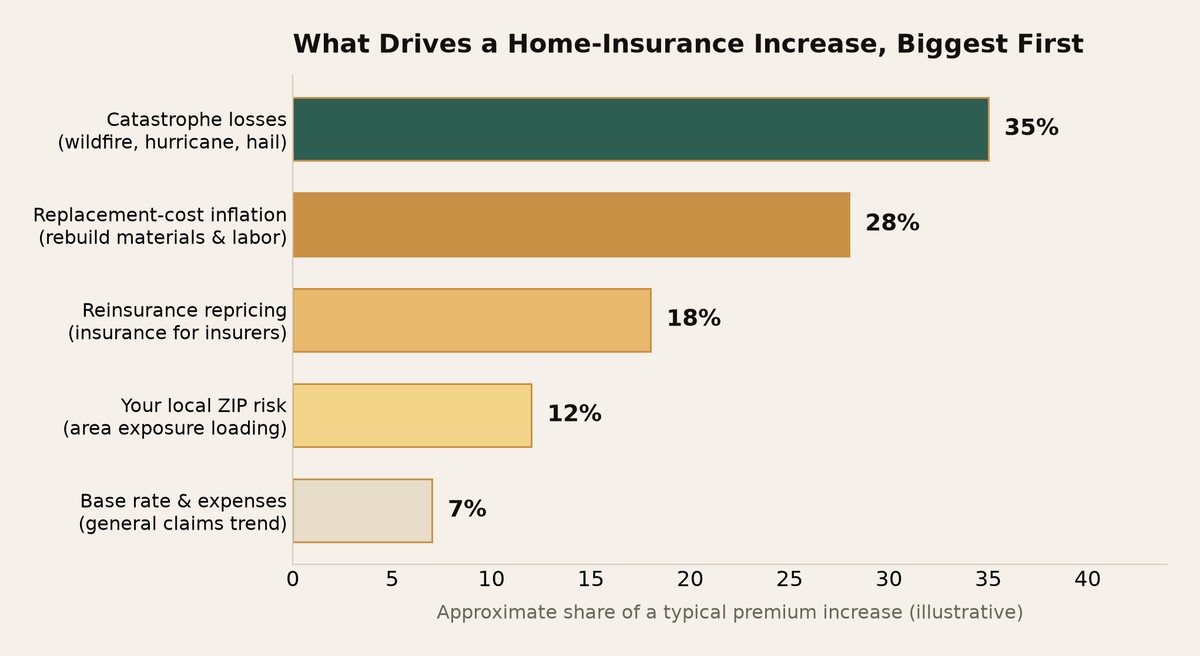
Strip away the noise and every premium increase comes from four buckets, and they are not equal in size. The biggest mover is catastrophe losses — the checks insurers actually wrote for wildfires, hurricanes, hail, and floods. Second is replacement-cost inflation, the rising price of lumber, roofing, and labor to rebuild your specific home. Third is reinsurance, the insurance that your insurer buys, which repriced sharply and gets passed straight through to you. Fourth, layered on top, is your local risk — the ZIP-level exposure that decides whether the first three hit you at 4% or 40%.
Here is the part most articles get wrong: they list ten reasons as if each matters equally. They don’t. Nationally, the loss-and-rebuild forces explain the bulk of the increase; the “you filed a claim” or “your credit dropped” factors are real but usually move your bill by low single-digit hundreds, not the thousand-dollar jumps hitting coastal and wildfire markets. Understanding why home insurance is so expensive starts with ranking the causes by dollars, which is exactly how the rest of this guide is organized — biggest first.
Climate and Catastrophe Losses Are the Single Biggest Driver

What’s happening: Insurers price next year’s premiums off last year’s payouts, and the payouts have been brutal. Globally, 2025 marked the sixth consecutive year that insured natural-catastrophe losses topped $100 billion, landing near $107 billion, per Swiss Re Institute. The January 2025 Los Angeles wildfires alone produced an estimated $40 billion in insured losses — the largest insured wildfire event on record. Severe convective storms (hail, straight-line winds, tornadoes) added another $50 billion.
Why it hits your bill even if you’re nowhere near a fire or coast: insurance is a pooled, national product. When a carrier writes $40 billion in wildfire checks in one quarter, it has to rebuild capital, and it does that by raising rates across its whole book — including the quiet suburb in Ohio that never flooded. The Insurance Information Institute notes natural-disaster losses have escalated roughly tenfold from the 1980s to the 2020s in inflation-adjusted dollars. That is a structural, not a one-year, shift: more people and more expensive homes now sit in harm’s way, and the storms are landing more often. This is the number-one reason home insurance is so expensive in 2026, and it is the one you personally can do the least about.
So what for you: if you live in a wildfire, hurricane, hail, or flood-exposed area, budget for continued increases and put your energy into the mitigation and shopping levers below — that is where your control actually is.
Replacement Cost Inflation Is Not Your Home’s Market Value
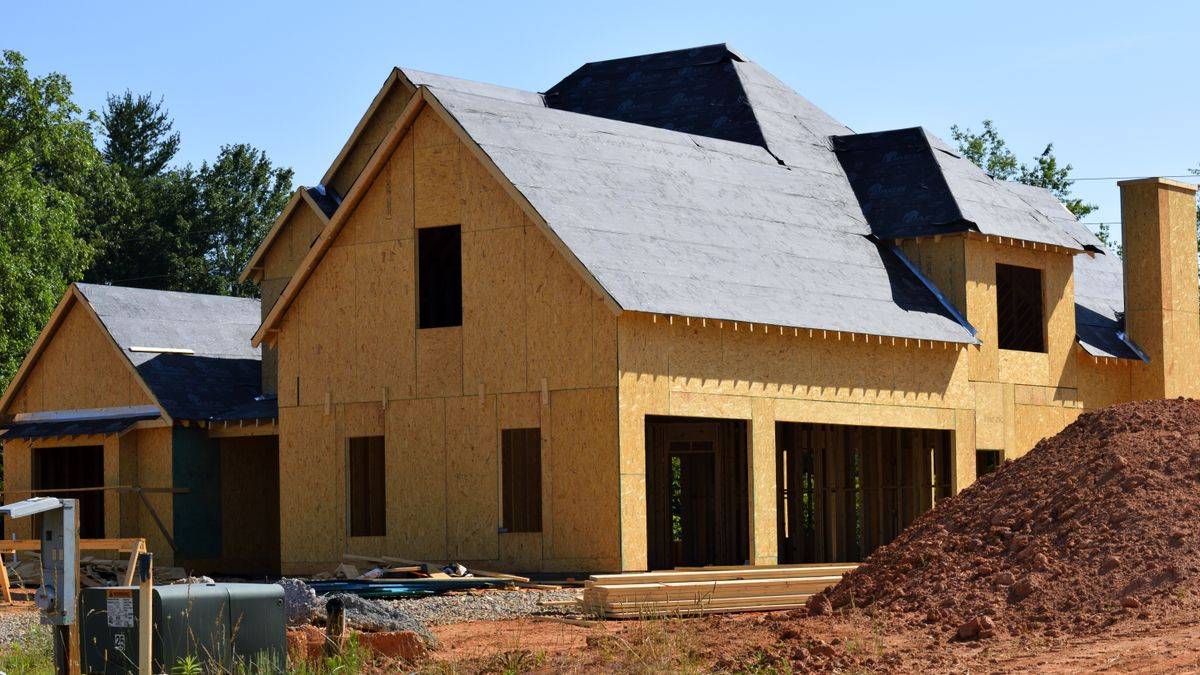
What it is: Your dwelling coverage is based on replacement cost — what it would take to rebuild your house from studs up at today’s material and labor prices — not what it would sell for. This trips up almost every homeowner. Your home’s market value can fall while your premium rises, because rebuild costs and resale prices are two different markets. Cumulative replacement costs related to homeowners insurance soared 55% between 2020 and 2022, per the Insurance Information Institute, driven by pandemic supply-chain shocks, lumber spikes, and a construction-labor shortage.
The mechanism: when the price of framing lumber, asphalt shingles, drywall, and skilled trades all jump, the dollar figure your insurer would owe to rebuild jumps with it. Insurers run automated “inflation guard” endorsements that re-rate your dwelling limit upward each year to keep you fully covered. That protects you from being underinsured after a total loss — but it also mechanically raises your premium even in a year when nothing about your house changed. It is the second-largest driver nationally and the one homeowners misunderstand most.
So what for you: don’t fight the inflation-guard adjustment blindly, but do verify the number is realistic for your home. If your carrier has your rebuild cost pegged well above what a local builder would actually charge per square foot, you may be over-insured and overpaying — a conversation worth having with your agent at renewal.
Reinsurance Is the Price Hike You Never See on Your Bill
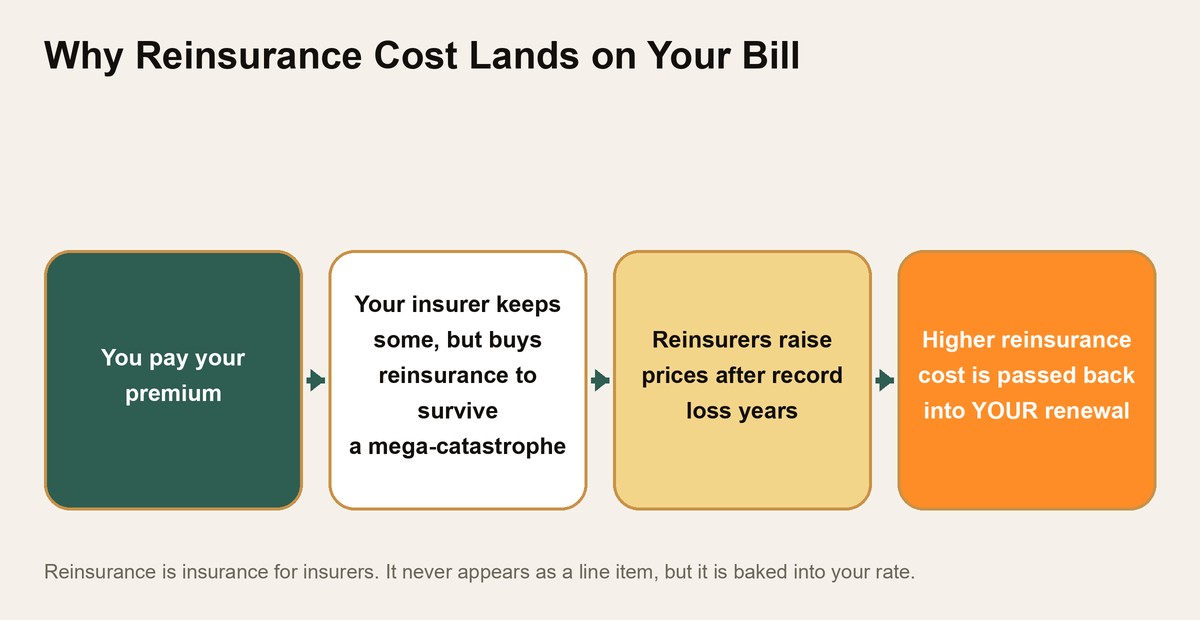
What it is: Reinsurance is insurance for insurance companies. Your carrier can’t absorb a $40 billion wildfire alone, so it buys coverage from global reinsurers to cap its own catastrophe exposure. After the record loss years, reinsurers raised property-catastrophe prices sharply and pulled back on how much low-layer risk they’d cover. That cost does not appear as a line item on your declaration page, but it is baked into your rate.
Why it matters more than it sounds: reinsurance is a large, rising slice of what your insurer spends, and it is repriced globally every year (major renewals hit January 1 and mid-year). When reinsurers demand more, primary insurers have two choices — pay it and pass it to policyholders, or stop writing in the riskiest markets. Both have happened, which is why some homeowners in California and Florida saw not just higher prices but carriers leaving entirely. The 2023 homeowners net combined ratio of 110.9 — the industry’s worst underwriting result since 2011 — is the scoreboard: carriers paid out more than they took in, and reinsurance cost was a big reason.
So what for you: this is the invisible force behind “my insurer stopped writing my area.” You can’t negotiate reinsurance, but you can make your specific home a better risk (hardening, roof age, claims history) so a carrier still wants you when capacity tightens.
Why Your State and ZIP Code Move the Number the Most
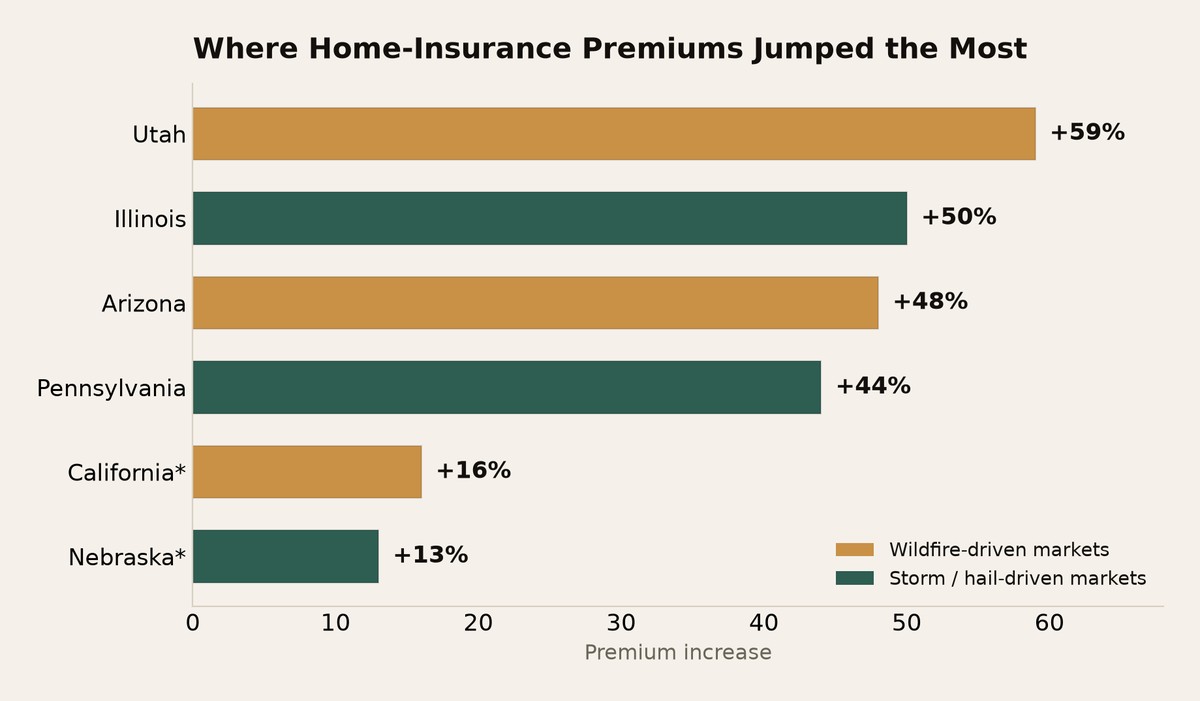
Nationally, premiums are up single-to-low-double digits — but the average hides everything. The same three forces above get multiplied by your local risk, so two identical houses can see wildly different renewals. A third of U.S. ZIP codes saw increases above 30% from 2021 to 2024, while low-risk areas saw far less. Here is how the spread looks, mixing recent cumulative increases with 2026 projections:
| State / market | Recent premium trend | Primary risk driver |
|---|---|---|
| Utah | +59% (2021–2024) | Wildfire, rapid rebuild-cost growth |
| Illinois | +50% (2021–2024) | Severe convective storms (hail, tornado) |
| Arizona | +48% (2021–2024) | Wildfire, extreme heat |
| Pennsylvania | +44% (2021–2024) | Storm frequency, rebuild inflation |
| California | ~+16% projected 2026 | Wildfire, carrier retrenchment |
| Nebraska | ~+13% projected 2026 | Hail and convective storms |
| Florida | Highest absolute premiums nationally | Hurricane, litigation costs |
| Low-risk inland ZIPs | Low single digits | Minimal catastrophe exposure |
The pattern is clear: coastal wind, wildfire, and hail-alley states carry the double-digit hikes, while sheltered inland ZIPs get off comparatively light. If you’re deciding where to buy, insurance cost now belongs in your math right next to the mortgage — a $4,000 premium versus a $1,200 one is a $233/month difference that quietly reshapes what you can afford. (For the buying side of that equation, see our guide to closing costs for a buyer and how much house you can afford on a $100k salary.)
A Real Renewal Decoded From $1,800 to $2,500
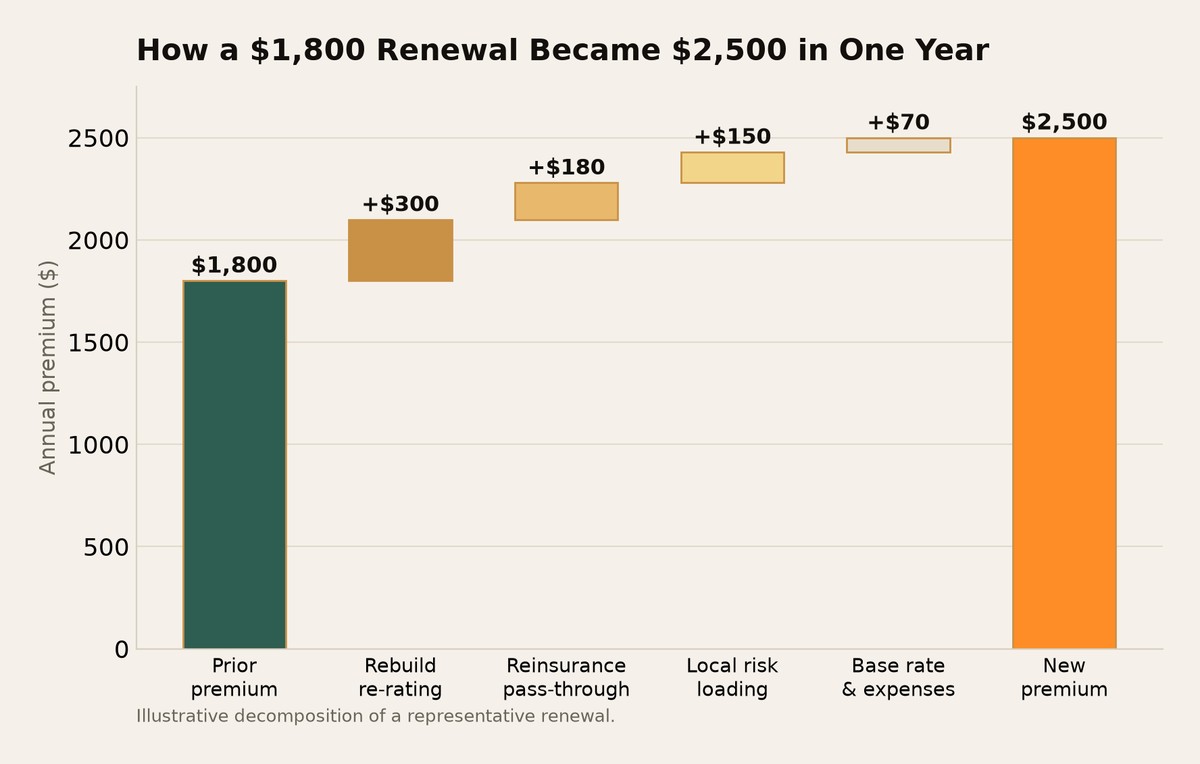
Abstract percentages don’t sting the way a real renewal does. So here’s a representative decomposition of a homeowner whose premium went from $1,800 to $2,500 in one year — a $700, roughly 39% jump — showing where each dollar came from. These figures are illustrative of how carriers stack the increases, not a quote for any specific home.
| What drove the increase | Added to premium | The reason |
|---|---|---|
| Replacement-cost re-rating | +$300 | Inflation-guard raised the dwelling limit to match higher rebuild costs |
| Reinsurance pass-through | +$180 | Carrier’s own catastrophe coverage repriced upward |
| Local catastrophe / risk loading | +$150 | ZIP-level wildfire or storm exposure re-scored higher |
| Base rate and expense trend | +$70 | General claims-cost inflation and operating costs |
| New premium | $2,500 | $1,800 base plus $700 in stacked increases |
Notice what is not on this list: the homeowner didn’t file a claim, didn’t add a pool, and their credit didn’t change. Roughly $630 of the $700 came from forces entirely outside their control — rebuild inflation, reinsurance, and local risk. That is the uncomfortable truth of why home insurance is so expensive for so many people at once: most of the increase is systemic, which is exactly why the levers that work are the structural ones, not “call and complain.”
How to Actually Lower Your Home Insurance Premium

You can’t fix reinsurance markets, but a disciplined renewal can realistically shave 20-40% off the number in front of you. Here is the playbook, ordered by how much each lever typically moves the bill, with honest ranges and the catch on each.
| Lever | Typical savings | The catch |
|---|---|---|
| Shop 3+ carriers | 10–30% ($200–$1,000+) | Must compare identical coverage, not just price |
| Raise deductible $500 → $2,500 | 10–25% (~$400/yr) | You pay more out of pocket on a claim |
| Bundle home + auto | 5–25% | Verify each is still cheapest standalone |
| Harden the home | 5–20% | Real upfront cost |
| New / impact-resistant roof | Up to 20–35% in wind/hail states | Major expense, but big lever |
| Stay claims-free | Up to 20% | Don’t file small claims you could self-pay |
Shop at Least Three Carriers Every Renewal
Best for: everyone, every year. This is the single highest-ROI move. Rates for identical coverage routinely vary by $1,000 or more between carriers because each one weighs your ZIP, roof, and claims history differently. The Consumer Federation and multiple 2025 shopping studies found switchers saving 20-30% regularly, and one documented case cut a premium 25% ($1,041) for the same coverage. The catch is discipline: match dwelling limit, deductible, and endorsements line-for-line, or you’re comparing a smaller policy, not a cheaper one.
Raise Your Deductible on Purpose
Best for: homeowners with an emergency fund who don’t file small claims. Moving from a $500 to a $1,000 deductible can cut your premium roughly 10-25%, and going to $2,500 saves more — often around $400 a year or more. The math works because you’re agreeing to eat the small losses. The catch: never set a deductible higher than the cash you can actually put your hands on tomorrow, and note that many coastal states apply a separate percentage hurricane/wind deductible you can’t lower the same way.
Harden the Home and Prove It to Your Insurer
Best for: anyone in a wildfire, wind, or hail zone. Insurers give real credits for mitigation they can verify: a new or impact-resistant roof (up to 20-35% off in hail and hurricane states), defensible space and ember-resistant vents in wildfire zones, storm shutters, a monitored alarm, and automatic water shutoff devices. The catch is you often have to document it — photos, receipts, an inspection — and the upfront cost can be four figures, so prioritize the roof, which is both the biggest credit and the thing most likely to trigger a non-renewal if it’s aging out.
Two more that quietly matter: roof age (many carriers won’t write or will surcharge a roof over 15-20 years, so replacing a tired roof can reset your insurability), and your credit-based insurance score, which insurers use in most states — California, Maryland, and Massachusetts restrict or ban it, but elsewhere improving it lowers your rate. This is educational information, not insurance or financial advice; your actual savings depend on your home, insurer, and state, so confirm specifics with a licensed insurance agent or your state’s department of insurance.
What to Do When You Are Non-Renewed or Uninsurable

This is the part most articles skip, and it’s where people panic. If a carrier drops you or no admitted insurer will quote you, you are not out of options — but the options get more expensive and more limited, so work them in order.
Try the Standard and Surplus-Lines Market First
What it is: before assuming you’re uninsurable, shop independent agents who represent multiple carriers, then non-admitted surplus-lines (excess & surplus, or E&S) insurers that specialize in higher-risk homes. Surplus-lines policies are legal and widely used in tough markets, but they aren’t backed by your state guaranty fund and often carry higher prices and more exclusions. The catch: read the exclusions carefully — some strip wind or wildfire coverage you assumed was included.
Use Your State FAIR Plan as the Backstop
What it is: every state offers a FAIR Plan (Fair Access to Insurance Requirements) or a similar residual-market plan — the insurer of last resort for people the standard market won’t cover. It is not free government insurance; it’s a private pool funded by all admitted insurers in the state. The California FAIR Plan alone carried 668,609 policies with about $724 billion in total exposure by December 2025, after its residential exposure grew 424% between September 2020 and mid-2025 — a direct readout of how many people the standard market pushed out. The catch: FAIR Plans are typically pricier and thinner (often bare-bones dwelling and fire coverage), so most people pair a FAIR Plan with a separate “difference in conditions” policy for liability and theft.
Never Let It Lapse Into Lender Force-Placed Coverage
The warning: if you have a mortgage and your coverage lapses, your lender will buy “force-placed” (lender-placed) insurance and bill you for it. It protects the lender’s interest, not yours — no liability, no contents — and it commonly costs 1.5 to 2 times a normal policy, and up to 10 times in extreme cases. It is the worst outcome on this list. Always secure replacement coverage before an existing policy ends, even if the only bridge is a FAIR Plan, so you never fall into force-placed pricing. If you’re mid-purchase and hit an insurability snag, this is also why a thorough home inspection checklist matters — roof, wiring, and defensible-space issues surface here and can be fixed before they cost you a policy.
Frequently Asked Questions
Why is home insurance so expensive in Florida specifically?
Florida carries the highest homeowners premiums in the country because it stacks hurricane exposure with years of heavy claims litigation and roofing-claim abuse that drove insurers to insolvency or exit. Fewer carriers plus catastrophic wind risk equals the steepest rates nationally, even after recent state reforms.
Why is home insurance so expensive in Texas?
Texas combines Gulf hurricane risk on the coast with the nation’s worst severe-convective-storm belt — hail and wind — across the rest of the state. Hail alone causes billions in roof claims yearly, so insurers price Texas roofs aggressively and often require impact-resistant materials for the best rates.
Does my credit score really affect my home insurance rate?
In most states, yes. Insurers use a credit-based insurance score that studies link to claims likelihood, and a lower score can meaningfully raise your premium. California, Maryland, and Massachusetts restrict or ban the practice, but in the majority of states improving your credit can lower your rate.
Why did my premium go up when I didn’t file any claims?
Because most of the increase isn’t about you. Rebuild-cost inflation, reinsurance repricing, and your area’s catastrophe risk get applied to every policyholder in the pool regardless of individual claims history — which is why a clean-record homeowner can still see a $700 renewal jump.
Are older homes more expensive to insure?
Usually, yes. Older roofs, knob-and-tube or aluminum wiring, outdated plumbing, and older HVAC all raise claim risk, so insurers surcharge them or decline coverage until they’re updated. Replacing a roof over 15-20 years old or upgrading old wiring is often the fastest way to lower an older home’s premium.
Will home insurance costs keep rising in 2026?
Most forecasts point to continued increases — roughly 4% nationally in 2026 with double-digit hikes in high-risk states like California — because catastrophe losses and rebuild costs aren’t reversing. Our 2026 housing market predictions cover how this feeds into overall affordability.
The Bottom Line on Your Rising Premium
Home insurance got expensive because catastrophe losses hit records, rebuilding got costlier, reinsurance repriced, and your ZIP absorbed all three — and most of that is outside any single homeowner’s control. What you can control is real: shop three carriers, right-size your deductible, harden the home, keep the roof current, and never let coverage lapse into force-placed pricing. Do those, and you can often recover a big chunk of the increase even in a hard market. If you’re renewing soon, start the shopping now rather than the week it’s due — the best time to fix a bad renewal is before it renews.