







Here is the short answer. Realtor.com names September 27 through October 3 as the best week of 2026 to buy a home. Their researchers put the potential savings near $14,000 on a typical home. That is real money, and the week is real. But it is a national average, and no one buys the national average. The best time of year to buy a house depends on how your own market moves through the year, what mortgage rates are doing, and how long you can afford to wait. This guide covers all three, with the actual numbers.
Key Takeaways
- Realtor.com scored every week from 2018 through 2025 and named September 27 to October 3 the best week of 2026 to buy, with 13.3% more homes for sale than an average week.
- Listing prices that week run about 3.5% below their seasonal peak. On a $416,000 median home, that is roughly $14,000 in savings.
- Buyer competition drops about 30.1% below its yearly peak, and homes sit about 64 days, 13 days longer than at the year’s fastest pace.
- The whole country now has 4.9 months of housing supply, the highest in over ten years, so buyers have more room to negotiate than in any recent fall.
- Mortgage rates are rising, not falling. The 30-year rate climbed from 6.65% in late August to 6.95% by September 17, 2026. Waiting for cheaper money has been a losing bet this year.
- The national best week is a starting point. Months of supply, days on market, and the share of price cuts in your own zip code decide your real window.
What the Best Week to Buy Research Actually Measures
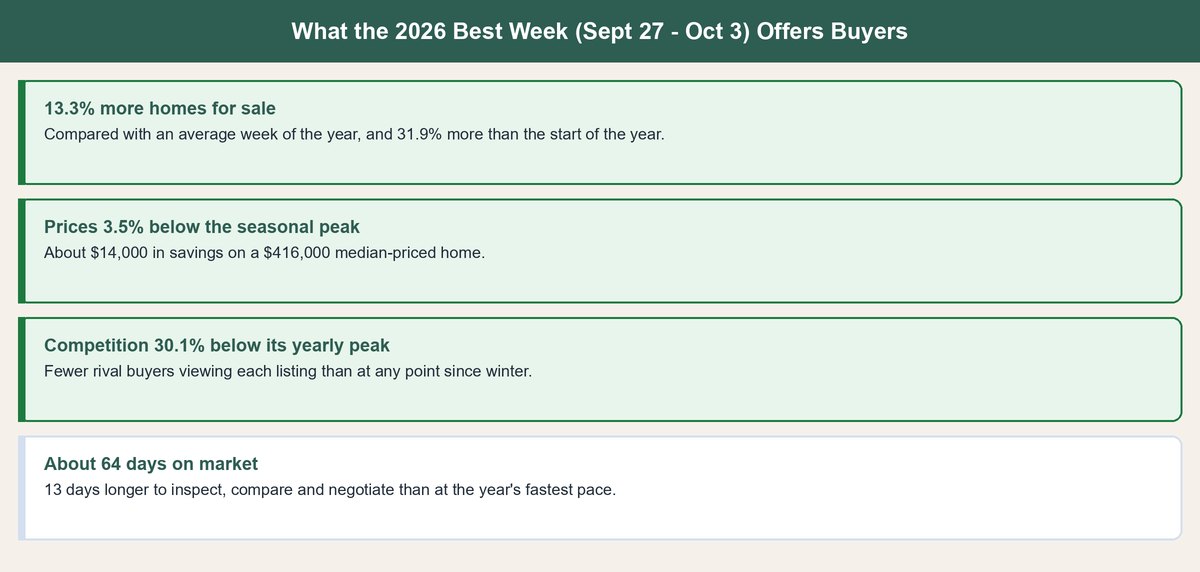
The best week is not a guess. Realtor.com scored every week of the year using listing data from 2018 through 2025, and left out 2020 because the pandemic scrambled the calendar. Each week got graded on six measures. Those are listing prices, total homes for sale, fresh listings, time on market, buyer demand, and the share of homes with price cuts. The week of September 27 through October 3 scored best across all six. One thing they left out on purpose is mortgage rates, because rates do not follow the seasons. Keep that in mind. We will come back to it.
Here is what the winning week actually delivers, straight from the announcement.
| What the week offers | The number | Measured against |
|---|---|---|
| More homes to choose from | +13.3% | An average week of the year |
| More homes than winter | +31.9% | Active listings at the start of the year |
| Lower asking prices | −3.5% | The seasonal price peak |
| Dollar savings | ~$14,000 | A median home near $416,000 |
| Less buyer competition | −30.1% | The yearly peak in views per listing |
| More time to decide | ~64 days on market | 13 days longer than the fastest week |
| Motivated sellers | 5.7% of listings cut their price | The homes still sitting from summer |
Why does all of this land in one week? The mechanics are simple. Families who wanted to move before the school year are gone by late September. That removes a big block of competing buyers. Meanwhile, sellers who listed in May and June are still sitting there, four months in, watching the leaves turn. Many of them cut their price rather than carry the home through winter. More supply, fewer rivals, softer prices. Hannah Jones, senior economist at Realtor.com, put it plainly. The week brings together “elevated inventory, less competition and prices that have eased from their seasonal high.”
So what should you do with this? Treat the week as a marker for the fall season, not a coupon that expires Friday. The conditions that make it the best time of year to buy a house build through September and hold into November. A buyer who is ready in mid-October has nearly the same edge as one who signs during the magic week.
How Each Season Treats Homebuyers Differently
The best week sits inside a yearly rhythm that repeats with remarkable consistency. Once you see the pattern, you can place yourself in it on purpose instead of by accident.
| Season | Homes to choose from | Prices | Competition | Who holds the edge |
|---|---|---|---|---|
| Winter (Dec–Feb) | Fewest of the year | Lowest of the year | Very light | Buyers, on price only |
| Spring (Mar–May) | Rising fast | Climbing toward the peak | Heaviest of the year | Sellers |
| Summer (Jun–Aug) | Near the top | At or just past the peak | Hot June, cooling August | Sellers early, even late |
| Fall (Sep–Nov) | Still high, aging | Fading from the peak | Light | Buyers |
Winter Gives You Leverage but Little to Choose From
What happens. Listings thin out to their yearly low, since few owners want strangers touring the house during the holidays. Prices sit at their softest point too.
Your edge. A seller listing in January usually has a reason. A job move, a divorce, an estate. Motivated sellers negotiate. If the right house appears in winter, you can often buy it well.
The trade. Choice. Realtor.com’s data shows nearly a third fewer active listings at the start of the year than in early fall. You may wait months for a home that fits, and settling for the wrong house is the most expensive mistake in real estate.
Spring Brings the Most New Homes and the Most Bidding Wars
What happens. New listings pour in from March through May, and buyers pour in faster. Demand routinely outruns supply, which is why prices climb toward their early-summer peak.
Why sellers win. Every family aiming to move before September shops in spring. That crowd bids against you. Offers over asking, waived protections, and appraisal gaps are all spring specialties. If you must buy in spring, learn how an appraisal gap clause protects your cash before you write an offer.
Worth knowing. Spring is the best season to pick from the widest range of fresh, well-kept homes. You pay for that privilege in price and stress.
Summer Starts Hot in June and Softens by August
What happens. Prices usually peak in June. Then the market slows through July and August as vacations pull buyers away and school deadlines pass.
Your edge. Late summer is when the first real cracks appear. Homes listed in May that have not sold start taking price cuts. A listing with 60 days on the clock in August belongs on your watch list.
The trade. Sellers in early summer still expect peak prices, and many will wait you out. Patience works better in August than in June.
Fall Combines Choice, Price Cuts, and Room to Breathe
What happens. This is the season the best-week research points at. Inventory is still near its yearly high, but the buyer crowd has gone home. Homes take about 64 days to sell, which gives you time to inspect, compare, and negotiate.
Why it works for you. The sellers still on the market in October have already missed the summer window. Carrying a house through winter costs real money in payments, taxes, and upkeep, so price cuts multiply. That mix of high supply and tired sellers is exactly what makes fall the best time of year to buy a house for most people in most markets.
One warning. Fall inventory is aging inventory. Some homes sat all summer for a reason. Inspect harder, not softer, when the discount looks generous.
How to Read Your Own Market Instead of the National Average
Here is the part the headlines skip. The $14,000 figure is a national blend of thousands of zip codes, and your market may look nothing like it. A Texas suburb with a dozen new subdivisions behaves differently from a Chicago neighborhood where nothing gets built. The good news is that three public numbers tell you which market you are standing in. Check all three before you decide the calendar matters more than your street.
Months of Supply Tells You Who Holds the Power
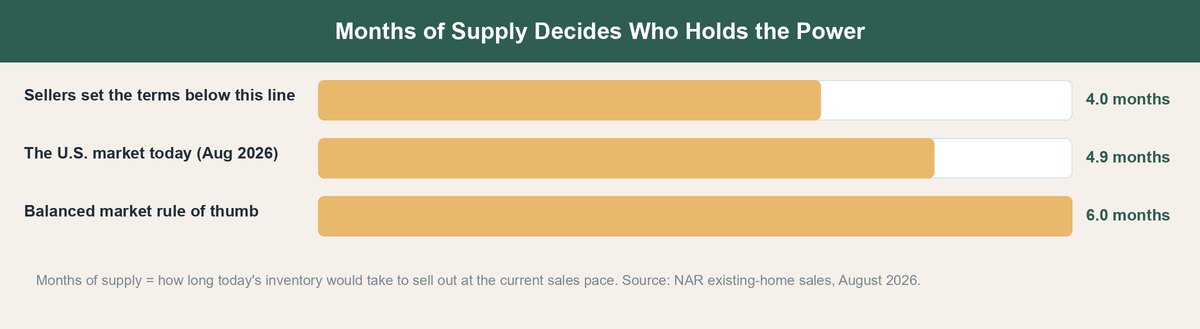
What it is. Months of supply asks a simple question. If no new homes were listed, how long would the current inventory take to sell out? NAR’s August 2026 data shows 1.62 million homes for sale nationally, which works out to 4.9 months of supply. That is the highest reading in more than ten years.
How to read it. Around six months has long been treated as a balanced market. Below four, sellers set the terms. Above six, buyers do. At 4.9 and climbing, the country is drifting toward buyers, which is why NAR’s own economists say shoppers have better room to negotiate now. Ask any local agent for your area’s number, or divide active listings by last month’s closed sales yourself.
Days on Market Tells You How Fast You Must Move
What it is. The median time between listing and contract. During the best week, the national figure runs about 64 days.
How to read it. If homes in your target zip code go under contract in two weeks, you are in a fast market, and fall discounts will be thin. Waiting for October gains you little when three other buyers tour every new listing on day one. If homes sit 70 or 90 days, the seasonal playbook works exactly as written. Move at the market’s speed, not the calendar’s.
The Share of Price Cuts Shows Who Is Done Waiting
What it is. The percentage of active listings that have reduced their asking price. Nationally, about 5.7% of homes cut their price during the best week.
How to read it. A rising share of cuts means sellers are chasing the market down, and your offer 5% below asking stops being rude and starts being Tuesday. Filter any listing site for price reductions and days on market over 60. That list is where fall bargains actually live. Then walk in prepared, with a full buying checklist already done, because the best-priced home in the neighborhood still sells fast.
Why Rising Rates Change the Waiting Math in 2026
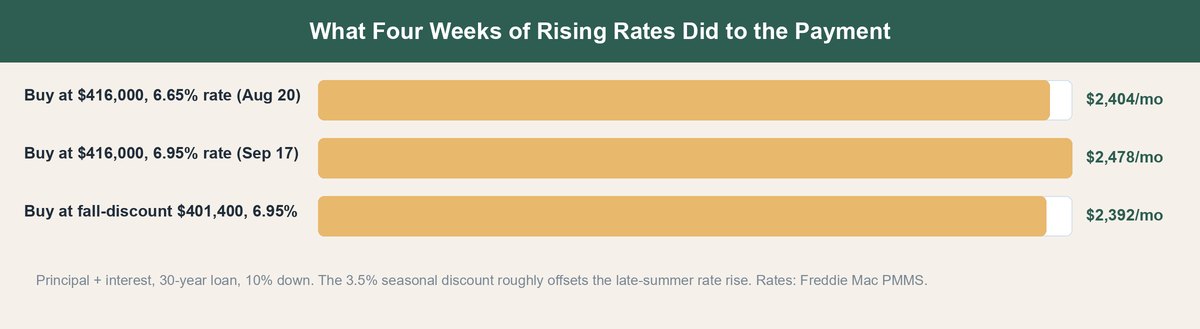
Now the uncomfortable part, and the reason “just wait for rates to drop” is not honest advice this year. Mortgage rates in 2026 have been climbing. Freddie Mac’s weekly survey put the 30-year fixed rate at 6.95% on September 17, 2026. Four weeks earlier it was 6.65%. That is a 0.30-point rise between late August and mid-September, and the Federal Reserve’s own data feed shows the climb week by week. Anyone who waited through the summer for cheaper money got more expensive money instead.
What does 0.30 points cost? Take the median $416,000 home with 10% down, which means borrowing $374,400. At 6.65%, the principal-and-interest payment is about $2,404 a month. At 6.95%, it is about $2,478. That is roughly $75 more every month, and about $26,700 more over a 30-year loan. In monthly-payment terms, the rate move wiped out most of a typical fall discount in four weeks.
Here is the honest trade-off, run both ways.
- Buy during the fall window at today’s rate. A 3.5% seasonal discount cuts that $416,000 home to about $401,400. Borrowing $361,300 at 6.95% costs about $2,392 a month. You locked the lower price forever, and you borrowed $13,000 less.
- Wait for a better rate. If rates fall later, you can refinance and keep your discounted purchase price. But if prices firm up in spring while you wait, the discount is gone, and it does not come back. You can refinance a rate. You cannot refinance the price you paid.
Notice what that comparison does not say. It does not say rates will keep rising, and it does not say they will fall. Nobody knows, including every commentator who sounds certain. Our housing market outlook covers the forecast side in depth. What the numbers do say is that waiting is a trade with two open risks, price and rate, against one known gain, more time to save. Weigh it as a trade, not as a free option.
One more thing rising rates quietly do. They thin out your competition. Every rate bump pushes some buyers out of the market, which is part of why competition in late September runs 30% below peak. If your budget still works at 6.95%, you are shopping against fewer people than at any point since spring.
Frequently Asked Questions
Is fall really the best time of year to buy a house?
For most buyers in most markets, yes. Fall combines near-peak inventory, prices about 3.5% below their seasonal high, and roughly 30% less buyer competition. Winter offers lower prices but far fewer homes to choose from.
What week is the best time to buy a house in 2026?
Realtor.com names September 27 through October 3, 2026, based on weekly listing data from 2018 through 2025. Buyers that week see about 13.3% more listings than average and potential savings near $14,000 on a median-priced home.
Is it better to buy when prices dip or wait for lower mortgage rates?
That is a trade, not a rule. A locked purchase price is permanent, while a rate can be refinanced later if rates fall. In 2026, rates rose from 6.65% to 6.95% in four weeks, so waiting has carried a real cost.
What is the worst time of year to buy a house?
Late spring, in most markets. April through June brings the year’s heaviest competition and peak prices, since families racing the school calendar bid against each other for fresh listings.
How do I know if my local market favors buyers or sellers?
Check three numbers. Months of supply above six favors buyers, and below four favors sellers. Long days on market means room to negotiate. A rising share of price cuts means sellers are motivated. The national figure is 4.9 months as of August 2026.
Should I buy now or wait until 2027?
That depends on your savings, your job stability, and your local market, not on anyone’s forecast. Run the trade-off honestly. Waiting risks both higher prices and higher rates, while buying now locks today’s price with tomorrow’s refinance still open.
The Calendar Is an Edge, Not the Whole Answer
The best-week research is real, and the fall window it points to is the closest thing housing has to a recurring sale. But the calendar only sets the stage. The buyers who win in October are the ones who spent September getting pre-approved, learning their local months of supply, and building a shortlist of homes that have sat too long. The best time of year to buy a house is the season when the market leans your way and you are actually ready to act. This fall, both of those things can be true at once.
This article is educational, not financial advice. Mortgage rates, prices, and inventory change constantly, so verify current numbers and talk to a licensed lender or agent before making decisions about your own purchase.
Featured photo by Scott Webb on Unsplash.