







A San Francisco Victorian street with the Bay Bridge beyond. Photo: Tobias Kleinlercher, CC BY-SA 3.0.
California homeowners who carry earthquake coverage paid an average of $1,440 a year in 2025, roughly $120 a month, according to the California Department of Insurance’s most recent premium and policy count data call. That is the number every quote page leads with. It is also the least important number in this decision. The figure that actually determines whether the policy is worth owning is the deductible, which on a California Earthquake Authority policy runs 5% to 25% of your dwelling limit. On a Bay Area house insured to rebuild for $900,000, a 15% deductible means $135,000 comes out of your pocket before the policy pays a dollar. Here is the real math, including the honest case where it does not pencil.
Key Takeaways
- The average California homeowners earthquake policy cost $1,440.11 in 2025, an average rate of $1.62 per $1,000 of insured value (California Department of Insurance).
- Only 15.24% of California homeowners policies carry earthquake coverage; across all residential policy types the take-up rate is 12.48%.
- CEA deductibles are 5%, 10%, 15%, 20% or 25% of your dwelling limit, not of your home’s market value. Homes with dwelling limits above $1,000,000, and pre-1980 raised-foundation homes without verified retrofit, cannot buy below 15%.
- USGS puts the odds of at least one magnitude 6.7 or greater quake in the San Francisco Bay region between 2014 and 2043 at 72%, and magnitude 7.0 or greater at 51%.
- A brace-and-bolt seismic retrofit costs roughly $3,000 to $7,000, qualifies for grants up to $3,000, and earns a CEA premium discount of up to 25%.
What Earthquake Insurance Actually Costs in California Today
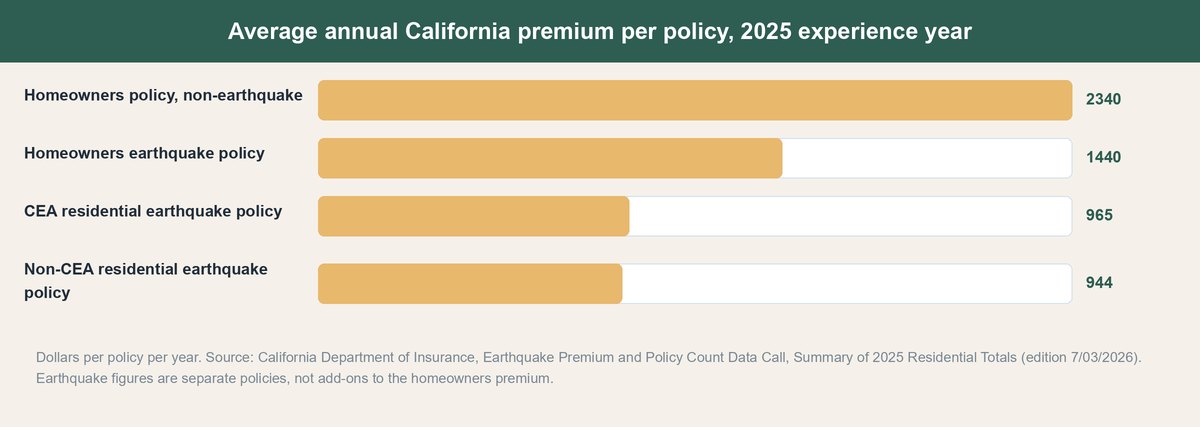
The cleanest answer to the earthquake insurance California cost question comes from the state itself, not from a quote form. Every licensed insurer in California reports its earthquake premium and policy counts to the Department of Insurance each year. The 2025 experience year summary, published July 2026, is the closest thing to a market-wide price list that exists.
For the homeowners market specifically, insurers wrote $1,327,914,241 of earthquake premium across 922,090 policies. That works out to $1,440.11 per policy per year, on an average insured exposure of about $890,000 per home. The implied rate is $1.62 per $1,000 of coverage.
Two structural facts sit behind that average. First, roughly 61% of California’s residential earthquake policies come through the California Earthquake Authority, a publicly managed, privately funded pool that your existing insurer sells on behalf of. CEA reports about $19 billion in claim-paying ability and around $900 million in annual premium. Second, the private, non-CEA market charges a visibly higher rate per $1,000 of coverage: $1.98 versus CEA’s $1.57 across all residential lines. Non-CEA carriers often justify the spread with lower deductible options and broader contents coverage, which is a real trade and worth pricing both ways.
What moves your own number away from the average: distance to a mapped fault, soil type, year built, foundation type, number of stories, your dwelling limit, and the deductible you pick. A 1920s two-story house on a raised foundation in Oakland will not price like a 2005 slab-on-grade house in Livermore, even at the same coverage amount.
That statewide blend also hides real city-to-city spread, and CDI does not publish rates city-by-city. Bay Area cities vary by fault proximity and soil, so run your own address through CEA’s calculator rather than assuming the statewide number applies where you live.
How the Deductible Turns a Modest Premium Into a Six-Figure Number
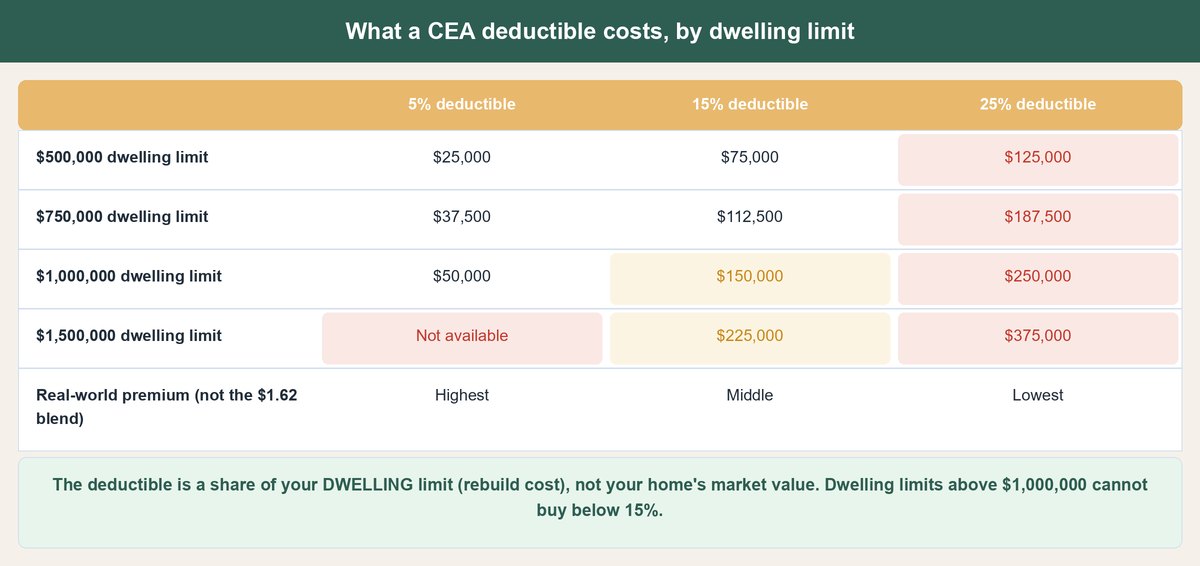
The percentage itself isn’t hidden — every carrier page states it, and most show a dollar example. What’s missing is the next step: weighing that figure against your annual premium. Coverage A, your dwelling limit, is the estimated rebuild cost — not your Zillow estimate, not what you paid.
That distinction cuts in the buyer’s favor in the Bay Area, where land carries an enormous share of the price. The June 2026 median single-family sale price was $2,128,000 in San Francisco and $2,310,000 in San Mateo County (California Association of Realtors). Nobody is insuring a $2.3 million dwelling limit on a 1,700-square-foot Peninsula ranch house, because you are not rebuilding the dirt. The deductible math runs off the rebuild figure, which is usually a fraction of the sale price.
It still lands hard. Modeled at the statewide average rate of $1.62 per $1,000, here is what the trade looks like:
| Dwelling limit (Coverage A) | Modeled annual premium | Per month | 5% deductible | 15% deductible | 25% deductible |
|---|---|---|---|---|---|
| $500,000 | ~$810 | ~$68 | $25,000 | $75,000 | $125,000 |
| $750,000 | ~$1,215 | ~$101 | $37,500 | $112,500 | $187,500 |
| $1,000,000 | ~$1,620 | ~$135 | $50,000 | $150,000 | $250,000 |
| $1,500,000 | ~$2,430 | ~$203 | Not available | $225,000 | $375,000 |
Treat those premiums as a floor, not a quote. The $1.62 rate is a statewide blend across every risk zone and every deductible tier, and Bay Area addresses near the Hayward, San Andreas or Calaveras faults price above it. CEA’s own premium calculator is the only way to get your actual number.
You’ll also see $3.54 per $1,000 cited elsewhere as the going California rate, drawn from carrier-quote surveys rather than the state’s own data call. The two figures answer different questions: $3.54 is what carriers quote a new applicant today; $1.62 is written premium divided by exposure across every CDI-reported policy in force, pulled down by the CEA’s roughly 61% share of the book and by owners who chose higher deductibles for lower rates. Use a $3.54-style number to sanity-check a live quote; use the CDI book-wide rate to read the market as a whole.
The ratio is what matters. At a $900,000 dwelling limit and a 15% deductible, you are paying roughly $1,460 a year to expose yourself to $135,000 of first-dollar loss. That is about 92 years of premium sitting inside the deductible. Anyone framing this as “cheap peace of mind” has not run that division.
Three details soften it, and they are real. Loss of Use coverage on a CEA policy never carries a deductible, so temporary housing money arrives without you clearing the six-figure threshold first. Every CEA homeowners policy includes $10,000 of building code upgrade coverage. And the first $1,500 of emergency repairs is paid with no deductible applied.
Why Your Standard Homeowners Policy Pays Nothing After a Quake
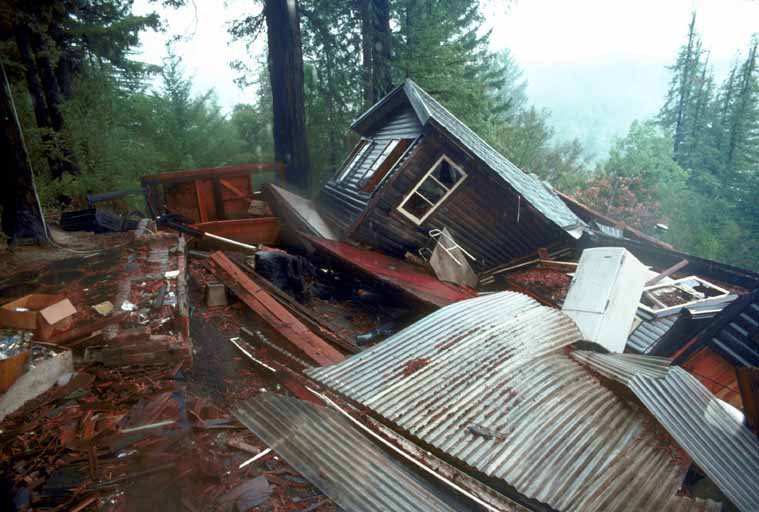
This is not a coverage gap you can argue your way out of after the fact. The Department of Insurance states it plainly: homeowners, renters and condominium policies do not cover damage from earthquakes (California Department of Insurance). Earthquake is a separately underwritten peril on a separate policy, which is why it never appears in the premium drivers behind a rising homeowners bill. If you are trying to understand why the base policy itself keeps climbing, that is a different set of causes driven by wildfire, reinsurance and rebuild costs.
One carve-out exists and it matters. California law requires that homeowners and renters policies cover fire damage caused by or following an earthquake. Post-quake fire is a large share of expected Bay Area losses, so your standard policy is not silent on the peril, only on the shaking.
California also forces the conversation on you. Insurance Code section 10081 bars an insurer from issuing or renewing a residential property policy unless the named insured is offered earthquake coverage. The Department of Insurance describes the practical mechanics: the offer must come at least every other year, in writing, stating limits, deductible and premium, and you have 30 days to accept. If you have owned a California home for a decade and believe you were never offered earthquake coverage, you almost certainly were and declined it by silence.
One timing detail catches procrastinators specifically. After a damaging quake hits an area, insurers typically stop selling new earthquake coverage there for 30 to 60 days, per National Association of Insurance Commissioners guidance. Buying before the ground moves is the only way to be sure you can buy at all in the weeks after it does.
The Three Levers That Actually Move Your Premium
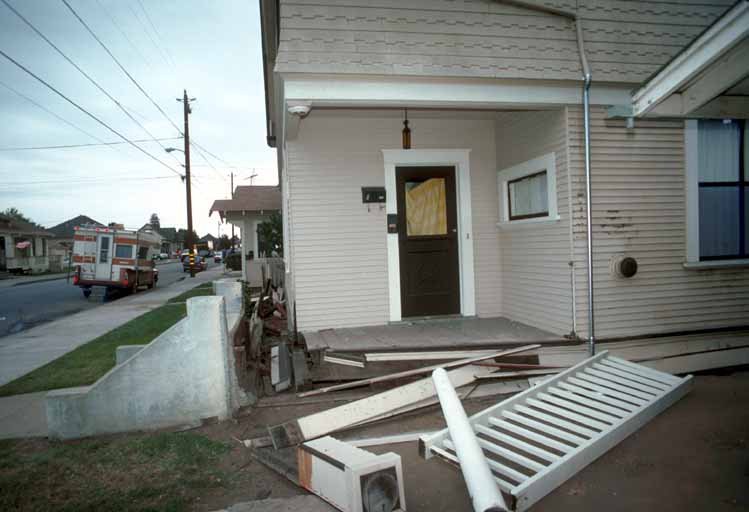
Once you accept that the deductible drives the value question, shopping this policy becomes a three-variable exercise rather than a hunt for the cheapest quote.
Choosing the Deductible Percentage That Matches Your Cash Reserves
What it does: moving from 25% down to 10% roughly doubles what you can claim on a bad day, and raises your premium accordingly. The real test: could you write a check for the deductible in the 90 days after a major quake, when contractors are scarce, prices spike and your equity is unsellable? The catch: if your dwelling limit exceeds $1,000,000, or your home sits on a pre-1980 raised foundation without verified retrofit, CEA restricts you to 15%, 20% or 25% regardless of preference. Buyers who assume they can simply purchase down to 5% are frequently wrong. CEA’s own floor is 5%; a few private carriers write lower, including GeoVera’s options down to 2.5%, at a materially higher premium worth pricing if even a 5% deductible is the dealbreaker.
Sizing Personal Property and Loss of Use Coverage Deliberately
What it does: CEA sells these as adjustable limits rather than a fixed package. On the Standard policy, personal property is bundled into the dwelling deductible — nothing pays toward contents until the dwelling loss itself clears that threshold. The Choice policy lets you set a separate 5%–25% personal property deductible instead, at added cost. Best for: households whose real exposure after a quake is 12 months of Bay Area rent, not a total structural rebuild. The catch: these are the coverages most often left at the minimum to hit a target premium, and they are the ones most likely to actually pay, because displacement is far more common than collapse.
Retrofitting the House to Earn the Hazard Reduction Discount
What it does: bolting the frame to the foundation and bracing the cripple walls is the single intervention with the best return here, because it lowers both your premium and the odds of the loss. CEA discounts run up to 25% for qualifying pre-1980 wood-framed homes on raised foundations, with tiered amounts by construction year and foundation type. The numbers: a brace-and-bolt retrofit typically costs $3,000 to $7,000, and the Earthquake Brace + Bolt program offers grants up to $3,000, plus an additional $7,000 for households earning $94,480 or less (California Residential Mitigation Program). The catch: eligibility is narrow. Slab-on-grade homes and post-1980 construction are outside the program, and the discount requires a documented, code-compliant retrofit with the water heater properly strapped.
What Bay Area Fault Odds Really Say About Whether the Policy Pencils
The USGS forecast is genuinely alarming and routinely misused. The 2014 Working Group put the probability of at least one magnitude 6.7 or greater quake somewhere in the San Francisco Bay region before 2043 at 72%, with 51% odds of a magnitude 7.0 or greater and 20% for magnitude 7.5 or greater (USGS Fact Sheet 2016-3020). The Hayward and Rodgers Creek system carries the highest single-fault probability at 33%, followed by the Calaveras at 26% and the San Andreas at 22%.
Here is the honest reading. That 72% is the chance of a damaging quake occurring in the region, not the chance that your specific house sustains damage exceeding 15% of its rebuild cost. Those are wildly different numbers. Shaking intensity falls off with distance and varies enormously with soil, and a bolted, plywood-braced wood-frame house 20 miles from the rupture is a very different claim than an unretrofitted 1925 bungalow sitting on bay mud two miles from it. A policy that only pays above a $135,000 threshold is not triggered by cracked drywall and a toppled chimney.
When it does not pencil: a post-1980 slab-on-grade house, well away from a mapped fault, owned by a household with real liquidity and meaningful equity elsewhere. At a 25% deductible the policy is close to a bet that your home is destroyed outright, and the same $1,500 a year invested in reserves compounds into the deductible in about a decade while remaining yours.
When it clearly does: the pre-1980 raised-foundation house near a major fault, where the mortgage is large relative to net worth. This is the case buyers underweight. Your loan does not vanish with the structure. If the house becomes uninhabitable and you owe $900,000 on it, you are paying that note while renting somewhere else, and the deductible stops being the scary number. Retrofit first, then insure, then set the deductible at what you could genuinely fund in a bad quarter.
This is educational content, not financial, legal or insurance advice. Coverage terms and rates vary by property and change over time. Talk to a licensed California insurance agent and read the actual policy before you buy or decline.
Frequently Asked Questions
How much does earthquake insurance cost per month in California?
The 2025 statewide average for homeowners was $1,440.11 a year, about $120 a month. Modeled at the average rate of $1.62 per $1,000 of dwelling coverage, a $500,000 limit runs roughly $68 a month and a $1,000,000 limit roughly $135.
Is earthquake insurance worth it in California?
It depends almost entirely on your deductible relative to your cash reserves and how much mortgage debt would survive the house. It is strongest for older raised-foundation homes near a fault with large loan balances, and weakest for newer slab homes owned by liquid households.
What is the deductible on California earthquake insurance?
CEA offers 5%, 10%, 15%, 20% and 25% deductibles calculated on your dwelling limit. Homes with dwelling limits over $1,000,000, and pre-1980 raised-foundation homes without verified retrofit, are limited to 15% or higher.
Does homeowners insurance cover earthquake damage in California?
No. Standard homeowners, renters and condominium policies exclude earthquake damage. California law does require them to cover fire that is caused by or follows an earthquake.
How many Californians actually have earthquake insurance?
Only 15.24% of homeowners policies carried earthquake coverage in 2025, and 12.48% across all residential policy types. About 61% of those policies are written through the California Earthquake Authority.
Can I lower my earthquake insurance premium?
Yes, mainly through a higher deductible, leaner personal property limits, or a qualifying seismic retrofit. The retrofit discount reaches 25% for eligible pre-1980 wood-framed homes on raised foundations and reduces the actual risk, not just the price.
The Bottom Line
Price this policy on the deductible, not the premium. Pull your real dwelling limit off your homeowners declarations page, multiply it by 5%, 15% and 25%, and ask which of those three numbers you could actually fund in the months after a major Bay Area quake. If none of them, retrofit first and revisit. If the answer is clear, run your address through CEA’s premium calculator rather than trusting any statewide average, including the ones above. The decision is genuinely close for a lot of Bay Area owners, and anyone telling you otherwise is selling something.