







Here is the short answer on when to refinance your mortgage: do it when the new loan pays back its closing costs before you sell the house or pay off the loan — and not before. That one test settles almost every case. It matters more than ever this year, because 2026 is not a falling-rate year. The average 30-year rate dipped to 5.98 percent in late February. Since then it has climbed almost a full point — 6.95 percent as of September 17, per Freddie Mac’s weekly survey. Most homeowners should sit tight. But a handful of refinances still pay off even while rates climb. This guide shows you the math that separates them, with real numbers you can check.
Key Takeaways
- The 30-year average sat at 6.95 percent on September 17, 2026 — up from a February low of 5.98 percent. Rates have been rising, not falling, for most of the year.
- Break-even is the whole decision. Divide total closing costs by monthly savings. Freddie Mac puts refinance closing costs at 3 to 6 percent of the loan amount, so a $400,000 refi can cost $12,000 or more.
- Refinancing $400,000 from the 2023 peak rate of 7.79 percent down to 6.95 percent saves about $229 a month — and still takes roughly 52 months to break even at low-end costs.
- FHA borrowers who put down less than 10 percent pay mortgage insurance for the life of the loan under HUD’s rules. Refinancing into a conventional loan at 20 percent equity is the only exit.
- If you hold a pandemic-era rate near 3 percent, a refi to 6.95 percent would raise the payment on a $350,000 loan by about $841 a month. Keep that loan.
- Waiting for rate cuts is a coin flip, not a plan. After the Fed cut in September 2024, mortgage rates rose from 6.08 to 7.04 percent in four months.
The Break-Even Math That Decides Every Refinance
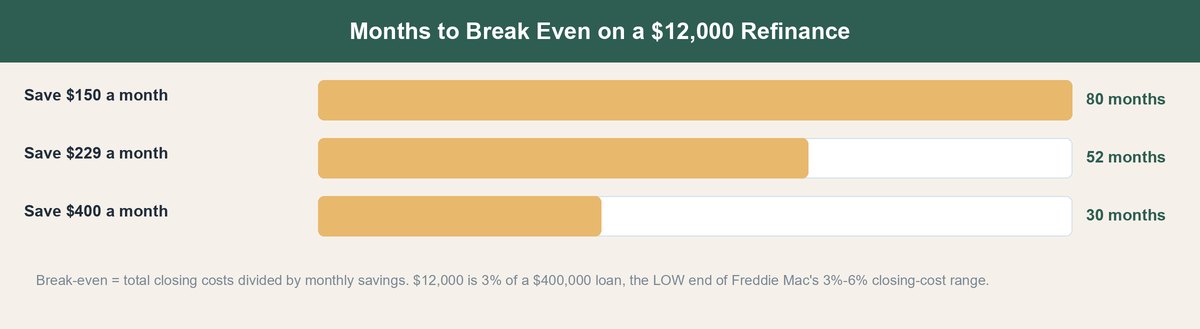
Every refinance is the same trade. You pay real money up front — lender fees, an appraisal, title work, escrow charges — to buy a lower monthly payment. The break-even point is the month your saved payments finally cover what you spent. Before that month, the refi has cost you money. After it, the refi earns.
The formula is one line. Take your total closing costs and divide by your monthly savings. Freddie Mac’s own guidance says to expect closing costs of 3 to 6 percent of the loan principal. On a $400,000 loan, that is $12,000 to $24,000. Save $229 a month against $12,000 in costs and you break even in 52 months — nearly four and a half years. Save $400 a month and it drops to 30 months.
Now add the second question almost everyone skips. How long will you actually keep this loan? The average owner moves, refinances again, or pays off early. If your break-even lands past five years and you might sell in three, the refi is a guaranteed loss dressed up as savings. That is why the honest rule for when to refinance a mortgage has nothing to do with predicting rates. It is a payback question, the same one you would ask before buying a rental or a new roof.
One more cost hides off the settlement sheet. A refinance restarts your amortization. In the early years of any mortgage, most of each payment is interest. Reset a loan you have paid for six years and you hand back the progress you made toward owning the house. The break-even math above ignores this, which means real break-even is usually a little worse than the simple division says.
Where Mortgage Rates Actually Stand This Fall
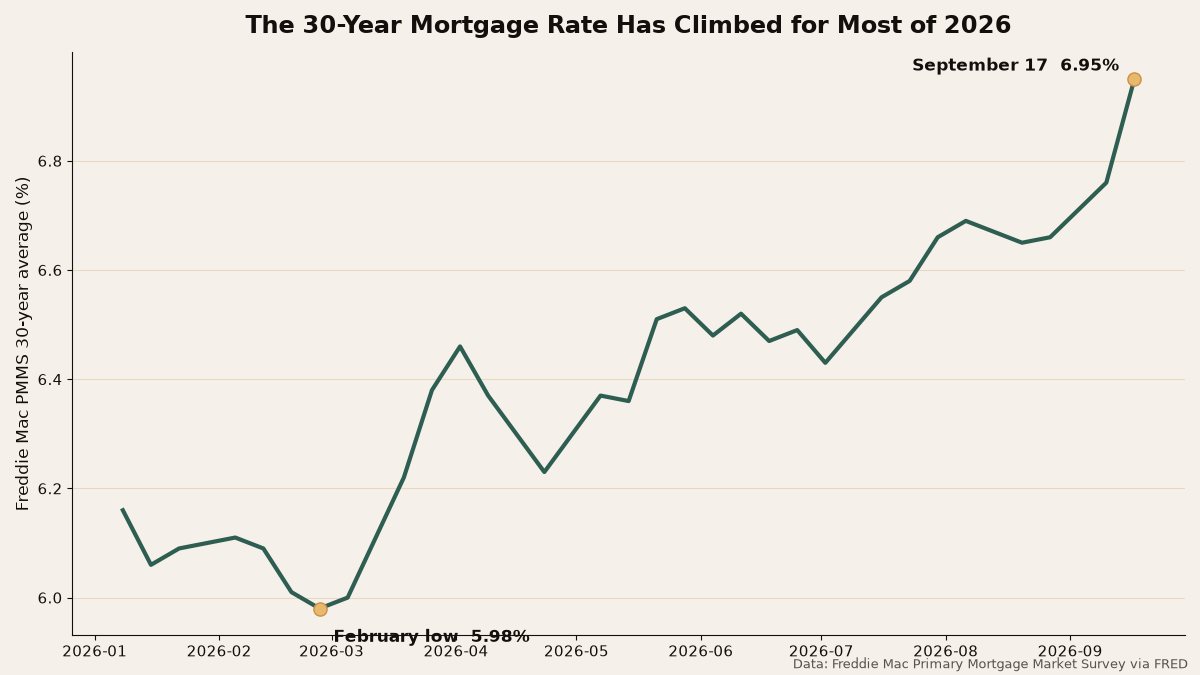
You will still see headlines pitching 2026 as a refinance window. The data says otherwise. Freddie Mac’s survey opened the year around 6.16 percent, touched 5.98 percent on February 26, and has climbed since spring. By September 17 it hit 6.95 percent — the highest reading of the year. Anyone who tells you rates are falling is describing February, not today.
That climb changes who a refi can help. In a falling-rate year, almost anyone with a recent loan wins by refinancing. In a rising-rate year, only borrowers whose current rate sits above today’s market can win on rate alone. That group is real but small: mostly people who bought or did a cash-out between mid-2023 and mid-2024, when the survey peaked at 7.79 percent in October 2023.
Everyone else is on the other side of the ledger. During 2020 and 2021, the 30-year average spent 86 of 105 weeks below 3.25 percent and bottomed at 2.65 percent in January 2021. Those loans are the cheapest mortgage money in modern American history. No 2026 refinance touches them. Every dollar of equity pulled out through a cash-out refi would reprice at more than double the old rate. The rest of this guide sorts the real opportunities from the traps.
Five Refinances That Still Pay Off While Rates Climb
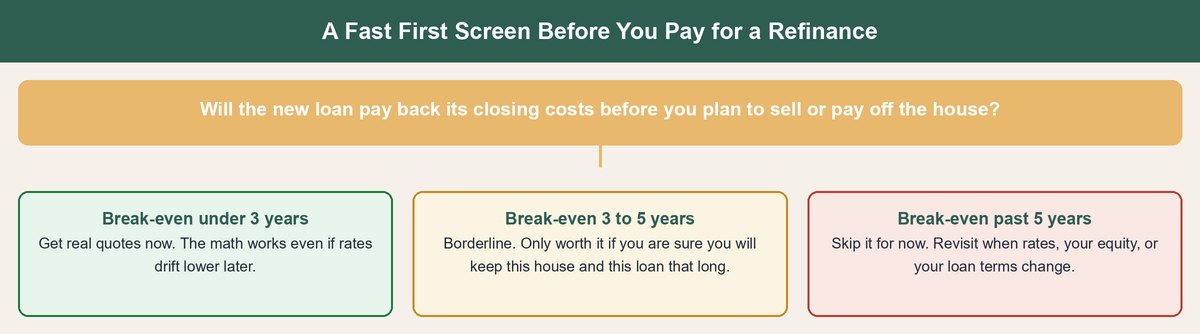
A rising-rate year does not close the refinance window. It narrows it to cases where the win comes from something other than a falling market rate — escaping a fee, escaping a reset, or restructuring debt. Here are the five that still clear the break-even test in 2026, with the numbers that make each one work.
Dropping FHA Mortgage Insurance Once You Reach 20 Percent Equity
What it is: FHA loans carry a mortgage insurance premium, or MIP — a fee of 0.55 percent of the loan balance per year for most buyers, on top of a 1.75 percent charge paid up front. Under HUD’s premium schedule, a borrower who put down less than 10 percent pays that fee for the life of the loan. It never falls off. On a $340,000 balance, MIP runs about $156 a month, every month, forever.
Why it works now: Refinancing into a conventional loan with 20 percent equity deletes the fee entirely, and rising home values have pushed many 2022–2023 FHA buyers past that equity line. The case is strongest when your FHA rate is also at or above today’s market. Take a late-2023 FHA loan at 7.25 percent on $340,000: principal, interest, and MIP total about $2,475 a month. A conventional refi at 6.95 percent costs about $2,251. That is $224 a month saved, and a lean $7,000 in closing costs — below Freddie Mac’s typical 3 to 6 percent range, common when lender credits offset fees — pays back in roughly 31 months.
Watch out: If your FHA rate is well below today’s 6.95 percent, run the numbers before you celebrate. Trading a 5.5 percent FHA loan for a 6.95 percent conventional one can eat the entire MIP saving.
Escaping an Adjustable Rate Before the Next Reset Hits
What it is: Hundreds of thousands of buyers took adjustable-rate mortgages in 2020 and 2021 at intro rates near 2.5 to 3 percent. Those fixed periods are expiring now, and the loans reset against today’s much higher index rates. Typical caps let the rate jump as much as 2 points at the first reset, then 1 to 2 points a year after that, up to 5 or 6 points over the start rate.
The math: A $400,000 ARM at 2.75 percent costs about $1,633 a month in principal and interest. After a first reset to 4.75 percent, the payment climbs toward $2,087. If the caps carry it to 6.75 percent, you are near $2,594 — over $960 a month above where you started, with more resets possible. A fixed refi at 6.95 percent costs about the same as the capped-out ARM but removes the uncertainty. Here the refi is not chasing savings. It is buying certainty on a payment that was going up anyway.
Before you sign: Pull your ARM’s actual caps, margin, and index from the loan note. Some ARMs will land lower than the worst case, and a loan officer can price both paths in an afternoon.
Consolidating Expensive Renovation Debt Without Repricing Everything
What it is: Owners who financed a remodel on credit cards or a personal loan often carry balances at rates far above any mortgage. Rolling that debt into housing debt can slash the interest — if you pick the right tool.
The right tool: This is where cash-out refinancing and a home equity line of credit split. A cash-out refi replaces your entire first mortgage at today’s rate. If your current mortgage is at 3 percent, that means repricing hundreds of thousands of cheap dollars to reach a few expensive ones — a terrible trade in 2026. A HELOC or home equity loan leaves the first mortgage untouched and prices only the new borrowing. The full comparison lives in our guide to the cash-out refinance versus HELOC decision, but the rule of thumb is simple: cash-out only makes sense when your existing rate is already at or above today’s market.
Best for: Owners with 2023–2024 mortgages near 7 percent or higher who also carry renovation debt. For them, one cash-out refi can lower the house rate and retire the card balances in a single closing.
Removing PMI When Your Servicer Will Not Cooperate
What it is: Private mortgage insurance on conventional loans is not a life sentence. Under the federal Homeowners Protection Act, summarized by the CFPB, you can request cancellation once your balance falls to 80 percent of the home’s original value. At 78 percent, the servicer must drop it on its own. PMI typically runs $75 to $375 a month on a $300,000 loan, depending on your credit and down payment.
Why a refi is the backup plan, not the first move: Asking your servicer costs nothing. Do that first — our walkthrough on getting PMI removed from your mortgage covers the exact steps. The refinance case appears when your equity came from a hot market rather than from paydown. Cancellation rights key off the original value. So an owner who bought with 5 percent down two years ago may hold 25 percent equity at today’s prices, yet still sit years from the 80 percent line on paper. A refi forces a fresh appraisal and resets the equity story — worth it only if the PMI saved outruns the closing costs before you would have hit 78 percent anyway.
Shortening the Term While Your Income Can Carry It
What it is: Swapping a 30-year loan for a 15-year one. The 15-year rate almost always runs cheaper — 6.26 percent versus 6.95 percent in the September 17 survey, a 0.69-point discount.
The math: On $300,000, a 30-year loan at 6.6 percent costs about $1,916 a month and roughly $390,000 in lifetime interest. A 15-year loan at 6.26 percent costs about $2,574 a month — $658 more — but total interest falls to about $163,000. That is over $226,000 of interest that never gets paid, in exchange for a higher payment for half as long.
Real talk: This only fits households with stable income and a real cushion, because the higher payment is mandatory every single month. If your goal is just a smaller payment rather than a shorter loan, a mortgage recast — a lump-sum paydown with the same loan — costs a few hundred dollars instead of thousands.
The Refinances That Quietly Lose Money This Year
The refinance industry earns fees at closing whether you win or not, so the pitch never stops. These three patterns look reasonable on a postcard and fail the math almost every time in 2026.
Chasing a Rate You Already Beat Years Ago
If you locked a rate below 5 percent — and most owners who bought or refinanced in 2020–2021 locked far below it — there is nothing to chase. Moving a $350,000 balance from 3 percent to today’s 6.95 percent would raise the payment from about $1,476 to about $2,317. That is $841 a month, more than $10,000 a year, for the same house. No closing-cost discount fixes that. The only reasons to touch a sub-5 loan are life events: divorce, removing a co-borrower, or a genuine cash emergency where every cheaper option is gone.
Restarting the 30-Year Clock for Pocket Change
A refi that saves $60 a month against $9,000 in costs needs 150 months — twelve and a half years — to break even. Almost nobody keeps a loan that long. And because the new loan restarts amortization, your early payments go back to being mostly interest. Small-savings refis are how a homeowner pays for a lender’s marketing budget. If the monthly saving is under about $150 on a typical loan, the answer is usually no.
Serial Refinancing That Stacks Fees Faster Than Savings
Each refinance bills its own closing costs, and each one resets the clock. An owner who refinances every time rates twitch can spend $30,000 in fees over a decade while barely denting principal. Before any second refi, add every closing cost you have already paid on the property to the new one, and demand that the combined total still breaks even. If you refinanced within the last two years, the bar should be very high.
Why Waiting for a Rate Cut Is Not a Plan
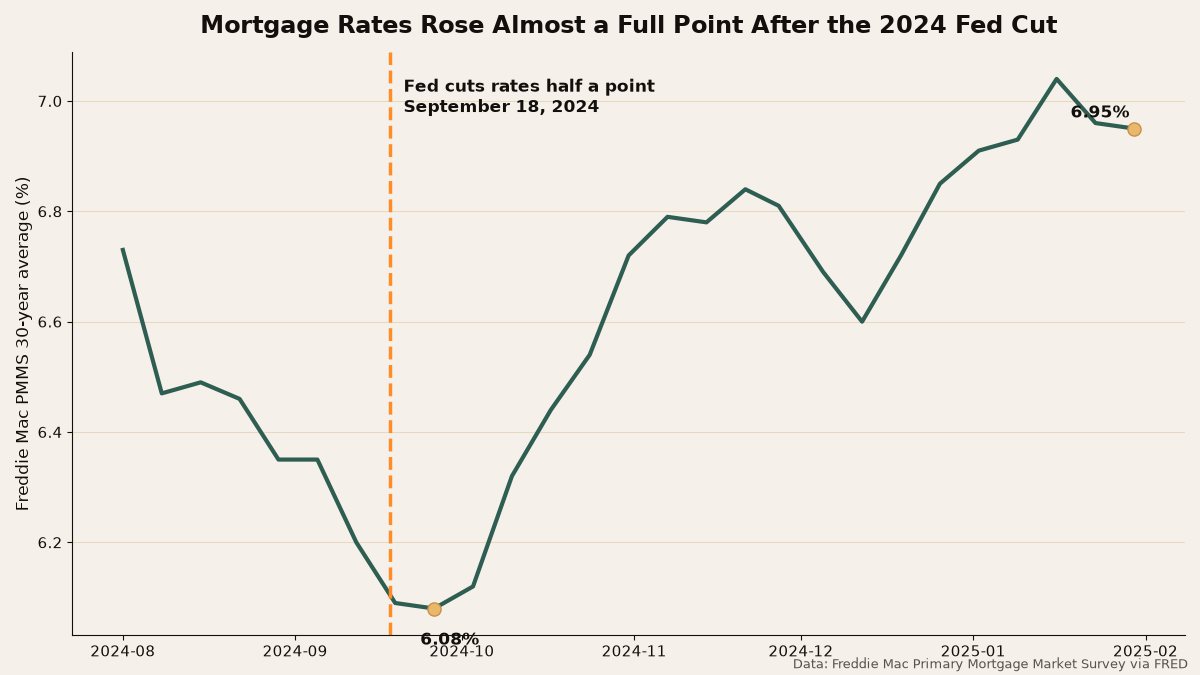
The most common 2026 refinance mistake is not a bad refi. It is a good refi postponed for a prediction. The logic sounds safe: the Fed will cut eventually, so wait and refinance at the bottom. The recent record says otherwise. On September 18, 2024, the Fed cut its policy rate by half a point. Mortgage rates did not follow it down. They went the other way — from 6.08 percent that month to 7.04 percent by mid-January 2025. Thirty-year rates track long-term bond yields and inflation expectations, not the Fed’s overnight rate, and the cut was already priced in before it happened.
This year repeated the lesson in miniature. February’s 5.98 percent was the moment, and everyone waiting for something better watched the survey climb for six straight months instead. Nobody rings a bell at the bottom.
The operator’s answer is to let arithmetic replace forecasting. If a refinance breaks even comfortably inside your holding period at today’s rate, take it. A borrower who saves $229 a month but waits a year for a better rate that never comes has burned $2,748 for nothing. And if rates do fall hard later, you can refinance again; the first refi does not lock the door. What you cannot do is collect savings retroactively from the months you spent waiting.
How to Run Your Own Numbers in Ten Minutes

You do not need a spreadsheet or a loan officer to get a first answer on when to refinance a mortgage. You need four numbers: your current balance, your current rate, a quoted new rate, and an itemized estimate of closing costs. Pull the first two from your latest mortgage statement. Get the quote and the cost estimate from two or three lenders. The Loan Estimate form they must give you lists every fee, including the title insurance premium — often the single biggest line after lender charges. Then divide costs by monthly savings and compare the answer to how long you honestly expect to keep the loan.
Here is the test applied to the three situations that define 2026:
| Scenario | Old monthly cost | New monthly cost | Change | Closing costs | Break-even | Verdict |
|---|---|---|---|---|---|---|
| Bought at the 2023 peak, $400,000 at 7.79%, refi to 6.95% | $2,877 | $2,648 | −$229 | $12,000 (3%) | 52 months | Borderline — works only if you will hold 5+ years, or can cut costs |
| Late-2023 FHA loan, $340,000 at 7.25% plus $156 MIP, refi to conventional 6.95% | $2,475 | $2,251 | −$224 | $7,000 (with lender credits) | 31 months | Strong yes at 20% equity — the MIP never drops off on its own |
| Pandemic loan, $350,000 at 3.00%, refi to 6.95% | $1,476 | $2,317 | +$841 | any | never | Keep the loan |
All payments are principal and interest on a 30-year term, rounded to the dollar; taxes and insurance ride on top of every option equally. Your numbers will differ — that is the point of running them.
Frequently Asked Questions
Is it worth refinancing to save $100 a month?
Only if the costs are small. $100 a month against $6,000 in closing costs takes 60 months to break even. Against $3,000 it takes 30. Get the itemized cost sheet before you decide, not after.
How much does it cost to refinance a mortgage?
Freddie Mac’s guidance says 3 to 6 percent of the loan amount. On a $300,000 loan that is $9,000 to $18,000, covering lender fees, appraisal, title insurance, and escrow charges. Lender credits can lower the cash due at closing, but they usually buy a higher rate in exchange.
Does refinancing hurt your credit score?
A little, briefly. The hard inquiry and the new account can trim a few points for a few months. Multiple mortgage inquiries inside a short shopping window are counted as one by the major scoring models, so compare several lenders without extra penalty.
Can refinancing get rid of FHA mortgage insurance?
Yes, and for most FHA borrowers it is the only way. If you put down less than 10 percent, HUD’s rules keep the annual premium in place for the life of the loan. Refinancing into a conventional loan with 20 percent equity removes it completely.
Should I wait for the Fed to cut rates before refinancing?
Waiting is a bet, not a strategy. After the Fed’s half-point cut in September 2024, the 30-year mortgage average rose almost a full point in four months. If the math works today, act today — you can always refinance again if rates truly fall.
How soon after buying a house can you refinance?
Rate-and-term refinances often have no required waiting period, though paying closing costs twice in one year rarely makes sense. Cash-out refinances usually require six to twelve months of ownership, depending on the loan program and lender.
The Bottom Line for This Rate Season
In a rising-rate year, when to refinance your mortgage stops being a rate question and becomes a payback question. Refinance to escape a permanent FHA premium, an ARM reset, or genuinely expensive debt — cases where the win does not depend on the market cooperating. Skip it when the pitch asks you to give up a rate you will never see again. And never postpone working math for a forecast — the 2024 episode showed how forecasts miss. Run the four-number test above before any lender runs it for you, and you will be ahead of most of the market.
This article is educational, not financial advice. Rates, fees, and program rules change and vary by borrower — confirm current terms with a licensed loan officer or financial adviser before you commit. When you are ready to go deeper on any piece of the decision, the guides linked throughout are the next stop.
Featured photo by Mikhail Nilov via Pexels.