







On a $1.5 million Bay Area home, the owner’s title policy runs about $3,287 on one major underwriter’s filed California rate schedule. At San Mateo County’s $2.31 million median, about $4,163. That is a one-time charge, and the title insurance cost works out to roughly 0.18% to 0.32% of the purchase price across the nine Bay Area counties, not the 0.5% to 1% that national articles keep quoting. The bigger money question is not the rate at all. California rates are filed with the state and apply everywhere, so the premium does not change when you cross a county line. What changes is who customarily pays it, and in the Bay Area that flips at exactly one border.
Key Takeaways
- The title insurance cost for an owner’s policy is roughly $2,627 on a $1M purchase and $3,947 on a $2M purchase, per Stewart Title’s California filed schedule effective July 7, 2025.
- California premiums are filed statewide per underwriter, so a Palo Alto policy and an Oakland policy price off the same schedule. The county does not move the rate.
- Eight of the nine Bay Area counties put the owner’s policy on the buyer by custom. Santa Clara puts it on the seller, along with the escrow fee.
- The schedule is regressive. Between $1M and $2M, each extra $500,000 of coverage adds $660. Above $2.5M it adds about $345, or 0.069%.
- Buying both policies together drops the loan policy to a concurrent rate, so the real added cost of insuring yourself is roughly $1,300 to $2,700, not the sticker premium.
- The owner’s policy is optional. The lender’s policy is not, and it protects the loan balance rather than your equity.
What the Filed California Rate Schedule Actually Charges at Bay Area Prices
Title insurance is one of the few closing line items where you can look up the real number instead of guessing. California requires every title insurer to file its schedule of rates with the Insurance Commissioner, a point the California Department of Insurance makes explicitly in its consumer guide. Those filings are public, and title companies publish consumer versions of them.
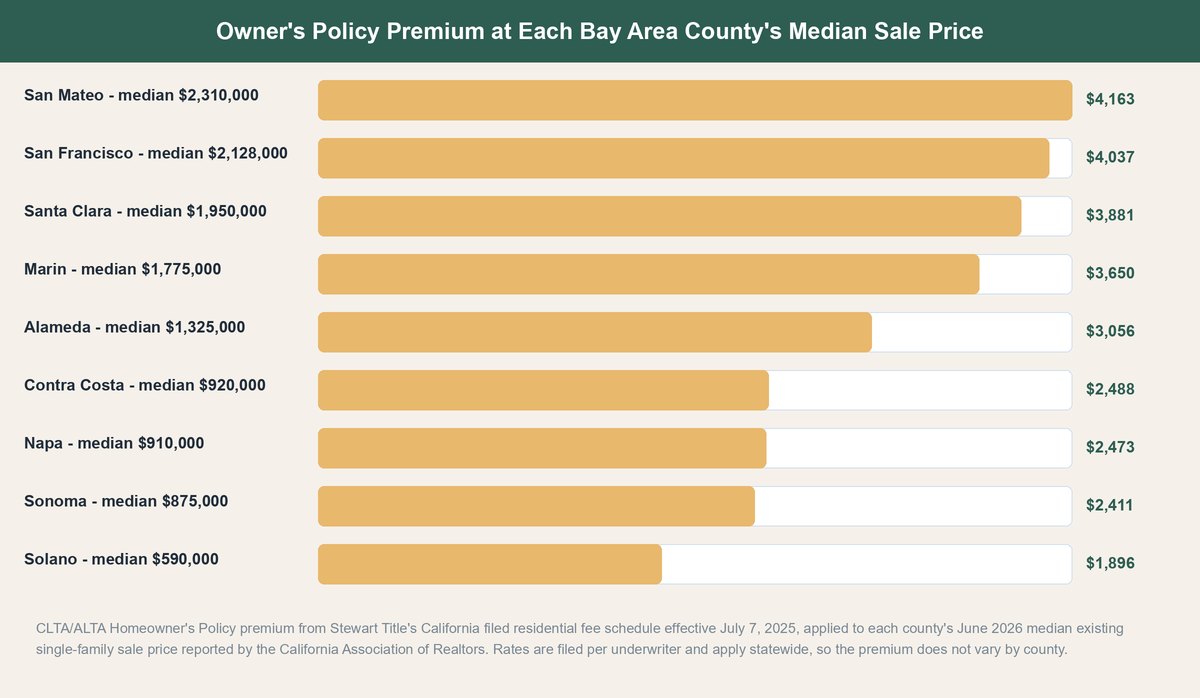
Working from Stewart Title’s California partial fee schedule, effective July 7, 2025, and pairing it with each county’s June 2026 median existing single-family sale price from the California Association of Realtors, here is what the owner’s policy actually costs at the middle of each Bay Area market.
| County | June 2026 median | Owner’s policy premium | Share of price | Customarily paid by |
|---|---|---|---|---|
| San Mateo | $2,310,000 | $4,163 | 0.180% | Buyer |
| San Francisco | $2,128,000 | $4,037 | 0.190% | Buyer |
| Santa Clara | $1,950,000 | $3,881 | 0.199% | Seller |
| Marin | $1,775,000 | $3,650 | 0.206% | Buyer |
| Alameda | $1,325,000 | $3,056 | 0.231% | Buyer |
| Contra Costa | $920,000 | $2,488 | 0.270% | Buyer |
| Napa | $910,000 | $2,473 | 0.272% | Buyer |
| Sonoma | $875,000 | $2,411 | 0.276% | Buyer |
| Solano | $590,000 | $1,896 | 0.321% | Buyer |
These are the CLTA/ALTA Homeowner’s Policy, the expanded-coverage form most one-to-four-unit residential buyers receive. Its price is defined in the filing as 110% of the standard residential rate, which is why the arithmetic checks cleanly: the $2,388 standard rate at $1M becomes $2,627 for the expanded form. Other underwriters file their own numbers, so treat these as the shape of the market rather than a quote.
Why the Familiar 0.5% Rule of Thumb Overstates a Bay Area Premium
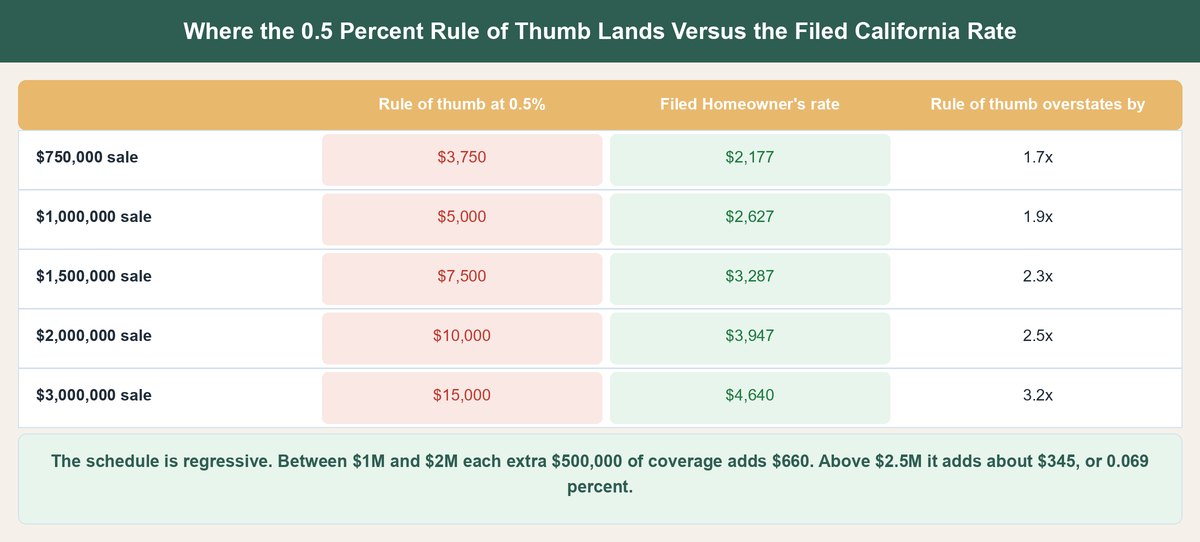
Every national explainer puts the title insurance cost at 0.5% to 1% of the purchase price. At Bay Area prices that guidance is not slightly off, it is off by a multiple, and it gets worse the more expensive the house.
The reason is structural. A title insurer is not pricing risk the way an auto carrier does. It is pricing a search-and-cure operation: pulling the chain of title, finding the unreleased deed of trust, clearing the old mechanics lien, then insuring against what the search missed. That work costs about the same on a $700,000 Vallejo bungalow as on a $3 million Atherton lot. So the filed schedule front-loads the fee and then flattens hard. The first $1M of coverage costs roughly $2,627. The second million adds $1,320. The third adds $693.
The practical consequence runs in the useful direction. Under-insuring to save money is close to pointless, because the marginal coverage is the cheapest coverage on the schedule. Insure the full purchase price and spend your negotiating energy on the lines that actually scale, which in the Bay Area means transfer taxes. Oakland’s tiered city transfer tax alone reaches 1.5% between $300,001 and $2 million, which on a $1.4 million sale is more than six times the entire owner’s policy premium.
Who Customarily Pays the Owner’s Policy in Each Bay Area County
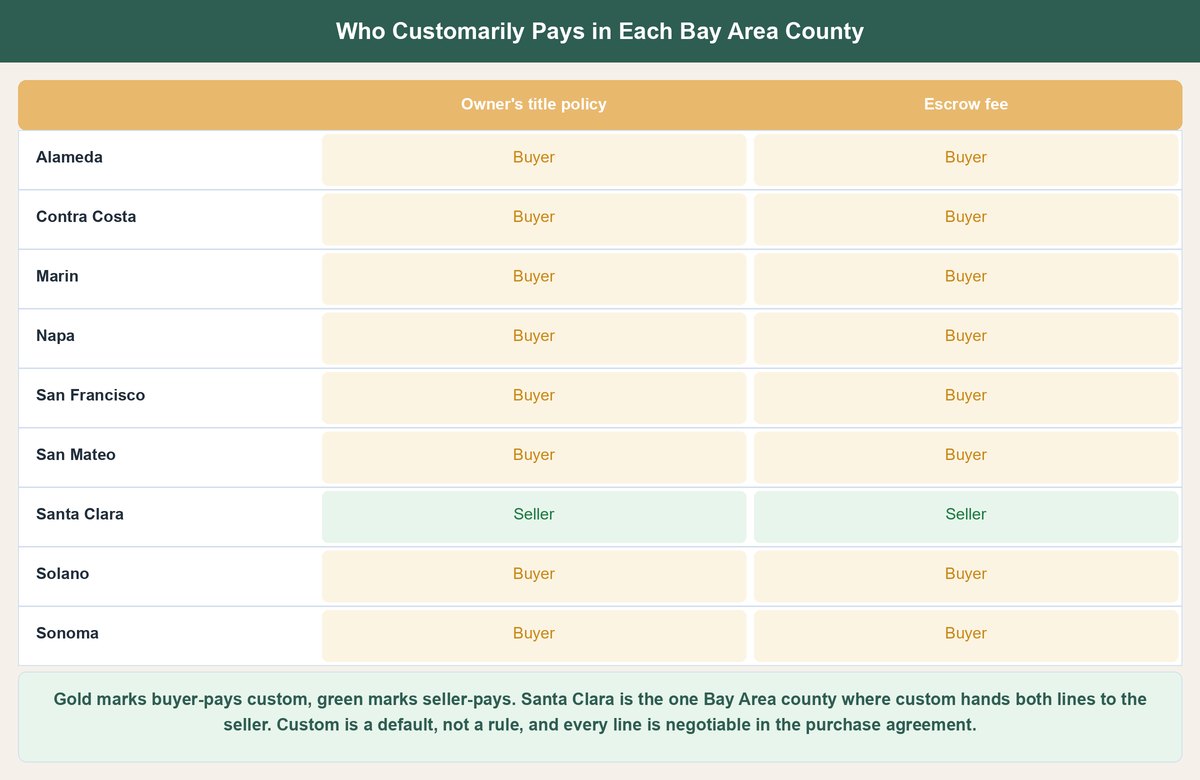
Here is the part almost nobody explains to Bay Area buyers before they are already in contract. There is no California rule about who pays for the owner’s policy. There is only county custom, it is genuinely inconsistent, and it reverses inside the Bay Area.
Fidelity National Title’s Who Pays What in California chart and First American’s California transfer tax and who-pays chart agree, independently, on the allocation. In Alameda, Contra Costa, Marin, Napa, San Francisco, San Mateo, Solano and Sonoma counties, the buyer customarily pays both the owner’s title policy and the escrow fee. In Santa Clara County, the seller customarily pays both.
That single reversal is worth real money and it is routinely missed. A buyer moving from a Fremont search to a Sunnyvale search is not just changing schools and commute, they are changing who absorbs roughly $3,900 of the closing statement. A seller listing in Santa Clara County who assumes the Alameda convention has mispriced their net by a similar amount.
Two wrinkles matter. Custom is not always uniform within a county: elsewhere in California, Yolo splits by city, with Davis on the buyer and the rest of the county on the seller, and Monterey splits between Salinas and the Peninsula. Nothing prevents that pattern in a Bay Area submarket. And these underwriter charts are revised periodically while custom itself drifts, particularly in soft markets where sellers start absorbing buyer-side costs to close. Ask escrow to confirm the current custom for your county and city before you set offer terms, and get it in writing on the estimated settlement statement.
Lender’s Policy Versus Owner’s Policy and What Each One Actually Covers
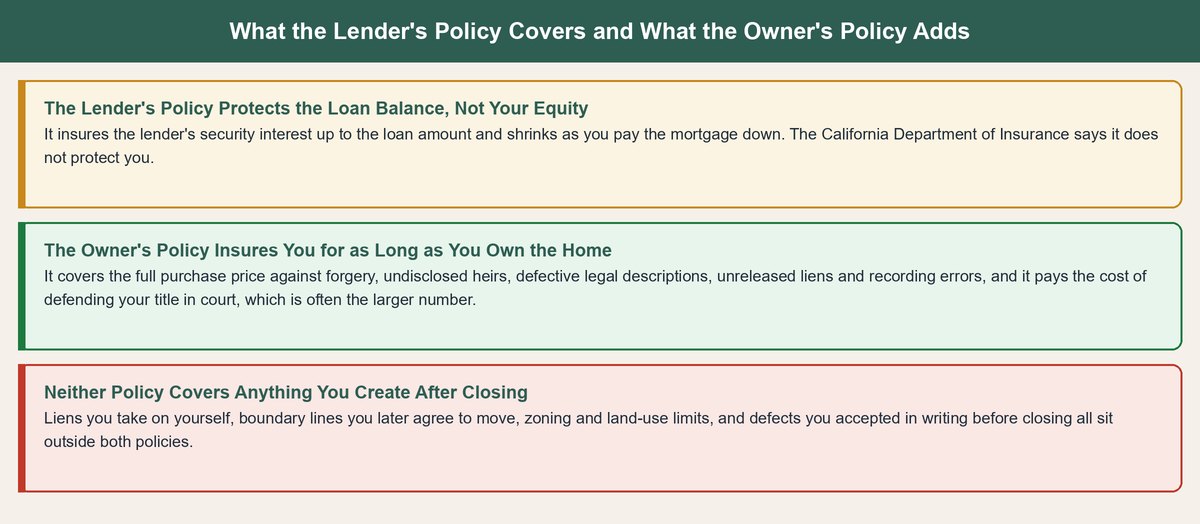
The confusion that costs people money is thinking the policy they already paid for protects them. It does not.
What the lender’s policy does. It insures the lender’s security interest up to the loan amount and amortizes down as you pay the balance. The California Department of Insurance puts it bluntly: the lender’s policy protects the lender’s interest and does not protect you. Almost every lender requires it, and the buyer pays for it in every Bay Area county.
What the owner’s policy adds. It insures you, for the full purchase price, for as long as you own the property. The covered defects are the ones a search can miss: a forged signature in the chain, an heir nobody knew about, a defective legal description, a lien that was paid but never released, a clerical error in the recorder’s office. Critically, it also funds the legal defense of your title, which in a contested Bay Area boundary or ownership dispute is frequently the larger exposure.
Why this is not a theoretical risk right now. Seller impersonation fraud, where someone poses as the owner of a free-and-clear property and sells it out from under the real owner, has moved from rare to routine. In a study by ALTA and ndp analytics drawing 783 responses from title companies, 28% reported at least one such attempt in 2023, and 16% of the firms that saw attempts paid claims. Vacant land and long-held, mortgage-free homes are the favored targets, which describes a great deal of inherited Bay Area property.
What the Owner’s Policy Really Adds Once the Concurrent Rate Is Counted
The sticker premium overstates what the coverage costs you, and this is the single most useful piece of arithmetic in the whole subject.
Rate schedules charge a reduced concurrent loan rate when the lender’s policy is issued alongside an owner’s policy. Skip the owner’s policy and the loan policy reverts to the full rate. So the honest comparison is not “premium versus zero,” it is the difference between two bundles.
Take a $1 million purchase with an $800,000 loan on the Stewart schedule. Lender’s policy alone at the full rate is $2,068. Owner’s policy plus the concurrent lender’s policy is $2,627 plus $1,340, or $3,967. The added title insurance cost of insuring yourself is therefore about $1,899, not $2,627. Run the same math at the Alameda County median and the delta is roughly $2,139; at San Mateo’s, roughly $2,694; at Solano’s, roughly $1,339. The Consumer Financial Protection Bureau makes the point in plainer language: buying both policies from one provider costs less than buying them separately.
Framed that way the decision looks different. You are spending between $1,300 and $2,700 once, to insure the largest asset you own against a category of failure you cannot inspect for and cannot fix yourself.
What Is Negotiable at a Bay Area Closing and What Is Not

Custom is a default, not a law. Everything below is a term of the purchase agreement.
Who pays the owner’s policy. Fully negotiable, and it moves with market leverage. In a market where buyers have choices, asking a seller in a buyer-pays county to cover the owner’s policy is a modest, cheap concession to request. In a multiple-offer situation it is the wrong thing to spend a concession on.
Which title company handles the deal. This is where the leverage actually sits. The Department of Insurance states the principle directly: the person who pays for the policy selects the title insurance company. If you are the buyer in Alameda County, that choice is yours, and the title insurance cost genuinely differs between underwriters because their loss and expense experience differs. The CFPB is explicit that shopping can save you money.
Escrow and sub-escrow fees, endorsements and courier charges. These sit outside the filed premium and vary more than the premium does. Ask for an itemized estimate, not a bundled “title and escrow” number.
The premium itself. Not negotiable. It is a filed rate, and a company that discounted it off-schedule would be violating its own filing. Do not spend goodwill trying.
The discounts that do exist are rule-based rather than negotiated: short-term or reissue credits when the property was insured recently, and builder or subdivision rates on new construction. You have to ask whether you qualify, because nobody volunteers it.
Edge Cases That Change the Title Insurance Cost Math
Refinancing. You do not rebuy the owner’s policy, which stays in force for as long as you own the home. You do buy a new lender’s policy, priced off a lower refinance schedule, roughly $1,911 on a $1 million refinance on the Stewart schedule. Ask about a short-term rate if the prior policy is recent.
All-cash purchases. No lender means no required policy at all, which is exactly when buyers skip coverage. It is also when the exposure is highest, because there is no lender-driven title review forcing anyone to look hard. Cash-heavy Bay Area submarkets are a live target for impersonation fraud for that reason.
New construction and subdivisions. Mechanics lien exposure is materially different, and builder rates and specific lien endorsements come into play. Read the endorsements rather than the headline premium.
Trusts, LLCs and title changes after closing. Moving a Bay Area property into a revocable living trust generally preserves coverage for the insured. Moving it into an LLC often does not, because the LLC is a different legal person. Confirm before you record the deed, not after.
Inherited property and probate sales. Chain-of-title complexity is where the expanded homeowner’s form earns its 10% surcharge, and this is the profile most exposed to undisclosed heirs. When a property sells out of an estate, the capital gains tax on a home sale interacts with title questions more often than people expect.
This is educational information, not financial, legal or tax advice. Title, tax and estate questions on a specific property should go to a licensed professional who can read your actual preliminary title report.
Frequently Asked Questions
How much does title insurance cost on a $1.5 million Bay Area home?
About $3,287 for the CLTA/ALTA Homeowner’s Policy on Stewart Title’s California schedule effective July 7, 2025, which is roughly 0.22% of the price. Other underwriters file different numbers, so get a written quote.
Is owner’s title insurance required in California?
No. The lender’s policy is effectively mandatory because lenders require it, but the owner’s policy is optional and protects only you. The lender’s policy covers the loan balance, not your equity.
Why does title insurance cost differ so much from state to state?
Because the pricing mechanism differs. California requires each insurer to file its own rates with the Insurance Commissioner. Some states set a single promulgated rate every insurer must charge, and others leave it to the market, so national averages travel badly.
Can I negotiate who pays for the owner’s policy in my county?
Yes. County custom is only a default and every fee allocation is a term of the purchase agreement. In eight of the nine Bay Area counties the buyer pays by custom, so a buyer-side request is a real ask, not an unusual one.
Do I pay for title insurance again when I refinance?
You buy a new lender’s policy, not a new owner’s policy. Your owner’s policy stays in force as long as you hold title. Ask your title company whether a short-term or reissue rate applies if the prior policy is recent.
What is a title insurance cost calculator actually quoting me?
It is looking up one underwriter’s filed schedule at your price and loan amount. It will not know your county’s custom, your endorsements or your escrow fees, so treat it as a floor rather than a total.
The Bottom Line for Bay Area Buyers and Sellers
The title insurance cost is knowable, published, and smaller than the internet suggests. The variable that actually moves money in a Bay Area deal is which side of the settlement statement it lands on, and that flips at the Santa Clara County line. Before you write an offer, ask escrow to confirm the current custom for your county and city in writing, and price the owner’s policy on its incremental cost rather than its sticker. To keep building the same clear-eyed view of the rest of the closing table, our closing costs breakdown for buyers and the buying a house checklist are the natural next reads.