






Search for the homestead exemption California provides and you get three different answers, because California has three different things wearing the name. One is automatic equity protection against creditors that you already have and never filed for. One is a document you record at the county recorder that adds protection the automatic one does not. The third is a $7,000 cut to your assessed value that has nothing to do with creditors and saves about $70 a year. Confusing them costs money both ways: people record documents they never needed, and people assume a tax form protected equity it never touched. Here is how the three separate, what each is worth, and why the numbers land strangely in the Bay Area.
Key Takeaways
- California’s automatic homestead protection applies with no filing, no form, and no fee — you get it by living in the home as your principal dwelling.
- The protected amount under Code of Civil Procedure section 704.730 is your county’s prior-year median single-family sale price, with a statutory floor and cap that both adjust annually for inflation.
- For 2026 those bookends land near $371,500 and $743,500 — but no state agency publishes the adjusted figures, and the numbers circulating in print disagree with each other.
- Eight of the nine Bay Area counties have medians far above the cap, so the county-median formula does no work here. Everyone gets the cap. Solano is the lone exception.
- The homeowners’ property tax exemption is a separate law: $7,000 off assessed value, claimed on form BOE-266, worth roughly $70 a year, and it protects nothing.
Three Separate Laws Share the Name Homestead Exemption in California
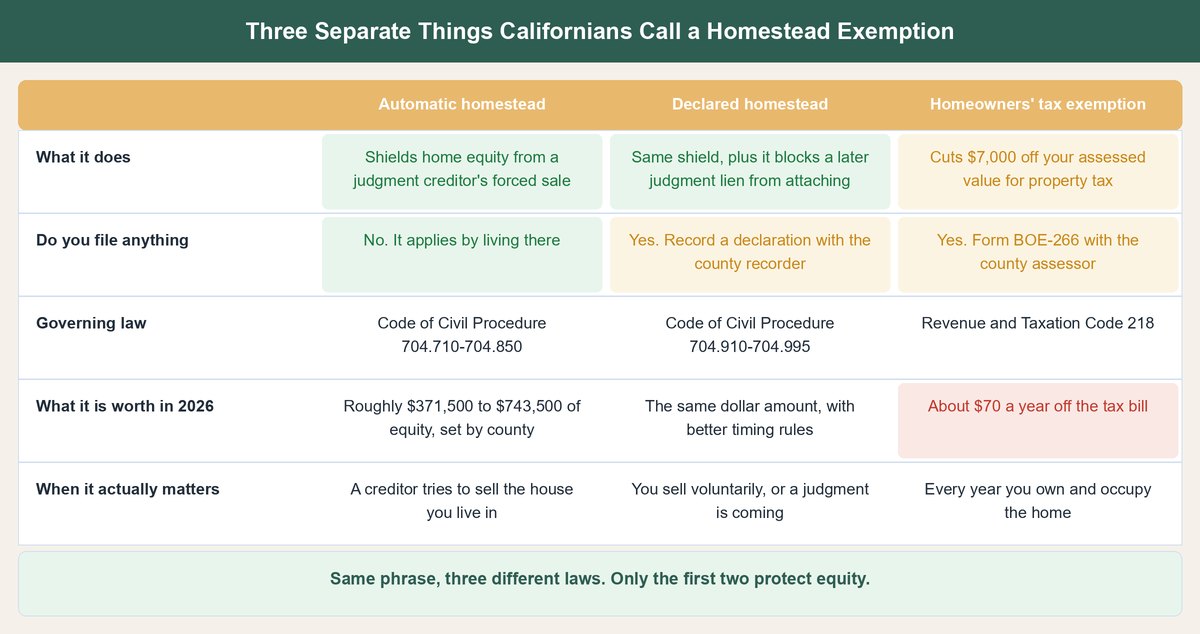
Separate them first, because every downstream question depends on which one you mean. The automatic homestead and the declared homestead both live in the Code of Civil Procedure and exist for one purpose: keeping a judgment creditor from taking the equity in the house you live in. The homeowners’ property tax exemption lives in the Revenue and Taxation Code and shaves a small amount off your annual assessment.
The confusion is durable because other states genuinely do combine them. In Florida and Texas the same phrase covers both jobs — unlimited automatic creditor protection written into the state constitution, plus a separately filed property tax exemption. The protections are separate there too, but the shared name travels. Californians arriving from those states file the tax form and think creditor protection is handled. It is not. The mistake runs the other way too: owners who hear the creditor protection is automatic assume the tax break is, and never file the claim.
The working rule: lawsuits, judgments and bankruptcy are Code of Civil Procedure territory; your annual tax bill is Revenue and Taxation territory. They never overlap.
How the Automatic Homestead Protection Works Without Any Filing
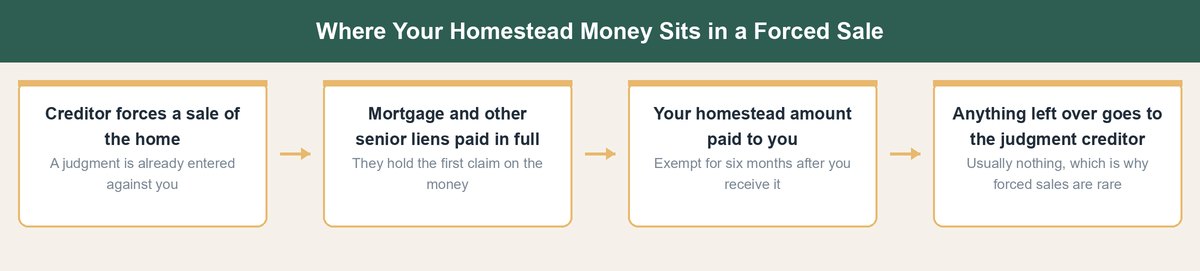
The automatic exemption is not a benefit you claim. It is a limit on what a creditor can take. A money judgment against you — a car accident, an unpaid business debt, a contractor dispute — does not let the winner sell your house for whatever it brings.
Here is the mechanism most explanations skip. In a forced sale the money comes off the top in a fixed order: senior liens first, meaning your mortgage, any HELOC, and property tax liens. Then your exempt homestead amount is paid to you. Only what remains goes to the judgment creditor. Under section 704.720, the proceeds you receive stay exempt for six months, giving you a window to move the money into another home.
The second-order effect is what matters. Because the creditor reaches only the residue, the arithmetic usually ends the sale before it starts. A Fremont owner with a $1.3 million house, an $850,000 mortgage balance and a roughly $743,500 exemption has $450,000 of equity behind a larger shield — nothing to reach, so no rational creditor files. The California homestead exemption works as deterrence far more than as a payout. The judgment lien still sits on your title and still has to be cleared when you sell or refinance.
What the Automatic Exemption Is Worth in 2026 and Who Actually Publishes the Number
The formula in section 704.730 is a sandwich. Your exemption is the greater of two things: your county’s median sale price for a single-family home in the prior calendar year, capped at a ceiling, or a flat floor. The statute set those bookends at $600,000 and $300,000, then added that both “shall adjust annually for inflation, beginning on January 1, 2022,” using the California Consumer Price Index for All Urban Consumers published by the Department of Industrial Relations, rounded to the nearest $25.
Now the part nobody states plainly. No California agency publishes the adjusted numbers. The Judicial Council issues no table, the Department of Industrial Relations publishes the index but not the resulting exemption, and the statute still reads $600,000 and $300,000 five years after those figures stopped being current. The amounts in circulation are computed by bankruptcy practitioners from the DIR’s own CPI tables, and they disagree: published 2026 caps include $743,459 and $743,681, and neither is a multiple of $25 as the current statutory text appears to require.
So the honest 2026 answer is a floor near $371,500 and a cap near $743,500, exact dollar contested. For nearly every homeowner decision that is enough — a $222 spread changes nothing. If you are in active litigation and the precise figure decides the outcome, ask a California judgment-enforcement or bankruptcy attorney holding the current index, not a blog post, including this one.
Why the County Median Formula Barely Does Any Work in the Bay Area
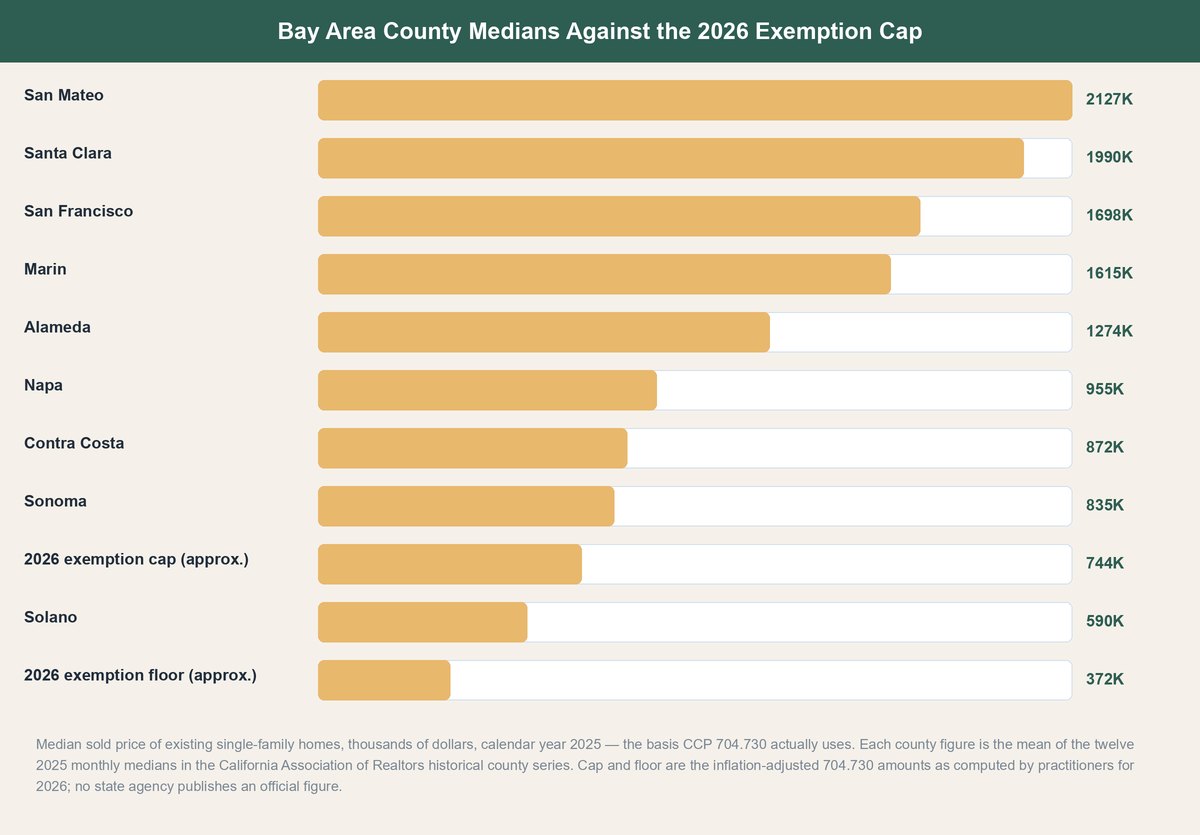
Here the law’s design and Bay Area reality come apart. The 2020 rewrite was sold as making the homestead exemption California grants responsive to local housing costs. The mechanism is the middle tier, your county’s prior-year median — and it only operates when that median actually falls between the floor and the cap. Above the cap it is irrelevant. Below the floor, irrelevant too.
Run the right numbers against the 2026 bookends and the tier collapses almost everywhere in the Bay Area. “Right” matters here: the statute keys to the prior calendar year, so a 2026 claim runs on calendar-year 2025 medians, not on whatever month C.A.R. published most recently. Below, each county’s 2025 figure is the average of the twelve monthly medians in the California Association of Realtors historical county series.
| County | CY2025 median SFH price (statutory basis) | Which tier applies | Practical 2026 exemption |
|---|---|---|---|
| San Mateo | $2,127,000 | Above the cap | ~$743,500 |
| Santa Clara | $1,990,000 | Above the cap | ~$743,500 |
| San Francisco | $1,698,000 | Above the cap | ~$743,500 |
| Marin | $1,615,000 | Above the cap | ~$743,500 |
| Alameda | $1,274,000 | Above the cap | ~$743,500 |
| Napa | $955,000 | Above the cap | ~$743,500 |
| Contra Costa | $872,000 | Above the cap | ~$743,500 |
| Sonoma | $835,000 | Above the cap | ~$743,500 |
| Solano | $590,000 | Between floor and cap | ~$590,000 |
| Fresno (comparison) | $436,000 | Between floor and cap | ~$436,000 |
| Kern (comparison) | $402,000 | Between floor and cap | ~$402,000 |
Eight of nine Bay Area counties are pinned to the ceiling. A San Mateo owner whose county median is nearly three times the cap gets exactly the protection a Sonoma owner gets with a median barely over it. Solano is the only Bay Area county where the median tier does what the legislature described, and there it produces less protection than the cap would.
For a long-tenured owner the consequence is blunt. Buy in Santa Clara County in 2009, pay the loan down, and you may hold $900,000 or $1.2 million of equity behind a shield of roughly $743,500. The overage is exposed. That is not cause for panic — a creditor must still win a judgment, then find the sale worth pursuing after the mortgage and exemption come off the top. But the “your exemption tracks your market” story is not true here, which is a real argument for umbrella liability coverage rather than assuming the homestead absorbs everything. If a sale is already on your mind, the capital gains math on a home sale is the other half of the same question.
When Recording a Declared Homestead Buys You Something the Automatic One Does Not

If the automatic protection is free and requires nothing, why does the declared homestead still exist? Because it does two things the automatic version cannot, both about timing.
Blocking a Judgment Lien From Attaching in the First Place
Under section 704.950, a judgment lien recorded after your homestead declaration generally does not attach to the declared homestead at all, provided the declaration naming you was recorded first. The automatic exemption never stops attachment; it only stops the forced sale. That difference surfaces years later at the title company, where a lien that never attached is far cleaner than one that did. Support judgments are carved out — child, family and spousal support liens attach regardless — and any surplus above the liens plus your exemption stays reachable.
Protecting the Money After a Voluntary Sale
This is the bigger one. The automatic exemption protects proceeds of a forced sale. Under section 704.960, a declared homestead protects the proceeds of a voluntary sale for six months, and if you reinvest in a new dwelling and record a fresh declaration, the protection carries over. Sell your own house with an outstanding judgment and no declaration on file and the cash in escrow is far more exposed than the house was.
The guidance is narrow rather than universal. No litigation and no plans to sell means the declaration is optional paperwork. If you have been served, a judgment is plausible, or you are weighing a sale while a claim is outstanding, recording costs a notary fee plus county recording fees — typically $115 to $150 in Bay Area counties, including the $75 state recording surcharge — and buys real optionality. It is the same recorder’s window where a transfer on death deed gets filed, and the same rule governs both: recording early is cheap, recording late is often too late.
How to Apply for the Homeowners’ Property Tax Exemption and What It Actually Saves
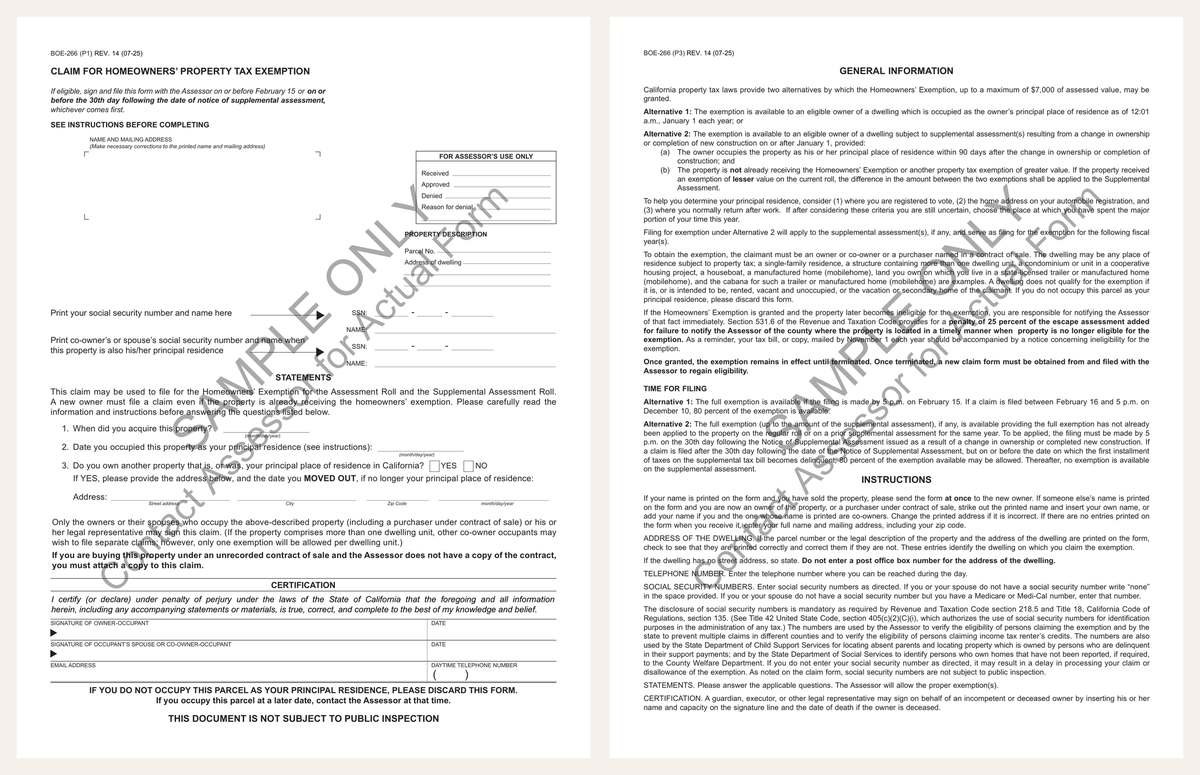
Now the third thing, which is what most people mean when they type “how to apply.” The homeowners’ property tax exemption removes $7,000 from the assessed value of an owner-occupied home. At Proposition 13’s 1% base rate that is roughly $70 a year, before local voter-approved rates nudge it up slightly.
The mechanics, straight from the BOE-266 claim form:
- Where it goes. To your county assessor, not the state. Every Bay Area assessor publishes its own copy of the same state form.
- The deadline that matters. File by 5 p.m. on February 15 for the full exemption. File between February 16 and 5 p.m. on December 10 and you get 80% of it — $5,600 of assessed value, about $56 a year.
- Eligibility is measured on one morning. You must own and occupy the home as your principal residence as of 12:01 a.m. on January 1.
- You file once. Once granted, it stays in effect until terminated. New owners must file their own claim even if the seller had one.
- Terminating late has teeth. If the home stops being your principal residence you must notify the assessor. Revenue and Taxation Code section 531.6 provides a 25% penalty on the escape assessment for failing to — the rare case where ignoring a $70 benefit costs real money.
Is $70 worth the paperwork? Alone, barely. But it is a one-time form for a benefit that runs as long as you own the home — roughly $2,000 over a thirty-year tenure — and the same visit to the assessor’s site is where you find the disabled veterans’ exemption and the appeal route if your property tax assessment looks wrong.
Edge Cases That Change the Answer for Bay Area Homeowners
Married Couples Do Not Get Two Exemptions
A common and costly assumption. The California homestead exemption applies per dwelling, not per owner, so a married couple sharing one home shares one exemption. Unmarried co-owners with separate interests are a different analysis, and one for counsel.
In Bankruptcy You Choose a System, and Bay Area Owners Rarely Choose Wrong
California filers elect between two exemption sets. System 1 uses the homestead described above. System 2, under section 703.140, caps the residence exemption at $29,275 but adds a flexible wildcard for other assets. For a Bay Area owner with real equity the choice is not close — roughly $743,500 against an exact $29,275 decides it. System 2 is for filers who rent or hold little equity and need to protect cash and vehicles instead.
Moving Out Does Not Always End the Protection
Residence is the trigger, but the statute anticipates messy lives. Under section 704.720, a judgment debtor who has moved out while a separated or former spouse still lives in the home keeps the exemption until the community property is divided. Divorce timing and creditor timing interact more than people expect.
The Amount Is Measured When You Claim It
The floor and cap rise each January. Section 704.965 provides that increases apply to existing declarations, unless a judgment creditor obtained its lien before the increase took effect. In a rising index that generally favors the homeowner, but it makes the sequence of dates worth documenting.
Frequently Asked Questions
Do I have to file anything to get the California homestead exemption?
Not for the automatic creditor protection — it applies because you live in the home. You do have to file for the declared homestead, recorded with the county recorder, and for the homeowners’ property tax exemption on form BOE-266 with your county assessor.
What is the California homestead exemption form called?
Two different forms. The property tax break uses state form BOE-266, “Claim for Homeowners’ Property Tax Exemption,” from your county assessor. A declared homestead uses a homestead declaration, notarized and recorded with the county recorder; many counties supply a template and title companies prepare them routinely.
How much is the California homestead exemption in 2026?
Roughly $371,500 at the floor and roughly $743,500 at the cap, with your county’s prior-year median applying if it falls between them. No state agency publishes the official adjusted figures, so confirm the exact dollar with an attorney if a case turns on it.
Does the homestead exemption stop foreclosure by my mortgage lender?
No. It protects equity from unsecured judgment creditors. Your mortgage holder and any HELOC lender hold consensual liens that sit ahead of the exemption, and property tax liens do as well.
Can I claim the homeowners’ property tax exemption on a rental or second home?
No. You must own and occupy the property as your principal residence as of 12:01 a.m. on January 1. Claiming it on a rental, a vacant property or a vacation home is not permitted, and failing to report that a home stopped qualifying carries a 25% escape-assessment penalty.
Is recording a declared homestead worth it if I already have automatic protection?
For most owners with no litigation on the horizon, no. It earns its small recording cost when a judgment is plausible or you plan to sell voluntarily, because only the declared homestead protects the proceeds of a sale you choose to make.
Putting the Homestead Rules to Work Before You Need Them
The through-line is that California’s protections are strong but static, while Bay Area equity is not. The exemption rises with a statewide inflation index; your equity rises with a market that has outrun that index for a decade, so the share of your net worth outside the shield grows quietly every year. Check which tier your county falls into, file the BOE-266 if you never have, and treat the declared homestead as a cheap move you make before trouble, not after.
This is educational information, not legal, tax or financial advice. Homestead protection and property tax relief turn on facts specific to your title, your county and your timing — talk to a licensed California attorney or tax professional before acting. If this was useful, the rest of our Bay Area ownership guides work the same way: plain mechanics, real numbers, and the parts other explanations leave out.