







AS OF JULY 2026, THE LAW HAS NOT CHANGED. The “No Tax on Home Sales” headlines are about proposals sitting in a House committee — not one of them has passed. If you sell today, the rules below are the rules that apply. Plan around the law, not the press release.
Here is the short answer most sellers are searching for: for the vast majority of homeowners, the capital gains tax on home sale proceeds is zero, because the first $250,000 of profit (single) or $500,000 (married filing jointly) is excluded outright. You only owe tax on gain above that exclusion — and even then, only at long-term rates of 0%, 15%, or 20%, plus a possible 3.8% surtax for high earners. The people who actually get bitten are long-tenured owners sitting on huge appreciation, sellers of a former rental, and inheritors who misunderstand their basis. This guide walks the exact math, who qualifies, how to legally shrink the bill, and what the 2026 repeal bills would really do.
Key Takeaways
- Most sellers owe nothing. Section 121 excludes $250,000 of gain for singles and $500,000 for married couples who meet the 2-of-5-year ownership-and-use test.
- You are taxed on gain, not on the sale price. Gain = sale price − selling costs − your adjusted basis (purchase price plus capital improvements). Big improvements directly cut the tax.
- Rates are 0%, 15%, or 20% on the taxable portion, based on total 2026 taxable income, plus a 3.8% NIIT surtax once income clears $200,000 single / $250,000 joint.
- The caps have not moved since 1997, when the median home was $129,000. NAR estimates 13+ million homeowners would now exceed today’s exclusion if they sold.
- Three 2026 bills would change this — full repeal, a middle-class carve-out, and a bipartisan bill to double-and-index the caps — but none has passed. Current law still rules.
- This is educational information, not personalized tax advice — run your real numbers past a CPA before you sign a listing agreement.
The 2026 Headline Versus the Law as It Stands Today
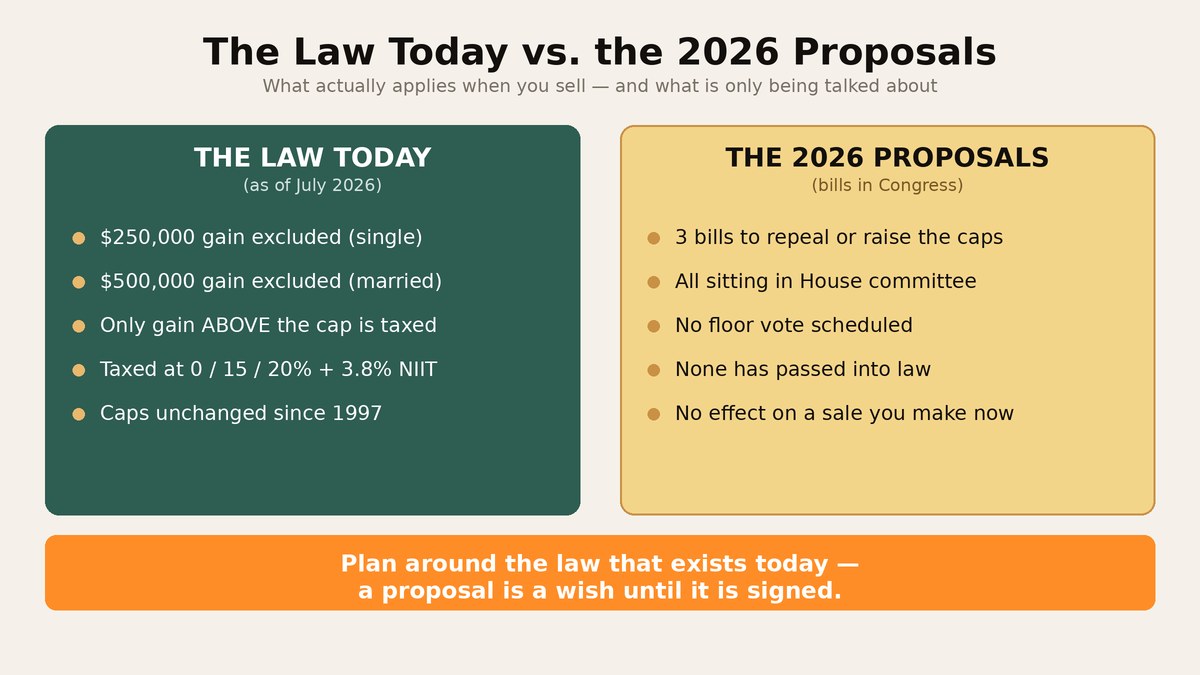
Every few weeks a “No Federal Tax on Selling Your House” clip goes viral, and sellers assume the gates are open. They are not. What actually happened is that lawmakers introduced bills. A bill is a wish until it clears the House Ways and Means Committee, passes the full House and Senate, and gets signed. As of July 2026, all of the home-sale capital gains proposals are still parked in committee — the No Tax on Home Sales Act (H.R. 4327) among them.
The reason the pressure exists is real, though. The $250,000/$500,000 exclusion was written into law in 1997 and was never indexed for inflation. The National Association of Realtors notes the median home price in 1997 was about $129,000 — the exclusion comfortably covered almost everyone. Nearly thirty years of appreciation later, NAR estimates more than 13 million homeowners would blow past today’s caps if they sold. That is the political fuel. It is also why you should understand the current capital gains tax on home sale mechanics cold: the law that costs you money is the one on the books, not the one on cable news.
How the Home-Sale Capital Gains Tax Actually Works

The single most expensive misunderstanding I see is a seller panicking over their sale price. You are not taxed on what the house sells for. You are taxed on your gain — the profit above what you have into the property. On a primary residence, the IRS then hands most people a giant exclusion that wipes out that gain entirely.
Think of it as a three-step gate. First, calculate the gain (sale proceeds minus your costs and your basis). Second, subtract the Section 121 exclusion you qualify for. Third, whatever survives is taxed at long-term capital gains rates — and only if you held the home more than a year, which primary-residence sellers almost always have. Miss the exclusion and you are exposed to the full gain; qualify for it and a $450,000 profit can be completely tax-free. The rest of this guide is really just those three steps in detail.
Do You Even Owe Anything After the $250,000 and $500,000 Exclusion
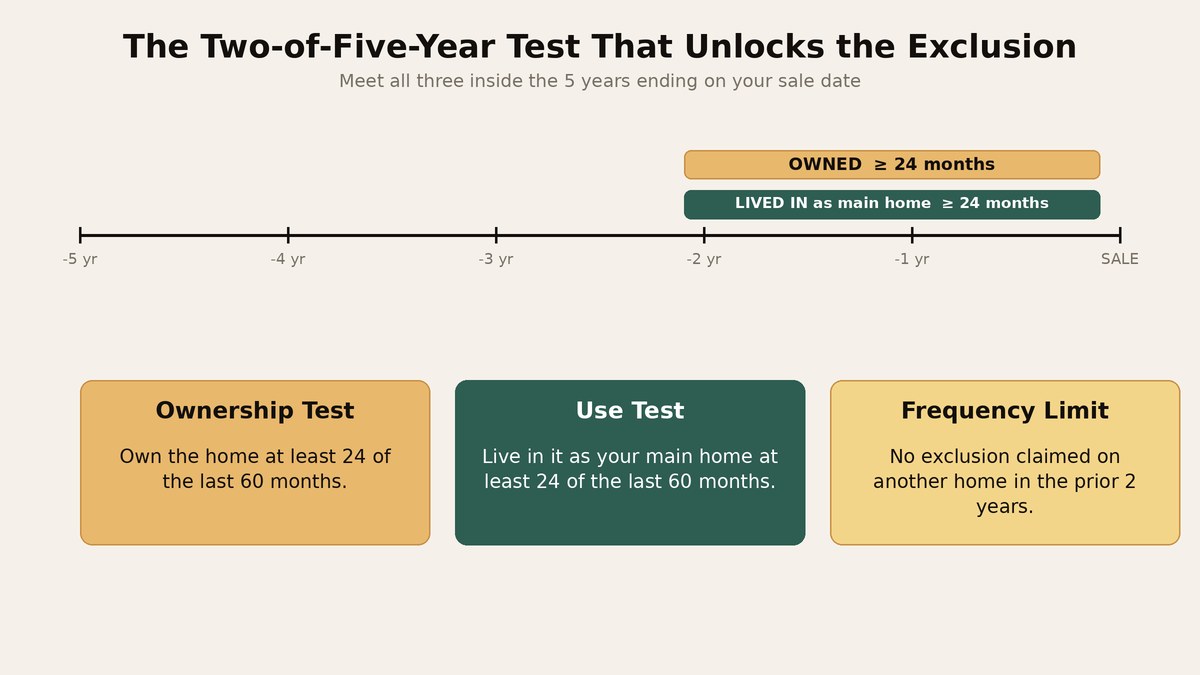
The exclusion is the whole ballgame, and it hinges on a single test. Per IRS Topic 701, to exclude gain on a primary residence you must pass the ownership and use tests and the frequency rule.
The Two-of-Five-Year Ownership and Use Test
What it is: You must have owned the home for at least 24 months and lived in it as your main home for at least 24 months out of the five years ending on the sale date. The 24 months of use do not have to be continuous, and the ownership and use periods do not have to be the same two years — they just both have to land inside that five-year window.
Why it matters: This is what lets you move out, rent the place for a year or two, and still sell tax-advantaged — as long as you sell before your two years of qualifying use ages out of the five-year look-back.
The Once-Every-Two-Years Frequency Limit
The catch: You cannot claim the exclusion if you already used it on another home sale within the two years before this sale. It is a once-per-24-months benefit per taxpayer, which stops people from serially flipping primary residences tax-free.
The Partial Exclusion Safety Valve
Best for: People forced to sell early. If you fail the two-year test because of a job relocation, a health situation, or an unforeseen circumstance (divorce, multiple births, job loss, and other IRS-recognized events), you can claim a prorated exclusion. Live somewhere 12 of the required 24 months for a qualifying reason and a married couple can still shelter up to $250,000 (half of $500,000). That partial exclusion saves sellers who assume it is all-or-nothing.
How to Calculate the Gain on Your Home Sale
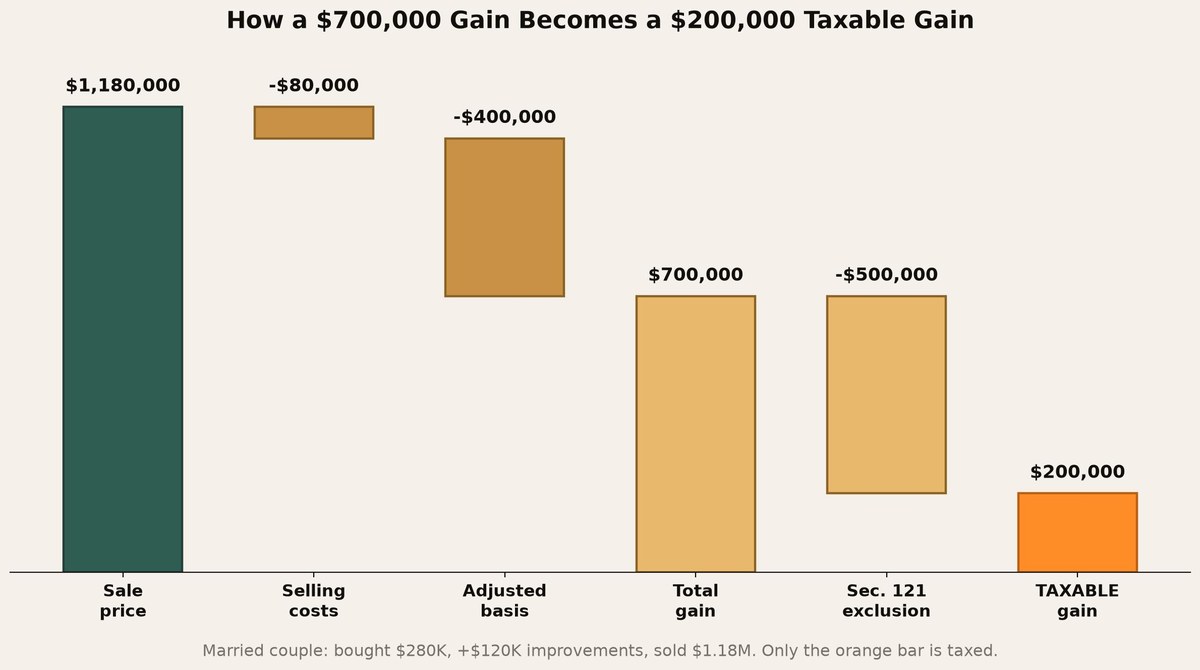
Let me run a realistic long-tenure example, because the abstract formula never lands until you see the numbers. Say a married couple bought in 2003 for $280,000, put in $120,000 of capital improvements over the years (a new roof, a kitchen remodel, a room addition), and sell in 2026 for $1,180,000 with about $80,000 in selling costs.
- Adjusted basis = $280,000 purchase + $120,000 improvements = $400,000
- Amount realized = $1,180,000 sale − $80,000 selling costs = $1,100,000
- Total gain = $1,100,000 − $400,000 = $700,000
- Section 121 exclusion (married) = −$500,000
- Taxable gain = $200,000
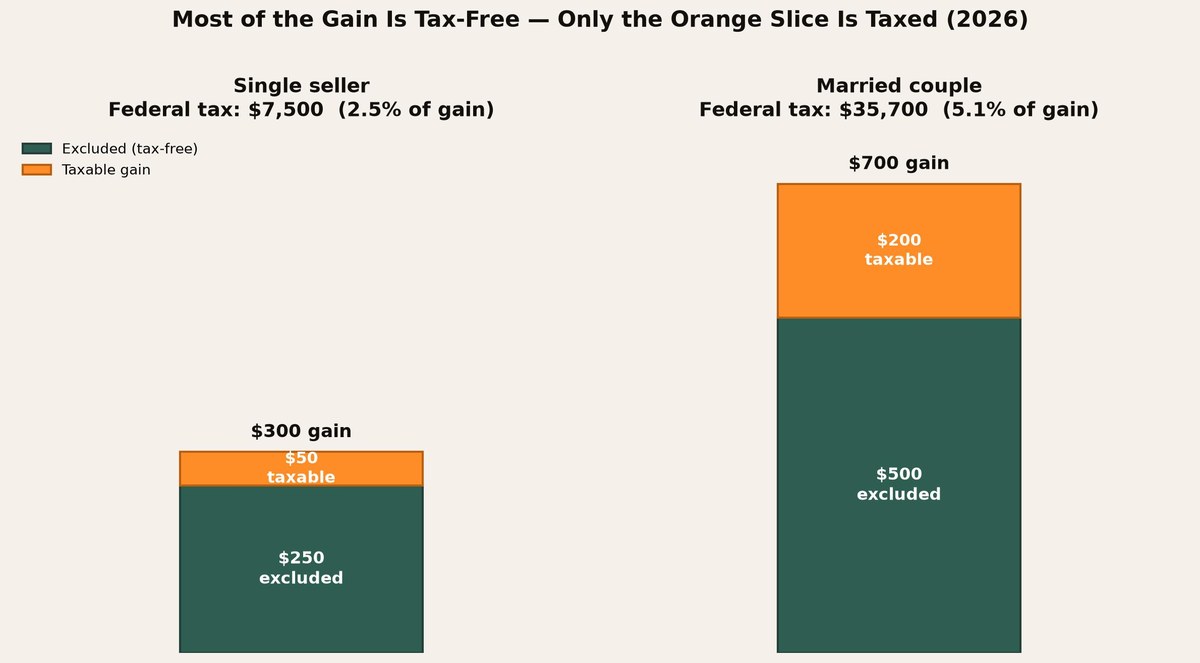
Notice how much work the basis did. Those $120,000 of improvements and $80,000 of selling costs pulled $200,000 straight out of the taxable column before the exclusion even applied. Now compare two common sellers side by side, so you can see what the capital gains tax on home sale profit actually comes to at the finish line.
| Line item | Single seller, $300K gain | Married couple, $700K gain |
|---|---|---|
| Total gain on the sale | $300,000 | $700,000 |
| Section 121 exclusion | −$250,000 | −$500,000 |
| Taxable gain | $50,000 | $200,000 |
| Long-term cap-gains rate | 15% | 15% |
| Capital gains tax | $7,500 | $30,000 |
| NIIT (3.8%, high earners only) | $0 | up to ~$5,700 |
| Total federal tax on the sale | $7,500 | ~$35,700 |
| Effective rate on the whole gain | 2.5% | ~5.1% |
Even the couple with a $700,000 gain pays roughly 5% of it, not the 15–20% the headline rate implies — because the first $500,000 came off the top tax-free. That is the number to keep in your head when a bill promises to “eliminate” this tax: for most people it is already small.
The 0, 15, and 20 Percent Rates Plus the 3.8 Percent NIIT Surtax
The taxable slice that survives the exclusion is a long-term capital gain, taxed on a separate rate schedule from your wages. For 2026, per the IRS-adjusted brackets, the breakpoints on taxable income are:
| 2026 long-term cap-gains rate | Single filers | Married filing jointly |
|---|---|---|
| 0% | Up to $49,450 | Up to $98,900 |
| 15% | $49,450 – $545,500 | $98,900 – $613,700 |
| 20% | Over $545,500 | Over $613,700 |
Two things sellers routinely miss. First, the home-sale gain stacks on top of your other income to decide the rate — a retiree with $40,000 of income and a $120,000 taxable gain can have part of that gain taxed at 0% and part at 15%. Second is the Net Investment Income Tax: a flat 3.8% surtax on investment income (including your taxable home gain) once modified adjusted gross income clears $200,000 single or $250,000 married. In a big-gain year the sale itself can push you over that line, which is exactly why our married example carried an extra ~$5,700. The NIIT applies to the lesser of your net investment income or the amount you exceed the threshold — a nuance a CPA will model precisely for you.
Legal Ways to Reduce or Even Erase the Tax

If your gain is going to exceed the exclusion, you are not helpless. There are legitimate, IRS-sanctioned levers — and none of them involve creative accounting.
Rebuild Your Basis With Capital Improvements
Best for: Long-tenured owners. Every capital improvement you made — additions, a new roof, HVAC, a kitchen or bath remodel, landscaping, a new driveway — adds to your basis and shrinks the gain dollar for dollar. Routine repairs do not count, but decades of real upgrades often do. Dig up the receipts; $150,000 of documented improvements can be worth $30,000+ in avoided tax.
Deduct Every Dollar of Selling Cost
What it is: Agent commissions, title and escrow fees, transfer taxes, and certain pre-sale fix-up costs reduce your amount realized. On a $1.2M sale, selling costs alone routinely run $70,000–$90,000 that never enters the taxable gain.
Use a 1031 Exchange on Investment Property
The catch: This one is for rentals and investment property, not your primary home. A 1031 exchange lets you defer the gain by rolling proceeds into a like-kind replacement property on a strict timeline. If you converted a rental into your home — or are weighing renting versus selling — read our guide on how to rent out your house and how depreciation interacts via bonus depreciation on rental property before you decide.
Time the Sale and Use the Widow(er) Step-Up
Best for: Recently widowed sellers and flexible-timing owners. A surviving spouse gets a stepped-up basis on the deceased spouse’s share (a full step-up in community-property states), which can erase most of the gain if they sell reasonably soon after. Separately, a surviving spouse can still claim the full $500,000 exclusion if they sell within two years of the spouse’s death. And spreading a sale into a lower-income year can drop you from the 15% bracket toward 0%.
This is educational information, not personalized financial, legal, or tax advice. Home-sale taxation turns on your exact numbers, state, and filing status — consult a licensed CPA or tax professional before you act.
The Three 2026 Bills Trying to Kill the Home-Sale Tax
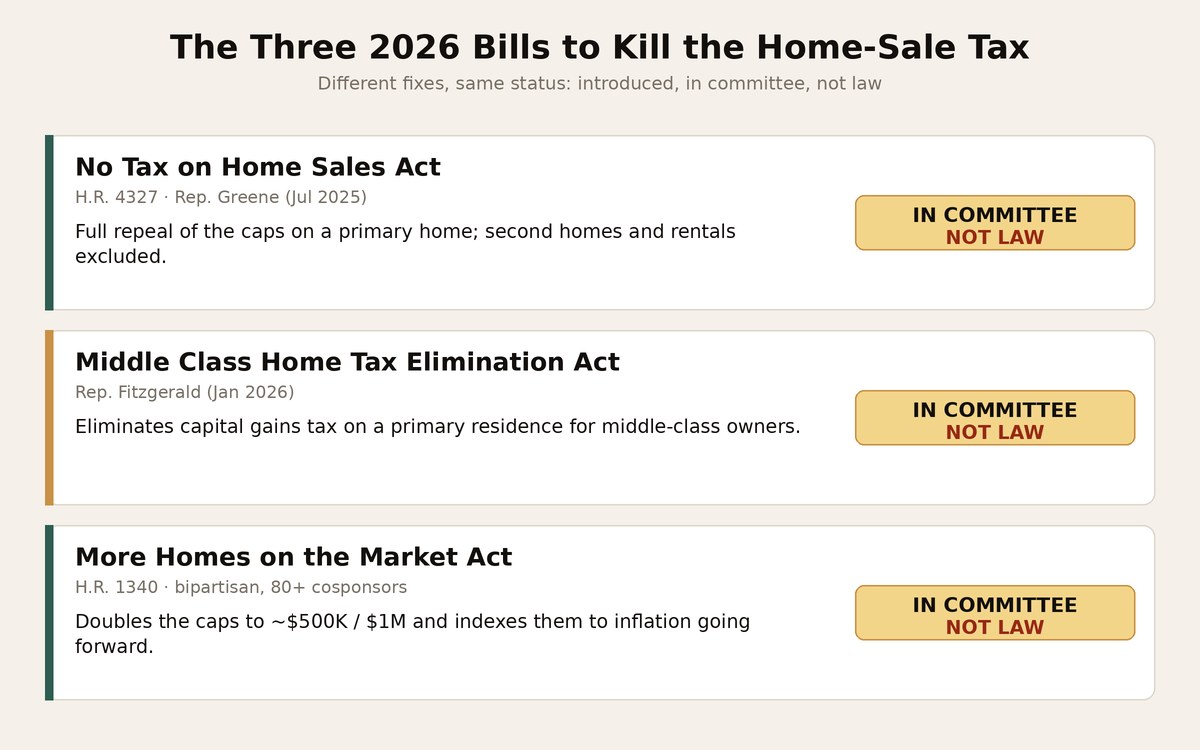
Here is the honest rundown of what is actually on the table in the 119th Congress — and, just as important, who each version would and would not help.
The No Tax on Home Sales Act (H.R. 4327)
What it does: Introduced by Rep. Marjorie Taylor Greene in July 2025, this is the full-repeal version — it removes the dollar caps entirely on a primary residence, so any gain on your main home would be federally tax-free. It carves out second homes, rentals, and flips. Status: Referred to the House Ways and Means Committee. Not passed, not scheduled for a floor vote. Who it helps most: Owners with enormous gains well above $500,000 — a smaller, higher-equity slice of sellers.
The Middle Class Home Tax Elimination Act (Fitzgerald)
What it does: Rep. Scott Fitzgerald introduced this in January 2026 to eliminate capital gains tax on the sale of a primary residence, framed around middle-class owners priced into a tax by inflation rather than genuine windfalls. Status: Introduced and referred to committee. Not passed. Who it helps most: Long-tenured middle-market owners whose gains have crept just over the caps.
The More Homes on the Market Act (H.R. 1340)
What it does: The bipartisan option. Instead of abolishing the tax, H.R. 1340 roughly doubles the exclusions — to about $500,000 single and $1,000,000 married — and, crucially, indexes them to inflation so they never freeze again. It has drawn 80+ cosponsors from both parties and real-estate-industry backing. Status: Referred to Ways and Means. Not passed. Who it helps most: The broadest group, and it is the version tax-policy watchers give the best odds precisely because it is bipartisan and revenue-limited.
What Could Actually Pass and How to Plan Around It
My read, grounded in how tax legislation usually moves: full repeal is the loudest but the longest shot, because scoring a total exemption is expensive and politically lopsided toward high-equity sellers. The double-and-index approach in the More Homes on the Market Act is the one with a real path — it fixes the actual problem (a cap frozen since 1997) without handing the biggest break to the biggest gains, and bipartisan bills with industry support are what survive committee. As CNBC reported in March 2026, none of these had become law, and nothing since has changed that.
So plan for the law as written. Do not delay a sale that makes sense for your life on the hope of a repeal — the market can move against you faster than a bill moves through Congress. Keep every improvement receipt, know your basis, and if your gain is heading past the exclusion, get a CPA involved before you list, not at tax time. If a bill does pass, it will almost certainly apply going forward, and you can adjust then. Whether you are selling on your own via our guide to selling a house without a realtor or handling an estate through selling an inherited house, the tax math starts with knowing your real gain.
Frequently Asked Questions
Is there still a one-time over-55 exemption on home sales?
No. That rule was replaced back in 1997 by the current Section 121 exclusion, which has no age requirement. Anyone who meets the 2-of-5-year ownership-and-use test gets the $250,000/$500,000 exclusion, whether they are 30 or 80.
What if I sell before living in the home for two years?
You generally lose the full exclusion, but you may qualify for a partial exclusion if the early sale is due to a job change, a health reason, or an IRS-recognized unforeseen circumstance. The partial amount is prorated by the months you did qualify — often still tens of thousands of dollars sheltered.
Do I owe capital gains tax on an inherited house?
Usually very little right away. Inherited property gets a stepped-up basis to its fair market value on the date of death, so gain is measured only from that new basis. Sell soon after inheriting and the taxable gain is often minimal — the step-up is one of the biggest breaks in the tax code.
How is a former rental that became my primary home taxed?
You can claim the Section 121 exclusion, but gain tied to the years it was a rental (nonqualified use) plus any depreciation you claimed is not fully excludable. Depreciation recapture is taxed up to 25%, and the exclusion is allocated between qualified and nonqualified use periods.
Does the $250,000/$500,000 exclusion apply to a second home or vacation property?
No. Section 121 covers only your principal residence. A second home or vacation property that was never your main home gets no exclusion, and the entire gain is taxable at long-term capital gains rates.
Will the 2026 “no tax on home sales” bills apply to a sale I make now?
No. None of the bills has passed, so they do not affect any sale today. If one becomes law, it will almost certainly take effect prospectively from an enactment date — not retroactively to sales already closed.
Know Your Number Before You List
The capital gains tax on home sale proceeds is far smaller than most sellers fear, and for the majority it is zero — but the exceptions are expensive, and they are exactly the sellers reading this. Nail down your basis, count every improvement and selling cost, and pressure-test the result with a tax pro before you sign anything. Watch the 2026 bills if you like, but make your decision on the law that exists today.